 Garden

Affiliate Disclosure
Some links on this page are affiliate links. As an Amazon Associate, we earn from qualifying purchases — at no extra cost to you. We do not buy, test, or physically handle the products we cover; our rankings come from aggregated owner reviews, ratings and expert consensus. Commissions never change our verdicts. How we rank · full disclosure.
Cloudy pool water is nearly always one of five things: a filter that is not doing its job, pH or calcium hardness too high, free chlorine too low, dead algae in suspension after a shock, or a heavy bather load overwhelming the sanitizer. Test the water before you add anything — four of the five causes show up on a test strip. Once you have fixed the real cause and are running the pump continuously, most pools clear in one to three days. Do not swim until you can see the bottom drain.
The reason cloudiness frustrates people is that the obvious response — throw more chlorine at it — only works for two of the five causes. The other three get worse while you wait.
Diagnose before you dose
| What the test says | Likely cause | Fix |
|---|---|---|
| Free chlorine below 1 ppm | Sanitizer deficit; early algae or bacterial bloom | Shock, brush, filter continuously |
| Combined chlorine above 0.5 ppm | Chloramines from heavy bather load | Shock to break them down; ventilate an indoor pool |
| pH above 7.8 | Calcium falling out of solution as fine haze | Lower pH with acid, in stages, retesting between |
| Calcium hardness above 400 ppm | Scale-forming water, persistent milkiness | Partial drain and refill with softer water |
| Everything in range | Filtration — dirty media, short run time, or bypass | Clean or backwash, extend run time, inspect the filter |
| Cyanuric acid above 100 ppm | Chlorine present but chemically locked up | Partial drain and refill; stop using stabilized tablets |
Target ranges for reference: free chlorine 2 to 4 ppm, pH 7.4 to 7.6, total alkalinity 80 to 120 ppm, calcium hardness 200 to 400 ppm in plaster or 175 to 275 ppm in vinyl, and cyanuric acid 30 to 50 ppm. If more than one number is out, correct total alkalinity first, then pH, then the rest — alkalinity is the buffer that holds pH steady, so fixing pH while alkalinity is wrong means it simply drifts back.
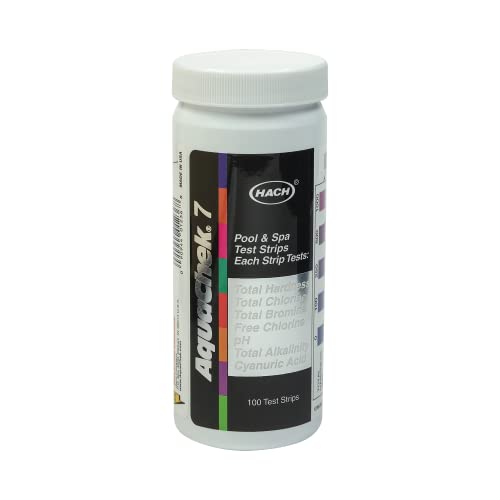
Best for finding out which of the five causes you actually have
- Free chlorine, total chlorine, pH, total alkalinity, hardness and cyanuric acid in one dip
- Cyanuric acid pad — the reading that explains most mystery haze
- 100 strips per bottle
- Result in about 15 seconds
Why buy it: cloudy water has five common causes and four of them show up on a strip, so testing first saves you from treating the wrong one.
We do not buy or physically handle the products we rank; verdicts come from aggregated owner ratings and expert consensus, described on how we rank. The ranked field is in the best pool test strips.

Handling chemicals while you fix it
Whatever the cause turns out to be, the handling rules do not change, and they matter more than the treatment itself.
- Never mix pool chemicals with each other, in any container, including the skimmer. One product at a time, pump running, wait the label interval, then the next.
- Never combine any chlorine product with an acid. The reaction releases chlorine gas. This is the mistake that sends pool owners to hospital.
- Never mix two chlorine types — cal-hypo contacting trichlor residue can ignite.
- Always add the chemical to a large volume of water, never water to the chemical.
- Test before every dose. Adding acid to water that is already at 7.4, or chlorine to water already at 4 ppm, makes the problem worse and costs a week.
The filter is the cause more often than people expect
If your chemistry is genuinely in range and the water is still cloudy, the filter is the answer. There are four distinct ways it fails, and they need different responses.
- It is simply dirty. Every filter has a clean starting pressure, noted when the media was new. Once the gauge reads roughly 8 to 10 psi above that baseline, flow has dropped enough to matter. Backwash a sand or DE filter; hose down or soak a cartridge.
- The run time is too short. A pool needs a full turnover of its volume each day, and in hot weather or after heavy use, two. Cutting pump hours to save electricity is the single most common cause of a chronically dull pool. If you are trying to clear cloudiness, run the pump 24 hours a day until it is clear.
- The media is exhausted. Sand rounds off and stops trapping fine particles after roughly five to seven years. Cartridges lose pleat structure after two to five seasons. DE grids tear. Media that looks fine can still have stopped working.
- Water is bypassing it. Sand can channel, leaving a preferred path straight through; a torn cartridge, a failed standpipe or a bad multiport spider gasket lets unfiltered water return to the pool. Symptom: pressure stays low, water stays cloudy, backwashing changes nothing.
Sand filters also have a specific weakness with cloudiness caused by dead algae — the particles are small enough that a portion passes straight through, which is why a pool can go hazy again an hour after vacuuming. Cartridge and DE filters catch finer material; DE catches the finest of all. If you are recovering from a bloom on a sand filter, a clarifier that clumps the particles together is genuinely useful.

Cloudy after shocking is normal
Green water turning cloudy gray or milky blue after a shock treatment is not a failure, it is the confirmation that the algae is dead. The remaining job is mechanical: get the corpses out of the water. That means running the pump continuously for 24 to 48 hours, cleaning or backwashing the filter as pressure rises — often several times in the first day — and vacuuming the settled layer to waste rather than through the filter.
Give it a settling period first. Turning the pump off for eight to twelve hours overnight lets the dead algae fall to the floor, which turns the vacuum into an efficient removal rather than a stirring exercise. This step is the one most owners skip and the reason so many report vacuuming for an hour with nothing to show for it.
Clarifier or flocculant?
| Clarifier | Flocculant | |
|---|---|---|
| What it does | Clumps fine particles so the filter can catch them | Drops everything to the floor as sediment |
| Time to clear | 1 to 3 days | Overnight, then vacuum |
| Pump | Run continuously | Off overnight to let it settle |
| Removal | Through the filter | Vacuum to waste — never through the filter |
| Needs a multiport valve | No | Yes, effectively — avoid with a cartridge filter |
| Water lost | Backwash only | Significant |
Neither one is a cure. Both are finishing tools that speed up the last stage once chemistry is correct and the filter is working. Using a clarifier to paper over high pH or an exhausted sand bed buys a day of slightly better water and then the haze returns.
When is it safe to swim?
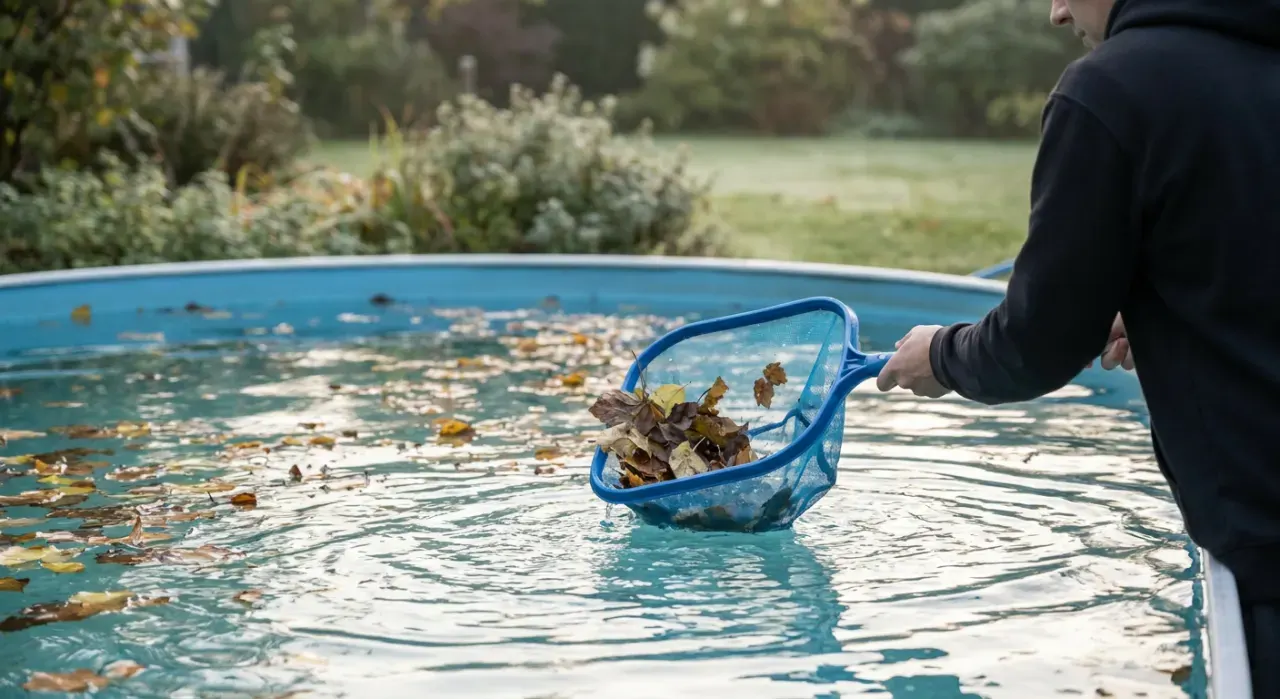
The standard is simple and it is worth taking literally: you should be able to clearly see the main drain or the deepest point of the pool floor. The CPSC's pool safety guidance treats water clarity as a safety requirement, not an aesthetic one, because a swimmer in trouble on the bottom of a cloudy pool may not be spotted in time. Combine that with a free chlorine reading of 1 to 4 ppm and a pH of 7.2 to 7.8 before anyone gets in.
Where to go next
Pool water chemistry covers all five target ranges and the order to correct them. If the haze is green rather than gray, start with pool algae treatment. For the specific post-shock case see why pool water is cloudy after shocking it, and for the filtration side, how often to clean a pool filter cartridge and cartridge vs sand filter. Everything else sits under the pools and spas hub.