 Garden

Affiliate Disclosure
Some links on this page are affiliate links. As an Amazon Associate, we earn from qualifying purchases — at no extra cost to you. We do not buy, test, or physically handle the products we cover; our rankings come from aggregated owner reviews, ratings and expert consensus. Commissions never change our verdicts. How we rank · full disclosure.
The short answer: do not vacuum living algae on the filter setting. Shock the pool first and let the chlorine kill the bloom, brush every surface, wait 12 to 24 hours for the dead algae to settle to the floor as gray dust, then vacuum to waste so it leaves the system instead of loading the filter. Keep a hose topping the pool up while you work, move the head slowly, and expect to repeat the settle-and-vacuum step once or twice. Budget two to four days for a full green-pool recovery.
Vacuuming a live bloom on filter mostly redistributes it. Kill it, drop it, remove it — in that order. We do not physically handle the equipment we rank; our picks come from aggregated owner reviews and expert consensus, described in how we rank, with the ranked field in best pool vacuums.
The full sequence
- Balance pH first, to 7.2 to 7.4. Chlorine is dramatically more effective at the low end of the range — at pH 8.0 a large share of free chlorine exists in the far weaker hypochlorite form. Shocking without correcting pH is why some treatments seem to do nothing.
- Shock hard. A visible green bloom typically needs a heavy dose rather than a maintenance dose; follow the product label for algae, which is usually two to four times the routine rate. Do it at dusk so sunlight does not burn off the chlorine before it works.
- Brush everything — walls, floor, steps, behind ladders, the shaded corners. Brushing breaks the protective film on the algae colony and exposes it to the chlorine. Black algae in plaster pools needs a stainless brush and real force; green algae comes off with a nylon brush.
- Run the pump continuously for 12 to 24 hours and hold free chlorine at shock level. The water usually turns from green to cloudy gray or milky blue — that color change means the algae is dead.
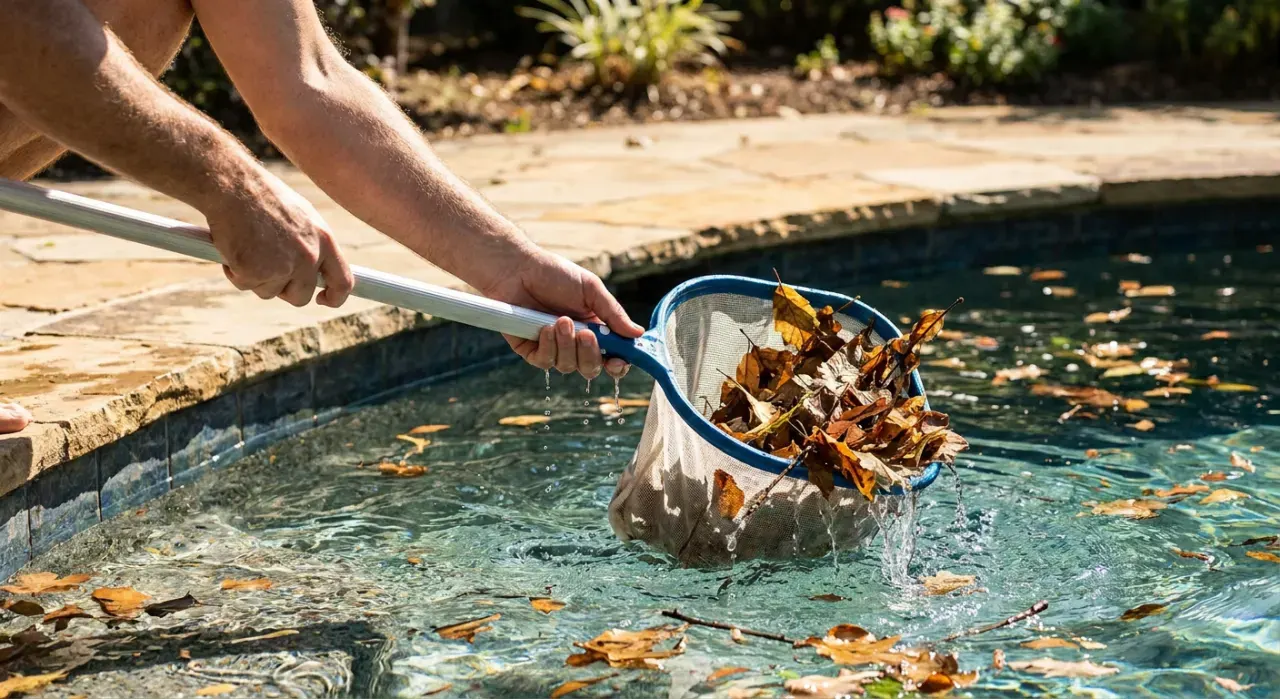
- Let it settle. Turn the pump off for 8 to 12 hours, ideally overnight, so the dead algae falls to the floor. This is the step most people skip, and it is what makes the vacuum efficient rather than a stirring exercise.
- Set the multiport valve to waste with the pump off. Never move a multiport handle while the pump is running — it destroys the internal spider gasket.
- Purge the vacuum hose of air, connect at the skimmer, and start the pump.
- Vacuum slowly, in overlapping straight passes. Half your normal walking pace. Any faster and the settled layer lifts back into the water column ahead of the head.
- Keep the water topped up. Waste mode discharges pool water the whole time. Run a garden hose in and stop before the level drops below the middle of the skimmer mouth, or the pump will pull air and lose prime.
- Return the valve to filter with the pump off, clean or backwash the filter, and run continuously for 24 to 48 hours. Add clarifier or flocculant if a haze remains.
- Repeat the settle-and-vacuum step the next day for a heavy bloom. Two or three passes over two or three days is normal.
Why waste and not filter
| Waste | Filter | |
|---|---|---|
| Where the algae goes | Out of the system entirely | Into the filter media, partly back into the pool |
| Filter cleaning during the job | None | Backwash or cartridge rinse every 10 to 20 minutes |
| Water lost | Significant — roughly 3,000 gal per hour at 50 gpm | Only what backwashing uses |
| Cloudiness afterward | Minimal | Common, especially with sand filters |
| Best for | Algae, silt, fine dead debris | Ordinary dirt, leaves, routine weekly cleaning |
Dead algae particles are in the range where sand filters struggle. Diatomaceous earth filters handle them better; cartridge filters clog quickly. If you have no waste position — which is the case for cartridge systems and most above-ground filters — the practical alternatives are to vacuum on filter and accept repeated cleaning, or to use a battery-powered handheld vacuum that captures debris in its own bag.
The three algae types behave differently
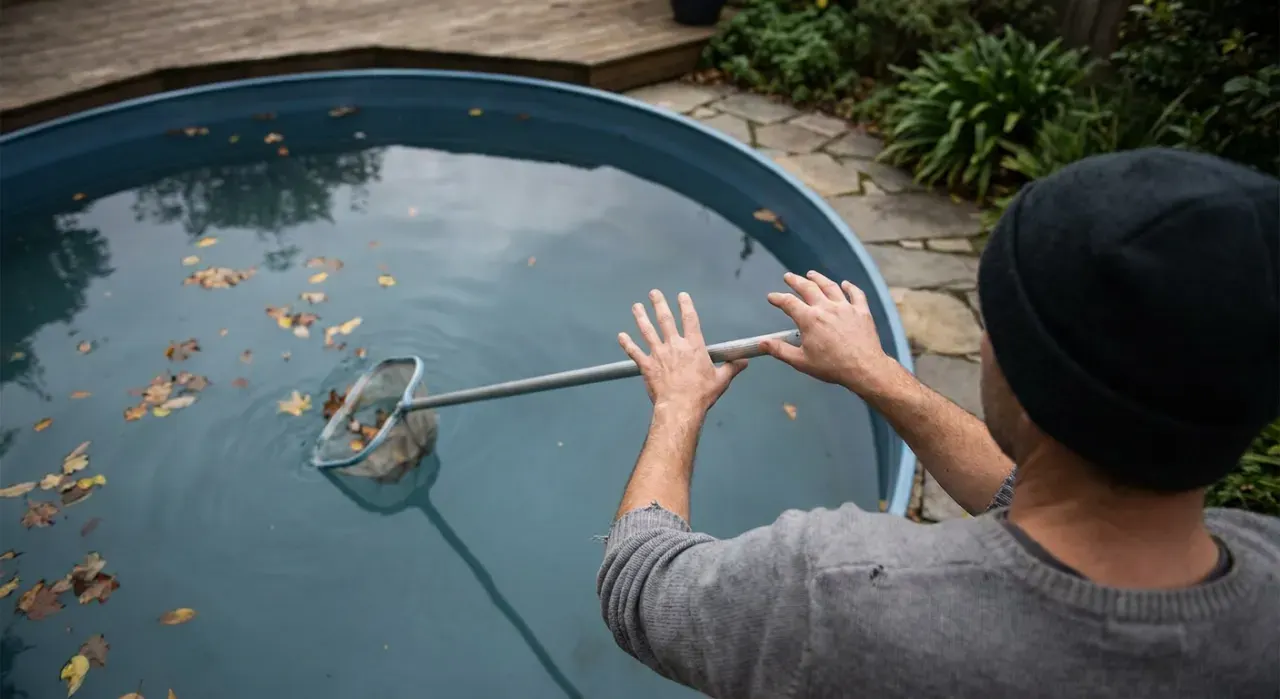
What you are looking at changes how hard the job is and how many passes it takes.
| Type | Appearance | Difficulty | Approach |
|---|---|---|---|
| Green algae | Free-floating, turns the whole pool green; slippery film on walls | Easiest | Shock, brush, settle, vacuum to waste. Usually clear in 2 to 3 days |
| Yellow or mustard algae | Dusty yellow-brown patches on shaded walls and floor; looks like sand or dirt | Moderate | Brushes off easily but returns. Needs a higher shock level and treatment of every item that entered the pool |
| Black algae | Dark spots with raised heads, rooted into plaster and grout | Hardest | Stainless brush to break the protective cap, spot-treat, repeated shocking. Weeks, not days |
Yellow and black algae both have a habit that catches people out: they survive on swimsuits, floats, brushes, nets and vacuum heads, and reinfect the pool days after a successful treatment. If you are fighting a recurring bloom, soak the equipment and swimwear in chlorinated water alongside the shock treatment, or you will simply reintroduce it.
Green algae is the one that most people mean and the one this procedure clears reliably. It doubles quickly in warm water — a pool that looked slightly hazy on Friday can be fully green by Sunday — which is why the response time matters more than the product choice.
Managing the water level
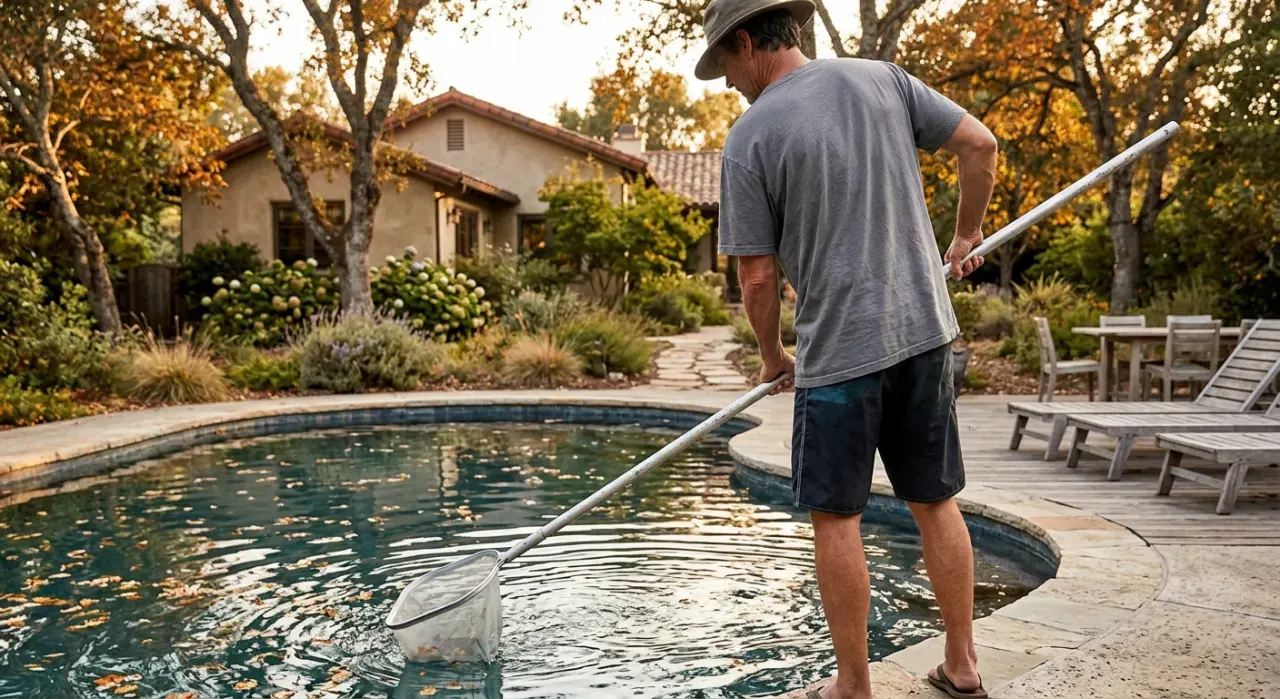
This is the part that catches people out. A residential pump at 50 gallons per minute sends 3,000 gallons an hour down the waste line. On a 20,000-gallon pool that is 15 percent of the volume per hour of vacuuming. Run the fill hose the entire time, check the skimmer level every few minutes, and stop before the water reaches the bottom third of the skimmer mouth. Losing prime mid-session on waste is how pumps get run dry and seals get cooked.
Where the discharge goes matters too. Pool water carries chlorine, algaecide and often copper, so do not send it onto a lawn, a vegetable bed or a storm drain if your municipality prohibits it — many do, and rules are jurisdiction-specific. Check your local requirements before discharging any significant volume.
Preventing the next bloom
- Free chlorine 1 to 3 ppm at all times, tested at least twice a week in summer. A bloom means chlorine hit zero at some point, usually during a hot week or after heavy rain.
- pH 7.2 to 7.6 so the chlorine you have stays active.
- Cyanuric acid 30 to 50 ppm to protect chlorine from sunlight — too little and it burns off by midday, too much and it locks the chlorine up.
- Full daily turnover, and check that the return jets are aimed to circulate the whole pool. Repeat blooms in one corner mean dead water there.
- Brush weekly, particularly steps, behind ladders and the shaded side.
Target chemistry is in what pool pH and chlorine levels should be, and if chlorine keeps vanishing, why my pool keeps losing chlorine works through the causes. For the routine weekly version of this job see how to vacuum a pool manually, and if the water is still hazy afterward, why pool water is cloudy after shocking covers the filtration side. Everything else is at the pools and spas hub.