 Garden

Affiliate Disclosure
Some links on this page are affiliate links. As an Amazon Associate, we earn from qualifying purchases — at no extra cost to you. We do not buy, test, or physically handle the products we cover; our rankings come from aggregated owner reviews, ratings and expert consensus. Commissions never change our verdicts. How we rank · full disclosure.
Close the pool once the water holds below 60°F but before the first hard freeze. The sequence: deep clean and balance the water, shock it, lower the level if your cover requires it, backwash and drain the filter, blow every line clear and plug it, add pool-specific antifreeze as a backup, drain the pump and heater, remove and store the ladder and accessories, then fit and secure the cover. The line-clearing step is the one that matters — frozen water in a pipe splits it, and you will not find out until spring.
Everything else on this list is about opening to clear water rather than green. The plumbing steps are about not spending a thousand dollars in April.
Timing
Below 60°F, algae growth largely stops, which is why that temperature is the trigger rather than a date on the calendar. Close while the water is still in the 70s and algae keeps working under the cover all winter, and you open to a green pool and a fortnight of recovery. Leave it too late and you risk a freeze reaching the equipment before the lines are cleared.
In practice that means late September to early November across most of the northern US, and it means watching the forecast rather than the date. Give yourself a clear, dry weekend with no freeze in the following week.
Balance and shock first
Water sits sealed for months, so whatever chemistry you close with is what works on the pool all winter. Correct chemistry now protects the surfaces; incorrect chemistry etches plaster or scales the walls over a long, undisturbed season.
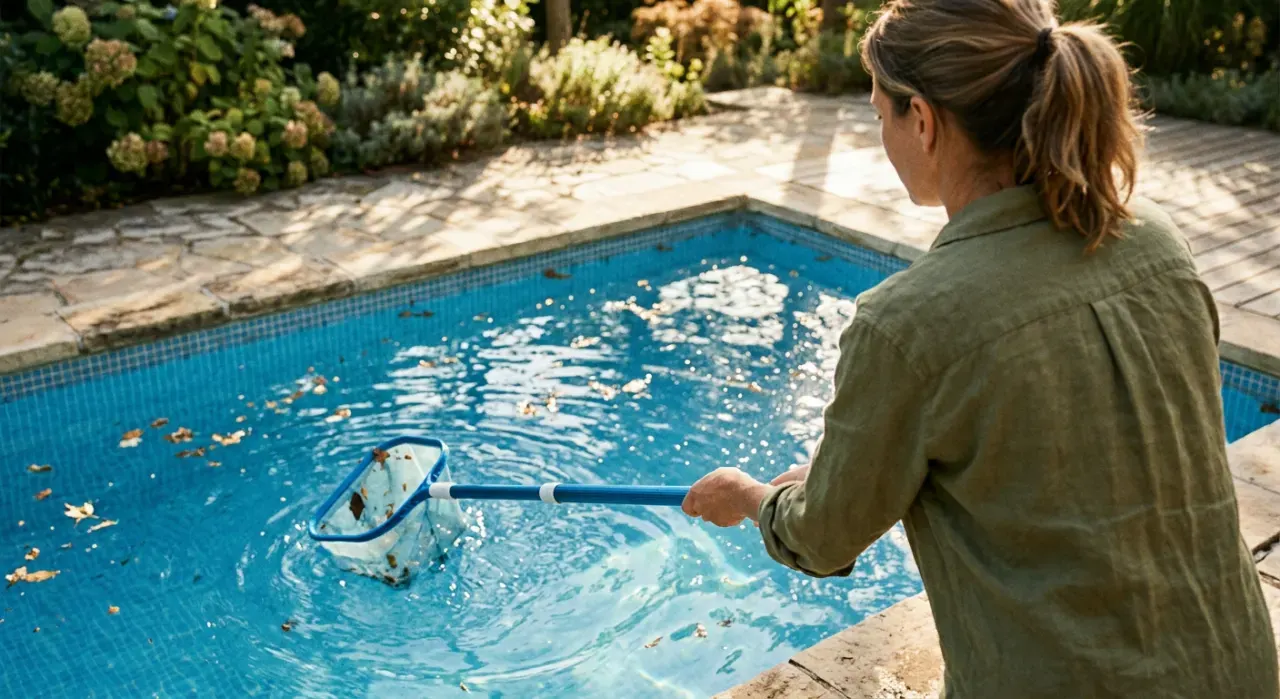
- Deep clean. Brush every surface, vacuum thoroughly, empty skimmer and pump baskets, and clean the waterline. Organic debris left in the water feeds algae all winter.
- Balance to target in the usual order — total alkalinity 80 to 120 ppm, then pH 7.4 to 7.6, then calcium hardness 200 to 400 ppm in plaster or 175 to 275 ppm in vinyl. Some closing guidance nudges pH and alkalinity slightly to the upper end of the range as a buffer against the winter drift, which is worth doing if you have the reagents to measure it accurately.
- Shock the pool a few days before closing, and let free chlorine fall back toward normal before you cover — sealing in shock-level chlorine can bleach a vinyl liner and degrade the cover.
- Add winterizing algaecide last, once chlorine has dropped, since high chlorine destroys most algaecides. Run the pump long enough to distribute it.
Handling rules do not change because it is closing weekend. Never mix pool chemicals with each other, never combine any chlorine product with an acid — that reaction releases chlorine gas — and always add the chemical to a large volume of water rather than water to the chemical. One product at a time, pump running, with the label's wait between additions. Full target ranges are in pool water chemistry.
Clearing the plumbing — the step that matters
Water expands when it freezes, and the pressure it generates splits rigid PVC, cracks pump housings, ruptures filter tanks and destroys heater heat exchangers. Every other task on this page is housekeeping. This one is why winterizing exists.
- Backwash or clean the filter, then open every drain plug on the filter tank and leave them out for the winter. Put them in a labeled bag taped inside the pump lid so they are not lost by April.
- Drain the pump. Remove both drain plugs, take out the basket, and let it empty completely. A cupful left in the volute is enough to crack the housing.
- Blow the lines clear. A shop vacuum on blow, or a dedicated blower, pushes water out of the skimmer and return lines back into the pool. Work each line until it blows only air and you see steady bubbling at the pool end.
- Plug each line as it is blown, while the air is still moving, so water cannot run back in. Expansion plugs in the returns; a skimmer plug or a gizmo in the skimmer.
- Add pool antifreeze as a backup to the lines in freezing climates, following the label for the quantity per line. Only pool antifreeze. Never use automotive antifreeze — ethylene glycol is highly toxic, and automotive products are not formulated for pool plumbing.
- Drain the heater completely per its manual, and drain and store a salt cell, chlorinator and any automation sensors as the manufacturers specify.
- Store the pump and small equipment indoors if it can be disconnected easily. A dry garage shelf beats a snowdrift.
If your pool has an in-floor cleaning system, a spa spillover, a heat pump, an attached water feature, or plumbing you are not confident you can fully clear, have a pool professional close it. A professional closing typically costs a few hundred dollars; a split heat exchanger costs considerably more than that, and a cracked underground line more again.
Water level and cover choice
| Mesh cover | Solid cover | |
|---|---|---|
| Rain and snowmelt | Passes through into the pool | Collects on top — must be pumped off |
| Cover pump needed | No | Yes, essentially always |
| Winter workload | Very low | Regular checking through the season |
| Water clarity in spring | Dirtier — fine debris and sunlight get through | Cleaner — blocks light, so less algae |
| Water level at closing | Lowered below the skimmer | Often left high with a skimmer plate; follow the manufacturer |
| Typical life | 8 to 12 years | 5 to 8 years |
Lower the level only if your cover type and manufacturer call for it. The older blanket advice to drain well below the skimmer has been revised by many manufacturers, because a fuller pool better supports the walls against ice pressure and, on a vinyl pool, against the ground pushing inward. Follow the instructions for your specific pool and cover rather than a general rule.

Best for a round above-ground pool in a region with real snow load
- Woven polyethylene with a 4 ft overlap for anchoring
- Fine mesh passes rain and snowmelt while holding debris out
- Metal grommets around the perimeter
- Mesh means no standing water to pump off all winter
Why buy it: a mesh cover lets meltwater through instead of collecting it, which is what saves owners the weekly winter chore of pumping a solid cover clear.

Best for clearing standing water off a solid winter cover automatically
- 1/3 HP, 1,745 GPH
- Automatic switching — runs when water collects, stops when clear
- 25 ft power cord
- Submersible, sits directly on the cover
Why buy it: water on a solid cover is heavy enough to tear it or pull the anchors, so an automatic pump is what stops a $300 cover becoming a spring write-off.
We do not buy or physically handle the products we rank — verdicts come from aggregated owner ratings and expert consensus, described on how we rank. The ranked fields are in the best above-ground pool covers and the best pool cover pumps.
Fitting and securing the cover
- Cover the whole pool with real overlap — 3 to 4 feet on an above-ground pool — and secure it with the cable and winch, wall clips or water bags as the design intends.
- Use air pillows under the cover on an above-ground pool. They compress as surface ice expands and take the load that would otherwise push outward on the walls. One good pillow, properly centered and only part-inflated, does the job; fully inflating it makes it burst.
- Never use water bags on an above-ground pool wall, and never anchor a cover to anything that could be pulled loose.
- Keep a cover pump on a solid cover and check it after every heavy rain and thaw. Standing water is heavy — a few inches across a large cover is a great deal of weight, enough to tear the fabric or pull the anchors out.
- Sweep off heavy snow load where you safely can, from the edge with a soft brush. Do not walk on a winter cover. It is not a safety cover and it will not hold you.
That last point deserves its own line, because it is a genuine hazard. A standard winter cover is a debris barrier, not a load-rated safety cover. It looks solid under snow and it is not. Keep children and pets away from the covered pool, keep the barrier fence and self-latching gate in service through the winter, and keep the ladder removed and stored. Closing the pool does not close the safety layers — see pool safety.
Through the winter
- Check the cover after every storm for tears, slipped anchors and pooled water.
- Empty and clear a solid cover of standing water; confirm the automatic pump is still running and not iced in.
- Keep the water level roughly where you left it — a mesh cover will refill the pool over the season, and a very high level can push the cover.
- Confirm the barrier and gate are still functioning. Winter is when fences get damaged and latches seize.
- Do not run the pump on a winterized system. The lines are deliberately empty.
Where to go next
For the above-ground specifics, how to winterize an above-ground pool and can you leave an above-ground pool up all year. To close with the right numbers, pool water chemistry. If you open in spring to green water, pool algae treatment. And for the equipment you are shutting down, cartridge vs sand filter. Everything else sits under the pools and spas hub.