 Garden


Affiliate Disclosure
Some links on this page are affiliate links. As an Amazon Associate, we earn from qualifying purchases — at no extra cost to you. We do not buy, test, or physically handle the products we cover; our rankings come from aggregated owner reviews, ratings and expert consensus. Commissions never change our verdicts. How we rank · full disclosure.
Price does not change the safety rules. Run any fuel generator outdoors only, at least 20 feet from the house, exhaust pointed away from doors, windows and vents — never in a garage, a basement, a shed or under a carport, even with the door open. The US Consumer Product Safety Commission states one portable generator can emit as much carbon monoxide as hundreds of cars and links more than 100 US deaths a year to generator CO. It is colorless and odorless. Fit CO alarms on every level of the home.
And never plug a generator into a wall outlet to power your house. Backfeeding energizes the utility line and can electrocute the crews restoring your power. A transfer switch or interlock kit installed by a licensed electrician is the only correct method. Source: CPSC Carbon Monoxide Information Center.
Under $500 you are choosing between two things you cannot have at once: watts and quiet. A conventional open-frame generator at this price gives you around 3,600 running watts — enough for a fridge, a freezer, a furnace blower and a sump pump — and it is loud. An inverter generator at the same money gives you 1,900 to 3,000 running watts, clean power that will not upset electronics, and a noise level you can hold a conversation next to. There is no machine under $500 that does both, and pretending otherwise is where most disappointment in this category starts.
Top Picks at a Glance

What Gets Cut Below $500
| Feature | Under $500 | $800–$1,500 |
|---|---|---|
| Running watts | 1,260–3,600W | 3,500–11,500W |
| Alternator windings | Often aluminum | Copper on better units |
| Electric start | Rare | Common |
| Dual fuel | Very rare | Common |
| CO shutdown sensor | Rare — one unit here has it | Increasingly standard |
| 240V output | Almost never | Standard above 5,000W |
| Transfer switch ready | No | Yes |
| Warranty | 1–2 years | 3 years typical |
| Parts availability in 5 years | Uncertain | Generally good |
The row that matters most is the last one. Budget generators are not usually ended by a dramatic failure; they are ended by a $30 carburetor that is no longer manufactured for a model discontinued three years ago. Buying from a brand with a real parts supply — WEN, Westinghouse, Champion — is the single best value decision at this price, ahead of any specification.
Our #1 Pick: WEN 56235i
The WEN 56235i is the budget generator that keeps working, and the reason is a component that costs the manufacturer almost nothing: a fuel shut-off valve. Close it with the engine running and the carburetor empties itself before storage, which prevents the varnish deposit that is far and away the most common reason a stored generator will not start when a storm arrives. Owners consistently report this machine starting reliably after long layups, which is not something you can say about most $400 generators.
The rest is a straightforward, honest package. Inverter output means clean power for laptops, TVs and anything with a circuit board, and it means the engine throttles down when the load is light — which is most of an outage — so it is both quiet and frugal. At around 39 pounds it is genuinely portable in a way that a 3,600-watt open-frame unit is not.
The limits are real and worth stating plainly. At 1,900 running watts it will run a refrigerator, lights, a router and devices; it will not start a sump pump or a well pump, and it will not run a space heater alongside anything else. If those are your loads, the Westinghouse WGen3600cv below is the better buy and you accept the noise.
Check price on Amazon → (paid link)

The Ranked Field
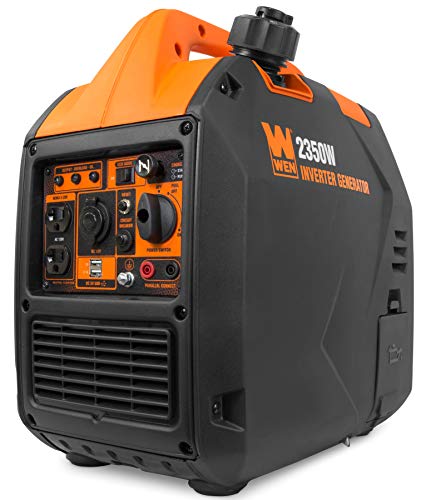
Best for a fridge, lights and devices during an outage, plus camping
- 2,350 surge / 1,900 running watts, inverter output
- Around 51 dBA at quarter load per the published rating
- Roughly 39 pounds — genuinely one-hand portable
- Fuel shut-off valve to clear the carburetor before storage
Why buy it: the fuel shut-off valve is the reason this one is still being rated well after three seasons — it is the single best defense against the stale-fuel failure that ends most budget generators.
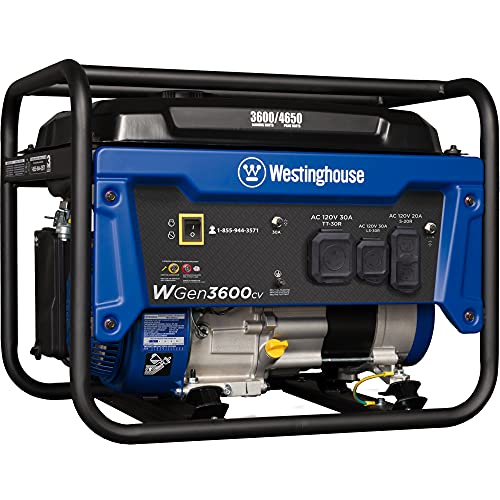
Best for running a fridge, a freezer, a sump pump and lights together
- 4,650 peak / 3,600 running watts, gasoline
- Built-in CO sensor that shuts the engine down automatically
- RV Ready 30A TT-30R outlet
- Recoil start with low-oil shutdown
Why buy it: nearly double the running watts of the inverter units here, and it is the only machine at this price with an automatic carbon monoxide shutdown — a genuine safety feature, not a spec-sheet item.

Best for campgrounds with decibel limits and small trailers
- 2,550 peak / 2,200 running watts, inverter output
- RV Ready 30A outlet despite the compact size
- Parallel capable — pair two for air conditioning
- Light enough to carry one-handed
Why buy it: a 30-amp RV outlet at this price is unusual, and parallel capability gives it an upgrade path that the cheapest units simply do not have.

Best for a bigger essentials list without giving up inverter quietness
- 3,600 surge / 3,000 running watts, inverter output
- RV Ready 30A outlet plus two household outlets
- Fuel shut-off valve and a low-oil shutdown
- Wheel and handle kit fitted
Why buy it: 3,000 running watts of clean inverter power at the very top of this budget — it sits right at the line, and it is worth watching for the moment it dips under.

Best for tailgating, a work site, or charging batteries
- 1,600 surge / 1,260 running watts, inverter output
- Around 28 pounds — the lightest here by a clear margin
- Quiet enough for campground use
- Small enough to store on a shelf
Why buy it: honest about what it is: 1,260 running watts will run a fridge or a few tools, not a house — and at 28 pounds it is the one you will actually carry.

Best for apartments, medical devices and indoor use where no engine is allowed
- 292Wh LiFePO4 battery with pure sine wave AC output
- Completely silent, no exhaust, safe to run indoors
- USB-C PD and a 12V socket
- No fuel, no oil, no maintenance
Why buy it: the only thing on this page that can legally run in the room with you — it will not power a house, but for a CPAP machine, phones, a router and lights it is the correct answer.
Quick Comparison
| Product | Best for | Rating | Price | Buy |
|---|---|---|---|---|
| WEN 56235i 2350-Watt Super Quiet Portable Inverter Generator with Fuel Shut Off | Best Overall Under $500 | — | Check (paid link) | |
| Westinghouse WGen3600cv 4650 Peak Watt Portable Generator with CO Sensor, RV Ready | Best Power Per Dollar | — | Check (paid link) | |
| Westinghouse iGen2550 2550 Peak Watt Super Quiet Portable Inverter Generator, RV Ready | Best Inverter Alternative | — | Check (paid link) | |
| WEN 56360i 3600-Watt RV-Ready Portable Inverter Generator with Fuel Shut Off | Most Output at the Limit | — | Check (paid link) | |
| AIVOLT 1600W Super Quiet Inverter Generator, 28lbs, 1260 Running Watts | Best Ultra-Budget | — | Check (paid link) | |
| Jackery Explorer 300 Portable Power Station, 292Wh, LiFePO4 | Best Silent Option | — | Check (paid link) |
What Each Wattage Tier Actually Covers
| Running watts | Realistically runs | Will not run |
|---|---|---|
| 1,200–1,300W | Fridge or freezer, lights, devices, small tools | Anything with a large motor |
| 1,900–2,200W | Fridge and freezer together, lights, router, TV, a coffee maker | Sump pump, well pump, AC |
| 3,000W | All of the above plus a furnace blower or a microwave | Well pump plus everything else |
| 3,600W | Fridge, freezer, furnace blower, sump pump, lights | Central AC, electric range, water heater |
| 292Wh battery | Phones, laptop, router, CPAP, LED lights | Any appliance with a compressor |
Remember that surge, not running watts, is what stops an appliance starting. A refrigerator drawing 150 watts steadily pulls 800 to 1,200 for the instant the compressor kicks in, and a sump pump drawing 600 can pull 2,400. Full sizing detail is in our portable generator guide.

How We Rank
We do not buy, run or test these machines. Rankings come from aggregated owner ratings across the most-owned budget generators, weighted toward reviews written after at least one storage season where starting reliability shows up, and cross-checked against published specifications for running wattage and outlet configuration. Four things carry the weight at this price: starting reliability after storage, which is the failure mode that ends budget generators; the presence of a fuel shut-off valve and low-oil protection; honest running watts rather than the peak figure; and brand parts availability, because a generator you cannot get a carburetor for is finished. Prices move constantly at this end of the market and were checked at the time of writing. Full method: how we rank.
What Owners Actually Complain About
Would not start after sitting. The dominant complaint on every budget generator, and almost always stale fuel rather than a defect. Machines with fuel shut-off valves fare visibly better in the review record.
Not enough power. A large share of one-star reviews describe a generator working exactly as specified while the buyer expected two or three times the output. Check the running watts figure, not the peak.
Noise from conventional units. A 3,600-watt open-frame generator runs 70 to 78 dBA. Buyers cross-shopping it against a quiet inverter model at the same price are consistently surprised.
Assembly and thin manuals. Common across the price band. Budget an hour and check the oil is filled before first start — many ship dry.
No 240V and no transfer switch outlet. Buyers planning to wire a budget generator into the house discover it cannot be done. That capability starts higher up the range.
The Verdict
For most people under $500 the WEN 56235i is the right buy — quiet, light, clean power, and the fuel shut-off valve that keeps it starting. If your list includes a sump pump or a well pump, take the Westinghouse WGen3600cv instead for nearly double the running watts and the only automatic CO shutdown sensor in this price band, and accept that it is loud. And if what you need is silent power for a CPAP machine, a router and phones — especially in an apartment where a fuel generator is not an option at all — the Jackery Explorer 300 is a different and better answer for a fraction of the money. Check price on Amazon → (paid link)
Sources: US Consumer Product Safety Commission Carbon Monoxide Information Center; ESFI portable generator safety.
More from this hub: power tools & workshop · best portable generators · best quiet generators · generator won’t start · how we rank.