 Garden


Affiliate Disclosure
Some links on this page are affiliate links. As an Amazon Associate, we earn from qualifying purchases — at no extra cost to you. We do not buy, test, or physically handle the products we cover; our rankings come from aggregated owner reviews, ratings and expert consensus. Commissions never change our verdicts. How we rank · full disclosure.
The decibel figure on a generator box is real, but it is measured under conditions you will rarely reproduce. The industry convention is to quote noise at quarter load, at 23 feet, in open air. Run the same machine at three-quarter load — which is what a home backup generator does during an actual outage — and it will typically read 5 to 10 dBA higher. A "51 dBA" generator is a genuinely quiet machine idling, and a fairly ordinary one working.
The second thing worth internalizing is that decibels are logarithmic. Ten decibels is roughly a doubling of perceived loudness. That means the gap between a 58 dBA inverter unit and a 75 dBA open-frame generator is not the 30 percent the numbers suggest — it is more like three times as loud. This is the entire reason inverter generators took over anywhere people have to sit near the machine.
Top Picks at a Glance

What the Numbers Actually Sound Like
| Level | Familiar equivalent | What it means in practice |
|---|---|---|
| 50 dBA | Refrigerator hum | Audible in a quiet yard, ignorable indoors |
| 55 dBA | Quiet office | Best inverter generators at light load |
| 60 dBA | Normal conversation | The common campground limit at 50 feet |
| 65 dBA | Loud conversation | Inverter generators at three-quarter load |
| 70 dBA | Vacuum cleaner | Twice as loud as 60 — neighbors notice |
| 75 dBA | Busy street | Typical open-frame home backup generator |
| 80 dBA | Garbage disposal | Large open-frame units at load; a genuine nuisance |
Distance does more work than any product feature. Sound pressure falls by roughly 6 dB every time you double the distance from the source, so moving a generator from 20 feet to 40 feet cuts perceived loudness substantially — and it happens to align exactly with the safety requirement to keep the machine at least 20 feet from the house. Placing it behind a solid barrier such as a garage wall or a fence, so there is no direct line of sight, helps again.
Our #1 Pick: Westinghouse iGen5000DFc
This is the largest machine on the page that still qualifies as quiet, and that combination is the whole point. At 4,500 running watts it is a real home backup generator — a fridge, a freezer, a furnace blower and lights simultaneously — rather than a camping accessory that happens to be discreet. Most machines with that output are open-frame units that run in the mid-70s dBA.
Efficiency mode is the feature that matters most in practice. Because an inverter generator does not need to hold 3,600 rpm to produce 60 Hz power, the engine drops to whatever speed the current load requires. During an outage, most of the hours are spent at light load — a fridge cycling, some lights, phones charging — and in that state the machine is genuinely unobtrusive. It only gets loud when something big starts, and then it settles again.
Dual fuel earns its place for a different reason. Backup generators sit unused for months and the most common reason one fails to start is stale gasoline gumming the carburetor. Stored on propane, that failure mode largely disappears. Owners consistently report the remote start as the thing they use most in bad weather. The fair criticisms: it is heavy for an inverter unit, and output on propane runs roughly 10 percent below the gasoline figure.
Check price on Amazon → (paid link)

The Ranked Field

Best for real home backup at a noise level neighbors will tolerate
- 5,000 peak / 4,500 running watts, dual fuel
- Inverter output with efficiency mode that throttles at low load
- Rated in the low 50s dBA at quarter load
- Remote electric start and a CO sensor
Why buy it: the largest output here that still sounds like a machine you can live next to, and efficiency mode means it only gets loud when it is actually working hard.
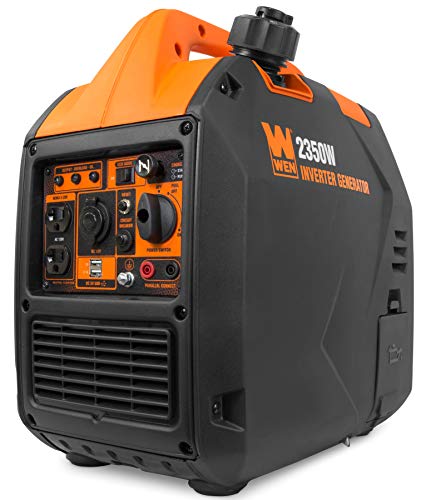
Best for camping, tailgating and running a fridge quietly
- 2,350 surge / 1,900 running watts
- Around 51 dBA at quarter load per the published rating
- Roughly 39 pounds — genuinely one-hand portable
- Fuel shut-off valve for clean storage
Why buy it: the cheapest genuinely quiet generator worth owning, and the fuel shut-off valve is why owners still rate it well after three seasons of sitting between trips.

Best for anyone who has to lift it alone, repeatedly
- 2,500 starting / 1,850 running watts
- Around 39 pounds with a fold-down handle
- Economy Mode for lower noise and fuel burn
- Free 3-year warranty with lifetime technical support
Why buy it: the quiet generator you will actually take places, because the reason a generator sits in the garage is almost never noise — it is weight.

Best for quiet backup that will still start after eight months in the garage
- 4,000 peak / 3,500 running watts, gasoline or propane
- RV Ready 30A outlet, parallel capable
- Remote electric start with a key fob
- Low-oil shutdown and a CO sensor
Why buy it: propane storage solves the failure that ends most backup generators — stale gasoline gumming a carburetor — without giving up the quiet inverter output.

Best for a campground or a driveway where a 30A outlet is needed
- 4,000 starting / 3,500 running watts, inverter output
- RV Ready 30A TT-30R outlet with Economy Mode
- Quiet Technology acoustic enclosure
- Free 3-year warranty and US support network
Why buy it: the size that starts a 13,500 BTU rooftop air conditioner while staying inside most campground decibel limits — an unusual combination.

Best for quiet hours, apartments, and anything that must run indoors
- 1070Wh LiFePO4 battery with 1500W AC output
- Completely silent except a cooling fan under load
- No exhaust, so it can run indoors safely
- Full recharge from a wall outlet in about an hour
Why buy it: the only thing on this page that is actually quiet rather than quieter — and the only one that can legally and safely run in the room with you.
Quick Comparison
| Product | Best for | Rating | Price | Buy |
|---|---|---|---|---|
| Westinghouse iGen5000DFc 5000 Peak Watt Dual Fuel Inverter Generator, Remote Electric Start | Best Overall | — | Check (paid link) | |
| WEN 56235i 2350-Watt Super Quiet Portable Inverter Generator with Fuel Shut Off | Best Value | — | Check (paid link) | |
| Champion Power Equipment 2500-Watt Ultralight Portable Inverter Generator with Quiet Technology | Best Ultralight | — | Check (paid link) | |
| Westinghouse iGen4500DFc 4000 Peak Watt Super Quiet Dual Fuel Inverter Generator, Remote Electric Start | Best Dual Fuel | — | Check (paid link) | |
| Champion Power Equipment 4000-Watt RV Ready Portable Inverter Generator with Quiet Technology | Best Mid-Size | — | Check (paid link) | |
| Jackery Explorer 1000 v2 Portable Power Station, 1070Wh, 1500W, LiFePO4 | Genuinely Silent | — | Check (paid link) |
Making a Generator Quieter — What Works and What Kills
What genuinely helps:
- Distance. Every doubling cuts about 6 dB. The safety minimum of 20 feet is also the cheapest noise treatment available.
- A solid barrier with no direct line of sight. A garage wall, a masonry fence, a parked vehicle. Sound travels in straight lines and blocking them works.
- Soft ground and anti-vibration feet. Concrete reflects and couples vibration; grass, gravel or rubber mats absorb it. A surprising amount of perceived generator noise is frame vibration rather than exhaust.
- Exhaust direction. Point it away from the house and away from any reflective wall.
- Economy or eco mode. Free, immediate, and the biggest single improvement on any inverter unit. Switch it off only when starting a large motor load.
- An aftermarket muffler or generator silencer where the machine supports one. Expect 5 to 10 dB, not miracles.
What will kill you: enclosing a running generator. Sound-proof boxes, sheds, deck skirts, garages with the door cracked open, tarps draped over the machine — all of these trap exhaust, and generator exhaust is where the carbon monoxide is. The US Consumer Product Safety Commission states that a single portable generator can emit as much carbon monoxide as hundreds of cars, and links more than 100 US deaths a year in the United States to generator CO. It is colorless and odorless, so there is no warning at all; people lose consciousness before they realize anything is wrong.
Run any fuel generator outdoors only, at least 20 feet from the house, with the exhaust pointed away from doors, windows and vents — never in a garage, a basement, a shed or under a carport, even with the door open. Fit CO alarms on every level of the home. Purpose-built running covers exist and are designed with open sides for airflow; those are rain protection, not enclosures, and the distinction matters. See generator carbon monoxide safety.
Also: never plug a generator into a wall outlet to power the house. Backfeeding energizes the utility line and can electrocute the crews restoring your power. A transfer switch or interlock kit fitted by a licensed electrician is the only correct method.

How We Rank
We do not buy, run or test these machines. Rankings come from aggregated owner ratings across the most-owned quiet and inverter generators, weighted toward reviews that describe noise under real load rather than at idle, and cross-checked against published decibel ratings and running wattage. Four things carry the weight: noise under working load rather than the quarter-load headline; useful output, since a silent machine that cannot start a fridge has not solved anything; throttle-down behavior, because economy mode is what makes an inverter unit livable; and starting reliability after storage. Prices were checked at the time of writing. Full method: how we rank.
What Owners Actually Complain About
Louder under load than expected. The dominant theme, and it is a measurement convention problem rather than a product fault. Assume 5 to 10 dBA above the box figure in real use.
Economy mode left off. Many owners run in standard mode without realizing, then report the machine as loud and thirsty. Check the switch.
Weight relative to output. Acoustic enclosures are heavy. A quiet 4,000-watt unit weighs noticeably more than an open-frame machine of similar output.
Hard starting after storage. Universal across gasoline generators, and the main argument for the dual fuel models here.
Price per watt. Inverter generators cost substantially more per watt than open-frame units. Buyers who do not need quiet are consistently better served by an open-frame machine.
The Verdict
For quiet home backup with real capability, the Westinghouse iGen5000DFc is the pick — enough output to matter, quiet enough to run through the night without an argument, and propane storage that solves the starting problem. Take the WEN 56235i if the budget is firm and the job is camping or a fridge, and the Champion 2500-Watt Ultralight if you will be carrying it. And if what you actually need is silence rather than reduced noise — quiet hours, an apartment, a bedroom medical device — buy the Jackery Explorer 1000 v2 instead, because no engine is ever going to be quiet enough for that job. Check price on Amazon → (paid link)
Sources: US Consumer Product Safety Commission Carbon Monoxide Information Center; ESFI portable generator safety.
More from this hub: power tools & workshop · best portable generators · best RV generators · best portable power stations · how we rank.