 Garden


Affiliate Disclosure
Some links on this page are affiliate links. As an Amazon Associate, we earn from qualifying purchases — at no extra cost to you. We do not buy, test, or physically handle the products we cover; our rankings come from aggregated owner reviews, ratings and expert consensus. Commissions never change our verdicts. How we rank · full disclosure.
A true standby generator is not a product you can order and take delivery of. It is a permanently installed system — a fixed unit on a pad, plumbed to natural gas or a large propane tank, wired to an automatic transfer switch, permitted and inspected — and it is sold and commissioned through dealers. Generac dominates US residential installations; Kohler, Briggs & Stratton and Cummins compete around it. Expect $9,000 to $17,000 installed for an air-cooled unit in 2026, and expect the installer to matter as much as the badge.
What you can buy online is the other half of the equation, and it is the half most people underbudget: the transfer switch, plus a large portable generator to feed it. That combination gives you a manual version of the same capability for $1,500 to $3,000. You go outside and start it, which is the entire difference. For a lot of households that is a perfectly reasonable trade.
The rule that makes all of this necessary. Never plug a generator into a wall outlet to power your house. Backfeeding pushes power through the utility transformer and onto the neighborhood lines, where it can electrocute a line worker who has already tested the circuit dead. It can also destroy your generator and start a fire when grid power returns out of phase. A transfer switch or an interlock kit installed by a licensed electrician is the only correct method, and there is no safe shortcut.
And the other one. Portable generators run outdoors only, at least 20 feet from the house, exhaust pointed away from doors, windows and vents — never in a garage, a basement or under a carport, even with the door open. The US Consumer Product Safety Commission states one portable generator can emit as much carbon monoxide as hundreds of cars and links more than 100 US deaths a year to generator CO. It is colorless and odorless. Fit CO alarms on every level. Source: CPSC Carbon Monoxide Information Center.
Top Picks at a Glance

Automatic Standby vs Manual Standby
| Installed standby + ATS | Large portable + manual switch | |
|---|---|---|
| 2026 total cost | $9,000–$17,000 | $1,500–$3,000 |
| Switchover | Automatic, 10–30 seconds | Manual — you start it and throw the switch |
| Works when nobody is home | Yes | No |
| Fuel | Natural gas or a 250–500 gallon propane tank | Gasoline, propane bottles, or gas if tri-fuel |
| Self-test | Weekly, automatic | You have to remember, quarterly |
| Circuits covered | Whole panel with load management | 6–10 circuits, or whole panel with a 100A switch |
| Noise | 60–70 dBA, enclosed | 70–80 dBA open frame, ~65 inverter |
| Servicing | Annual dealer visit | Oil, filters, stabilizer, quarterly exercise |
| Permit and inspection | Electrical plus gas | Electrical, for the switch |
Our #1 Pick: Reliance Controls Pro/Tran 31406CWK
The Reliance Pro/Tran is the reference product in manual transfer switches, and the feature that earns it the top spot is the pair of watt meters — one per generator leg. Without them, load management during an outage is guesswork: you flip circuits on until something trips, then work backwards. With them you can see exactly how much of the generator's capacity each leg is using and balance the two, which is what stops a 5,000-watt generator being tripped by 3,000 watts unevenly distributed.
The kit is complete in a way that matters when an electrician is standing in your basement charging by the hour: switch, power inlet box, and the cord between generator and inlet. Owners consistently report that the instructions are clear enough for the electrician to work quickly, and that clarity is worth real money — a faster install often more than covers the price difference against a cheaper kit.
The honest limits: six circuits is fewer than most households eventually want, and the 7,500-watt ceiling means it is the wrong choice if you are buying a 10,000-watt generator. For either of those, step up to the ten-circuit Pro/Tran2 or, for a large portable, a whole-panel 100A switch. And this is not a DIY installation. It is wired at the service panel and it must be permitted and inspected.
Check price on Amazon → (paid link)
The Ranked Field
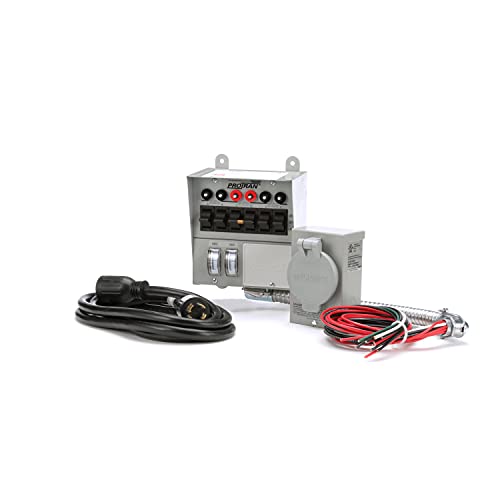
Best for connecting a 5,000 to 7,500 watt portable to the circuits that matter
- 30A, six circuits, for generators up to 7,500 watts
- Individual watt meters for each generator leg
- Complete kit with power inlet box and 10-foot cord
- UL listed; requires a licensed electrician to install
Why buy it: the reference product in this category — the per-leg watt meters are what stop you overloading the generator by guessing, and almost nothing else at this price has them.
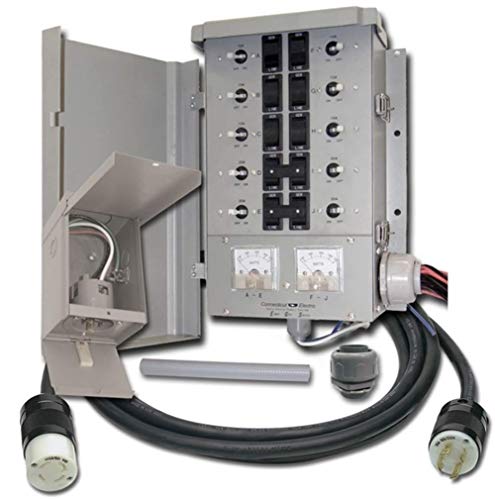
Best for covering more circuits on a smaller budget
- 30A, ten circuits, for generators up to 7,500 watts
- Includes inlet box and a 10-foot generator cord
- Wattmeter to monitor load
- UL listed manual transfer switch
Why buy it: ten circuits for roughly what six costs elsewhere, which matters because the circuits you did not include are the ones you will want at 2am.

Best for installers and homeowners who want the better-built version
- 30A, ten circuits, Pro/Tran2 chassis
- Watt meters for both generator legs
- Cleaner wiring layout that electricians consistently prefer
- UL listed
Why buy it: the Pro/Tran2 chassis is the one electricians ask for by name, and a faster install often costs less in labor than the price difference.

Best for a 10,000 watt or larger portable feeding a whole subpanel
- 100A / 24,000W double-throw switch, 120/240V
- Switches the whole panel rather than selected circuits
- Physically prevents utility and generator connection at once
- Requires a licensed electrician and a permit
Why buy it: a whole-panel switch instead of a six-circuit one, which is the correct match for a 10,000-watt-plus generator rather than trying to feed it through a small kit.

Best for a manual standby setup that never runs out of fuel
- 14,500 peak / 11,500 running watts on gasoline
- Tri-fuel: gasoline, propane or a natural gas connection
- CO sensor with automatic shutdown
- 50A and 30A transfer-switch outlets, remote electric start
Why buy it: plumbed to a natural gas line this gets closest to standby behavior without the installed price — the only thing missing is that it will not start itself.

Best for dense neighborhoods and HOA noise limits
- 12,000 peak / 9,500 running watts, dual fuel
- Inverter output, clean enough for sensitive electronics
- Markedly quieter than open-frame units of the same output
- Transfer switch ready with remote electric start
Why buy it: inverter output at 9,500 running watts is rare and expensive, and it is the only way to get near-standby capability without a generator your neighbors can hear all night.

Quick Comparison
| Product | Best for | Rating | Price | Buy |
|---|---|---|---|---|
| Reliance Controls 31406CWK Pro/Tran 30 Amp 6-Circuit Transfer Switch Kit for Generators up to 7500 Watts | Best Transfer Switch Overall | — | Check (paid link) | |
| Connecticut Electric EmerGen Transfer Switch Kit, 30 Amp, 10-Circuit, 7500 Watts, 10-Foot Cord | Best Value Switch | — | Check (paid link) | |
| Reliance Controls 310C Pro/Tran2 30-Amp 10-Circuit Manual Transfer Switch | Best 10-Circuit Build | — | Check (paid link) | |
| 100A Manual Transfer Switch, 24000W Double-Throw Safety Switch, 120/240 Volt | Best for Large Portables | — | Check (paid link) | |
| Westinghouse WGen11500TFc 14500 Peak Watt Tri-Fuel Home Backup Generator, Remote Electric Start | Best Generator to Pair With It | — | Check (paid link) | |
| Westinghouse iGen12000DF 12000 Peak Watt Dual Fuel Portable Inverter Generator, Remote Electric Start | Quietest Pairing | — | Check (paid link) |
Transfer Switch or Interlock Kit?
There are two legal ways to connect a generator to house wiring, and they suit different situations.
A manual transfer switch is a separate panel wired beside your main service panel, carrying a chosen set of circuits — typically six to ten. Each circuit has a three-position switch: utility, off, generator. It is tidy, it usually includes watt meters, and it forces you to decide in advance which circuits matter. Expect $200 to $500 for the kit plus $500 to $1,500 installed.
An interlock kit is a small mechanical plate fitted to your existing panel that makes it physically impossible to have the main breaker and the generator breaker on at the same time. It covers every circuit in the panel rather than a selected few, and it is cheaper — $100 to $250 for the kit plus a generator inlet box, $400 to $1,000 installed. The catch is compatibility: an approved interlock only exists for certain panel brands and models, and using an unapproved plate voids the panel listing and will fail inspection. Ask your electrician to check your panel first.
Either way, the job that both devices do is the same and it is the only reason they exist: they make it physically impossible for utility power and generator power to reach your wiring simultaneously. That is not a convenience feature. It is what stops your generator killing someone on a pole three streets away.
Sizing a Manual Standby Setup
Choose the circuits first, then the generator, then the switch — in that order, because the circuit list determines everything else.
| Circuit | Running watts | Include it? |
|---|---|---|
| Refrigerator | 150–200W | Always |
| Freezer | 100–150W | Always |
| Furnace or boiler control and blower | 600–800W | Always in cold climates |
| Sump pump | 500–800W | Always if you have a basement |
| Well pump | 800–2,000W | Always on well water |
| Kitchen and living room outlets | 300–600W | Yes |
| Lighting circuits | 200–400W | Yes |
| Internet, router, home office | 100–300W | Yes — cheap and high value |
| Garage door opener | 500–800W | Worth one circuit |
| Electric water heater | 4,000–4,500W | Rarely — too large for most portables |
| Central air conditioning | 3,500–4,000W | Only with a 10,000W-plus generator |
Add the running watts of everything you will have on at once, then confirm your generator's surge rating covers the largest motor starting while the rest is already running. Full sizing detail is in our portable generator guide.

How We Rank
We do not buy, install or test this equipment. Rankings come from aggregated owner ratings across the most-owned transfer switch kits and large home backup generators, weighted toward reviews written by or about a completed professional installation, and cross-checked against published specifications for amperage, circuit count and UL listing. Four things carry the weight: UL listing and code compliance, which is not optional here; kit completeness, because a missing inlet box or cord costs a second electrician visit; load metering, since managing a generator you cannot measure is guesswork; and installer feedback in the review record. Prices were checked at the time of writing. Full method: how we rank.
What Owners Actually Complain About
The install is not a weekend project. By far the most common theme. Owners who intended to do it themselves overwhelmingly report handing it to an electrician, and the ones who did not usually failed inspection.
Circuit count regret. Six circuits sounds like plenty until the outage arrives. Ten-circuit kits get consistently better long-term reviews for a modest price difference.
Conduit and fittings not included. Kits include the switch, the inlet and the cord, but the conduit run between them is usually extra. Budget for it.
Cord length. The supplied 10-foot generator cord constrains where the generator can sit — and it must sit at least 20 feet from the house. Most owners end up buying a longer cord, so buy it up front.
Standby quotes higher than expected. For installed systems, the gas line run and the panel work regularly cost more than the generator itself. Get multiple quotes before assuming the sticker price is the price.
The Verdict
If you want a generator that starts itself while you are at work, get dealer quotes for a permanently installed standby system and treat the installer's track record as seriously as the brand. If you want most of that capability for a fraction of the money and you are willing to go outside, buy the Reliance Controls Pro/Tran 31406CWK — or the ten-circuit Pro/Tran2 if you can stretch to it — have a licensed electrician install it with a permit, and pair it with a large dual or tri-fuel portable such as the Westinghouse 14500 Tri-Fuel. What you must not do, under any circumstances, is connect a generator to your house any other way. Check price on Amazon → (paid link)
Sources: US Consumer Product Safety Commission Carbon Monoxide Information Center; NFPA 70, National Electrical Code (Article 702 covers optional standby systems); ESFI portable generator safety.
More from this hub: power tools & workshop · best whole house generators · best portable generators · how far from the house · how we rank.