 Garden


Affiliate Disclosure
Some links on this page are affiliate links. As an Amazon Associate, we earn from qualifying purchases — at no extra cost to you. We do not buy, test, or physically handle the products we cover; our rankings come from aggregated owner reviews, ratings and expert consensus. Commissions never change our verdicts. How we rank · full disclosure.
The short version: the best battery chainsaw for most people is the EGO POWER+ CS1804 — an 18 in. bar, a brushless 56V motor owners compare to a 45cc gas saw, and a working 5.0Ah pack in the box. For hardwood rounds the Greenworks 80V holds torque better. But read this first: if you already own DeWalt FLEXVOLT, Makita LXT or Milwaukee M18 batteries, buying the bare tool on that platform is almost always the better financial decision, because the battery is most of what you are paying for.
Battery saws have genuinely displaced gas for domestic work, and the regulatory current runs the same way — the California Air Resources Board now requires most newly manufactured small off-road engines to be zero emission. What has not changed is that a chainsaw of any power source is the most dangerous tool most homeowners will own. OSHA lists a hard hat, safety glasses, hearing protection, heavy gloves, cut-resistant chaps and ankle-covering boots as standard chainsaw kit — the same list applies to a quiet battery saw, and quiet is exactly why people forget. See best chainsaw chaps.
The whole field including gas and corded is at best chainsaw. Everything else is at the pruning, trimming and hedges hub.
Top Picks at a Glance

Our #1 Pick: EGO POWER+ CS1804
What decides a battery chainsaw is what happens two thirds of the way through a full-depth cut. A weak saw slows, the chain starts polishing rather than cutting, heat builds and you end up rocking the bar to finish. A 56V brushless motor with real torque just keeps pulling, and across an afternoon that difference is not subtle.
Consensus Score ████████░░ 8.8 — owners consistently compare its cutting speed to small gas saws
The 18 in. bar is the other half of the argument. Most battery saws stop at 14 or 16 in., which is fine for limbing and irritating the moment a mature limb comes down in a storm. Eighteen inches covers rounds up to roughly 16 in. diameter in a single pass, and that is the difference between finishing a job and going back for a bigger tool.
Tool-free tensioning and an automatic oiler with a visible reservoir cover the two maintenance jobs owners neglect most, and the 56V platform runs EGO's mowers, blowers and trimmers, so the battery cost is spread across the shed rather than stranded in one tool.
The recurring criticisms are real. It is heavy — an 18 in. bar plus a 5.0Ah pack is genuine weight held out in front of you, and fatigue is the most common complaint. Runtime is finite and a second pack is close to essential for firewood work. Several owners report the oiler over-delivering and leaving a puddle under the saw in storage. New chains need tension checked repeatedly through the first few cuts. And it is expensive if you have no other EGO tools.
Check price on Amazon → (paid link)
Best Battery Chainsaws 2026: The Ranked Field

Best for one battery saw that covers storm cleanup, small felling and firewood
- 18 in. bar on a brushless 56V motor rated near a 45cc gas saw
- Chain speed around 11,000 RPM
- Tool-free tensioning and an automatic oiler with a level window
- 56V 5.0Ah battery and charger included
Why buy it: it has the bar length and the motor to do real work, so you are not buying a second saw the first time a big limb comes down.

Best for bucking hardwood rounds without moving to gas
- 80V brushless motor for high torque in thick timber
- 18 in. bar for larger diameter rounds
- Rapid charger included to reduce downtime
- Tool-free chain tensioning
Why buy it: the 80V platform holds torque through a full-depth cut in seasoned hardwood, which is exactly where 40V saws slow to a crawl.

Best for anyone already running a DeWalt 20V MAX and FLEXVOLT shop
- 16 in. Oregon bar and chain on a brushless 60V motor
- Tool-free chain tensioning and a bar retention knob
- Automatic oiling with a low-oil window
- FLEXVOLT packs also run 20V MAX tools
Why buy it: the battery is most of the cost of a cordless saw, so a pack that also runs your drill changes the maths completely.

Best for Makita LXT owners who do not want a second battery platform
- Runs two 18V LXT packs in series for 36V power
- 14 in. bar with chain speed up to around 3,940 FPM
- Automatic oiler with a view window and adjustable flow
- Kit ships with four 5.0Ah batteries and a dual charger
Why buy it: it delivers 36V performance without leaving the 18V LXT packs you already own, which is the cheapest route to a capable saw for Makita owners.

Best for limbing, pruning and clearing storm debris on a suburban lot
- 16 in. bar on a brushless 40V motor
- Tool-free chain tensioning
- Automatic bar and chain oiler with a level window
- Battery shared across a very wide Greenworks 40V range
Why buy it: a brushless motor at this price is rare, and it is what stops chain speed collapsing halfway through a cut.
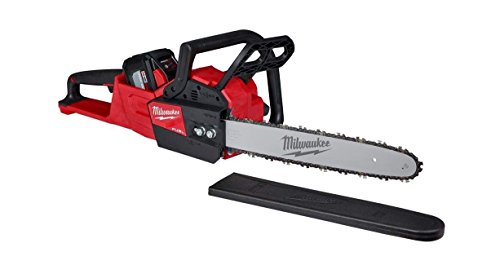
Best for M18 owners who want gas-class cutting speed from a battery saw
- 16 in. Oregon bar and chain, brushless POWERSTATE motor
- Milwaukee rates it against gas engines up to around 40cc
- Variable-speed trigger and automatic oiler
- Bare tool — uses existing M18 batteries
Why buy it: the variable-speed trigger gives genuinely fine control at the start of a cut, which is when a saw is most likely to skate.
Quick Comparison
| Product | Best for | Rating | Price | Buy |
|---|---|---|---|---|
| EGO POWER+ Chain Saw 18 in Battery Powered Cordless with 56V 5.0Ah Battery and Charger CS1804 | Best Overall | — | Check (paid link) | |
| Greenworks 80V 18 in Brushless Cordless Chainsaw with 2.0Ah Battery and Rapid Charger | Best Power | — | Check (paid link) | |
| DEWALT FLEXVOLT 60V MAX Brushless Cordless Chainsaw 16 in with Battery and Charger | Best for DeWalt Owners | — | Check (paid link) | |
| Makita XCU03PT1 18V X2 36V LXT Brushless Cordless 14 in Chain Saw Kit with 4 Batteries | Best for Makita Owners | — | Check (paid link) | |
| Greenworks 40V 16 in Brushless Cordless Chainsaw with 4.0Ah Battery and Charger | Best Value | — | Check (paid link) | |
| Milwaukee 2727-20 M18 FUEL 16 in Cordless Chainsaw Bare Tool | Best Cutting Speed | — | Check (paid link) |

How We Rank
We do not buy or physically handle these saws. Rankings come from aggregating star ratings and review volume across large owner-review sets, weighting recent reviews above launch-window ones, checking bar lengths, voltages, chain speeds, weights and safety features against manufacturer documentation, and reading negative reviews closely. In battery saws the negative reviews split cleanly into two groups — genuine oiler and tensioner faults, and owners expecting a 40V saw to do gas-saw work — and separating them is most of the analysis.
Four factors set the order. Torque under sustained load, taken from owner accounts of hardwood rather than headline chain speeds. Platform value, because the battery is frequently more than half the total cost. Weight and balance, weighted heavily since a saw you are fighting is a saw you control less well. And owner satisfaction, weighted by review volume. Prices were checked at the time of writing. Full method: how we rank.
The Saws, Reviewed
1. EGO POWER+ CS1804 — Best Overall
Covered above. Consensus Score ████████░░ 8.8. Strengths: near-gas cutting performance; an 18 in. bar that most rivals do not offer; tool-free tensioning and an automatic oiler; a 5.0Ah working pack included; and a battery platform spanning EGO's whole range. Recurring complaints: heavy at arm's length; finite runtime; over-oiling in storage; frequent early tension checks; and high cost without other EGO tools.
2. Greenworks 80V 18 in — Best Power
The battery saw for people who actually process wood. Voltage is a proxy for available torque, and 80V is what lets the chain keep its speed when the bar is fully buried in a hardwood round — the exact point where 40V saws stall. An 18 in. bar handles larger diameters, and the rapid charger cuts the gap between packs.
Consensus Score ████████░░ 8.0 — good ratings, with battery capacity the constraint
Recurring complaints: the 2.0Ah pack supplied is undersized for an 80V saw and owners consistently report very short runtimes, so a larger battery is effectively part of the purchase. The 80V range is narrower than 40V, so battery sharing is limited. It is heavy. Several reviewers rate the supplied bar and chain below the saw. And 80V packs are expensive to replace.
3. DEWALT FLEXVOLT 60V MAX 16 in — Best for DeWalt Owners
The saw that costs least if your garage is already yellow. FLEXVOLT packs run 60V tools and step down to power 20V MAX drills and drivers, which means the battery is genuinely dual-purpose rather than a single-tool expense. A 16 in. Oregon bar on a brushless motor is a properly capable setup for storm cleanup and small felling.
Consensus Score ████████░░ 8.5 — strong ratings, with platform ownership deciding the value
Recurring complaints: runtime on one pack is short for anything past limbing, and FLEXVOLT batteries are expensive bought separately. Owners report the bar retention knob loosening and needing re-checking. Several describe inconsistent oiling. It is heavier than a 16 in. saw suggests. And bought outright with no existing DeWalt tools, the total is high for the capability.
4. Makita XCU03PT1 36V — Best for Makita Owners
Makita's answer to platform lock-in, and a clever one. Rather than asking LXT owners to buy into a new 36V or 40V battery line, the saw takes two 18V LXT packs in series. If you already own four LXT batteries, you already own the expensive part. A 14 in. bar with chain speed up to around 3,940 FPM is a limbing and small-felling tool rather than a firewood machine.
Consensus Score █████████░ 8.9 — very high ratings, particularly on build quality
Recurring complaints: it needs two charged packs to run at all, so a single flat battery stops the saw. The 14 in. bar limits it on larger rounds. Owners report the oiler flow needing adjustment out of the box. Several describe the twin-battery door as a weak point for dust and debris. And the full kit price is high if you are starting from nothing.
5. Greenworks 40V 16 in — Best Value
The right saw for a suburban lot and a modest budget. A 16 in. bar covers the work most homeowners genuinely do, and a brushless motor at this price is unusual — it is what keeps chain speed up in the cut rather than fading. Tool-free tensioning, an automatic oiler with a level window, and a battery shared across one of the widest cordless yard ranges on the market.
Consensus Score ████████░░ 8.2 — strong ratings and consistently praised on value
Recurring complaints: the 4.0Ah pack is modest for sustained cutting. It bogs noticeably in seasoned hardwood. Several reviewers report oiler failures, which is the fault that destroys a bar fastest. The supplied bar and chain are frequently replaced early. And charge times are long relative to runtime.
6. Milwaukee M18 FUEL 2727-20 — Best Cutting Speed
The trade tool of the group. Milwaukee positions it against gas engines up to roughly 40cc, and the feature owners single out is the variable-speed trigger: being able to start a cut slowly and then bring the chain up to speed gives real control at the moment a saw is most likely to skate off the bark. A 16 in. Oregon bar and an automatic oiler round it out.
Consensus Score ████████░░ 8.7 — excellent ratings, sold as a bare tool
Recurring complaints: it is a bare tool, so the true cost includes a high-output M18 pack and charger. It is heavy. Owners report it draining smaller M18 batteries very quickly under load. Several describe the oiler as over-generous. And it is expensive for a 16 in. saw if you are buying into M18 from scratch.
How to Choose a Battery Chainsaw
Check your batteries before you compare saws. A bare tool on a platform you own can cost half what an equivalent kit costs on a new one, and packs do not cross brands. This one factor outweighs almost every specification below it.
Match the bar to the work, then stop. A 14 in. bar suits limbing and pruning. Sixteen inches is the all-round size. Eighteen inches is for firewood rounds and larger trunks. A longer bar is heavier, slower on a battery, and puts more of the kickback-prone nose out in front of you — it is not a free upgrade. Sizing detail is in what size chainsaw do I need.
Read voltage as torque and amp-hours as runtime. A 56V or 80V saw pulls harder through a deep cut; a bigger amp-hour pack simply lasts longer. Both matter, but they are not interchangeable, and a large pack on a low-voltage saw still bogs in hardwood.
Assume you will buy a second battery. Kits ship the smallest usable pack far more often than not, and the second battery is what turns a saw that stops mid-job into one that finishes it. Budget for it from the start rather than discovering it in the middle of a cleanup.
Safety: Quiet Does Not Mean Safe
Battery saws are dangerous in exactly the way gas saws are, and their manners make people careless. There is no starting ritual, no noise to announce that the tool is live, and no smell of exhaust — so owners pick them up one-handed, cut at head height off a ladder, and reach across their body in a way they never would with a screaming gas saw.
Kickback is the mechanism that hurts people. If the upper quadrant of the bar nose contacts wood or any solid object, the chain cannot pull through and instead drives the bar backward and upward toward your head and shoulder in a fraction of a second. The mitigations are specific: never cut with the nose; keep the tip visible and clear of hidden branches and the ground; wrap the thumb of your left hand fully under the front handle so the bar cannot be thrown clear; stand slightly to the side of the cutting line; and keep the chain sharp and correctly tensioned, because a dull or slack chain grabs. Test the chain brake before every session. Detail in what causes chainsaw kickback.
Never cut from a ladder and never above shoulder height — the tip goes out of sight, your body cannot brace, and a kickback adds a fall to a laceration. Remove the battery before clearing a jam, adjusting the chain or transporting the saw; the trigger lock is not a substitute. And hand any tree that is leaning, split, hollow, storm-loaded or within 10 feet of a power line to a certified arborist — OSHA requires unqualified people to keep that clearance.
What Owners Actually Complain About
Runtime leads every negative review set, and it is usually a pack-size problem. Kits ship small batteries, load is enormously variable, and owners comparing a saw to a fuel tank are comparing the wrong things. Buy the bigger pack.
Oiler faults are the most damaging complaint and appear across every brand. A saw with a failed oiler destroys a bar within an hour. Check for a thrown line of oil onto a light surface at part throttle before every session.
Chain tension generates a huge volume of reviews describing entirely normal behavior: new chains stretch through the first hour and all chains loosen as they warm. Over-tightening is the more expensive error because it grinds the bar rails. See how tight should a chainsaw chain be.
Supplied bars and chains draw consistent criticism on the value models, and a better chain is a cheap and worthwhile early upgrade. And platform lock-in is the strategic regret — several owners describe buying a saw on a battery line they own nothing else in and wishing they had not.
The Verdict
For most gardens the EGO POWER+ CS1804 is the battery chainsaw to buy: the bar length, the torque and the platform breadth all line up. Take the Greenworks 80V if hardwood rounds are the job and budget for a bigger pack. If you already own batteries, the DeWalt FLEXVOLT, Makita XCU03PT1 and Milwaukee M18 FUEL are all excellent and much cheaper in practice than they look. The Greenworks 40V is the value pick for limbing and storm debris. And whichever you choose, buy the chaps in the same order.
Check price on Amazon → (paid link)
Next: weigh the alternative in battery vs gas chainsaw, go smaller with best mini chainsaw, keep it cutting with how to sharpen a chainsaw chain, or browse more at tools.