 Garden

Affiliate Disclosure
Some links on this page are affiliate links. As an Amazon Associate, we earn from qualifying purchases — at no extra cost to you. We do not buy, test, or physically handle the products we cover; our rankings come from aggregated owner reviews, ratings and expert consensus. Commissions never change our verdicts. How we rank · full disclosure.
The short version: the best corded electric chainsaw is the Oregon CS1500 — a 15 amp motor, an 18 in. bar, and a built-in sharpening system that dresses the chain in a few seconds. If you cut often and want a saw that lasts, the Makita UC4051A is the better-engineered tool. If you want the cheapest capable saw, the Worx WG303.1 does the same work for around a hundred dollars.
Corded saws are the unglamorous value pick of the whole chainsaw category. You get 15 amps of continuous power for the price of a mid-range battery, unlimited runtime, no fuel system to go wrong and no battery to degrade in year six. What you give up is range — and the one moment a corded saw is useless is the power outage after a storm, which is exactly when many people want a chainsaw. Weigh that honestly before you buy.
Battery alternatives are at best battery chainsaw, the whole field including gas is at best chainsaw, and the trade-offs are laid out in electric vs gas chainsaw. Everything else is at the pruning, trimming and hedges hub.
Top Picks at a Glance

Our #1 Pick: Oregon CS1500
Most chainsaw advice quietly assumes an owner who sharpens. Most owners do not. A chain dulls from one touch of soil, gravel or a buried nail, and a dull chain does not just cut slowly — it makes you push, and pushing is how people lose control of a saw. The PowerSharp system built into this saw pulls a lever and dresses the chain against an integrated stone in a few seconds, without removing anything. That is a genuine safety feature disguised as a convenience.
Consensus Score ████████░░ 8.5 — high ratings, with the cord the main limitation owners cite
The rest of the saw is properly specified rather than an afterthought around the gimmick. Fifteen amps is the top of the domestic corded range and enough to keep chain speed up in a full-depth cut. An 18 in. low-kickback bar covers rounds to roughly 16 in. — larger than most battery saws in this price band. There is an automatic oiler with a level window, a chain brake and tool-free tensioning.
The recurring criticisms are consistent. The cord is the whole compromise: it snags in brush, limits you to the length of an extension lead, and dragging a live cord through a cutting area is a hazard that has to be actively managed. The PowerSharp stone is a consumable and owners report buying replacements. Several describe oil weeping from the reservoir in storage. It is nose-heavy for an 18 in. saw and fatiguing held out at arm's length. And it is dead weight during the power cut you bought a saw for.
Check price on Amazon → (paid link)
Best Electric Chainsaws 2026: The Ranked Field
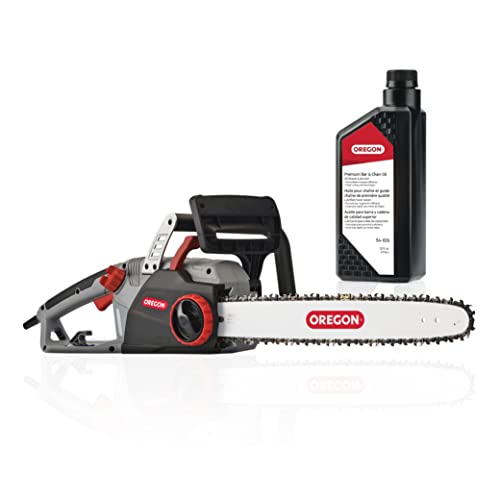
Best for the homeowner who wants a capable corded saw and will never file a chain
- 15 amp motor with an 18 in. low-kickback bar
- Integrated PowerSharp system sharpens the chain in three to five seconds
- Automatic oiler with a level window
- Chain brake and tool-free tensioning
Why buy it: the built-in sharpener fixes the maintenance job homeowners skip, and a dull chain is both slower and considerably more dangerous.

Best for frequent cutting where a saw needs to survive years of use
- 14.5 amp motor, chain speed around 2,900 FPM
- Built-in current limiter that reduces power under overload
- Electric chain brake and a large oil reservoir with a view window
- Tool-free chain adjustment and rear-handle layout
Why buy it: the current limiter protects the motor when the bar binds, which is what kills most corded saws long before the bar wears out.
Best for occasional yard work near an outlet at the lowest sensible price
- 14.5 amp motor with chain speed around 32 ft per second
- 16 in. bar, about 11 lb without oil
- Auto-tension system that prevents over-tightening
- Automatic chain lubrication with an oil level indicator
Why buy it: the auto-tension system removes the single most common way home users destroy a bar, which is winding the chain far too tight.
Best for limbing and pruning where a full-weight saw is more than you want to hold
- 9 amp motor with a 14 in. low-kickback bar
- Light enough for extended limbing work
- Automatic chain lubrication with an oil window
- Tool-free tensioning and a chain brake
Why buy it: a lighter saw is a saw you keep control of at arm’s length, and control matters more than power on limb work.
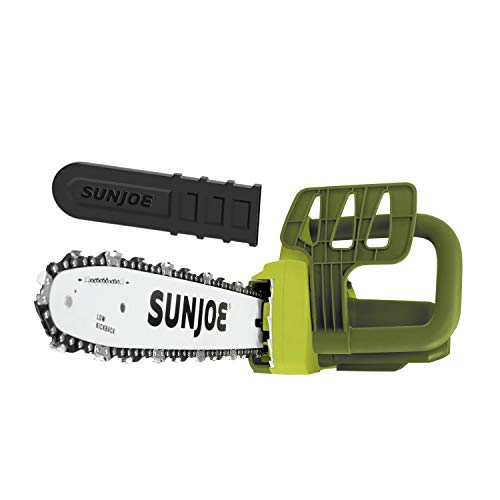
Best for small limbs, brush and anyone who finds a full-size saw too heavy
- About 7.7 lb — one of the lightest full chainsaws available
- 9 amp motor with a 14 in. bar
- Handles limbs and brush up to around 13.5 in.
- No fuel mixing, no tune-ups, two-year warranty
Why buy it: at under 8 lb it can be used at arm’s length without the fatigue that makes heavier saws genuinely dangerous.
Quick Comparison
| Product | Best for | Rating | Price | Buy |
|---|---|---|---|---|
| Oregon CS1500 18 in 15 Amp Self-Sharpening Corded Electric Chainsaw with PowerSharp | Best Overall | — | Check (paid link) | |
| Makita UC4051A 16 in 14.5 Amp Corded Electric Rear Handle Chain Saw | Best Build Quality | — | Check (paid link) | |
| Worx WG303.1 14.5 Amp 16 in Electric Chainsaw with Auto-Tension | Best Value | — | Check (paid link) | |
| Sun Joe SWJ599E 14-inch 9-Amp Tree Limb Master Electric Handheld Chainsaw with Low-Kickback | Best Lightweight | — | Check (paid link) | |
| Sun Joe SWJ699E 14-Inch 9.0 Amp Electric Chain Saw | Best Budget Buy | — | Check (paid link) |

How We Rank
We do not buy or physically handle these saws. Rankings come from aggregating star ratings and review volume across large owner-review sets, weighting recent reviews above launch-window ones, checking amperage, chain speed, bar length, weight and safety features against manufacturer documentation, and reading negative reviews closely. In corded saws the negative reviews cluster tightly around three things — oiler failures, tensioner faults and cord management — and separating design faults from undersized extension cords is a large part of the analysis.
Four factors set the order. Sustained power under load, judged from owner accounts of full-depth cuts rather than headline amperage. Maintenance design — oiler reliability, tensioning and sharpening. Weight and balance, weighted heavily because fatigue with a chainsaw is a safety issue. And owner satisfaction weighted by review volume. Prices were checked at the time of writing. Full method: how we rank.
The Saws, Reviewed
1. Oregon CS1500 — Best Overall
Covered above. Consensus Score ████████░░ 8.5. Strengths: a genuine built-in sharpening system; 15 amps of continuous power; an 18 in. bar unusual at this price; an automatic oiler with a level window; and a chain brake with tool-free tensioning. Recurring complaints: the cord; PowerSharp stones as a consumable; oil weeping in storage; nose-heavy balance; and useless in an outage.
2. Makita UC4051A — Best Build Quality
The saw to buy if you cut regularly and want it working in a decade. The feature that distinguishes it is the built-in current limiter: when the bar binds or the saw is overloaded, the electronics reduce power rather than letting the motor cook. Motor burnout from a pinched bar is what ends most corded saws, and this addresses it directly. An electric chain brake, a large oil reservoir with a view window and tool-free adjustment round it out.
Consensus Score █████████░ 8.9 — very high ratings, especially on durability
Recurring complaints: it costs roughly twice the budget corded saws for a 16 in. bar. Owners report the current limiter cutting in more readily than they would like in dense wood. It is heavy for a 16 in. saw. Several describe the oiler as over-generous and emptying the reservoir quickly. And the rear-handle layout suits two-handed bucking better than awkward-angle limb work.
3. Worx WG303.1 — Best Value
Better than its price suggests, and the value benchmark in the category. A 14.5 amp motor driving a 16 in. bar at around 32 feet per second, at roughly 11 lb without oil. The stand-out feature is auto-tension, which sets and holds chain tension without letting you over-tighten — and over-tightening is the most common way home users grind out a bar and cook a chain.
Consensus Score ████████░░ 8.5 — very high ratings, with the cord the only real limitation
Recurring complaints: owners report the auto-tension mechanism slipping or failing over time, which converts a convenience into a problem. Several describe oil leaking from the reservoir in storage. It is nose-heavy. The supplied chain is soft and often replaced early. And, in common with all corded saws, the cord snags and it is useless without power.
4. Sun Joe SWJ599E — Best Lightweight
The limbing saw. A 9 amp motor and a 14 in. low-kickback bar in a light package, aimed squarely at branches and cleanup rather than felling. Weight matters more on this work than power does: limbing is done at arm's length and often at odd angles, and a saw you can still control after twenty minutes is a safer saw than a more powerful one you are fighting.
Consensus Score ████████░░ 8.4 — strong ratings within clearly defined limits
Recurring complaints: underpowered for anything past limbs and small trunks, and owners who bought it for firewood rate it poorly. The plastic construction is described as feeling cheap. Chain tension slips more often than on the better saws. Several report the oiler underdelivering. And the short cord entry point means cord management needs care.
5. Sun Joe SWJ699E — Best Budget Buy
Worth including specifically because weight is a safety factor. At around 7.7 lb this is among the lightest genuine chainsaws available, which means it can be controlled by people who would struggle with a 12 lb machine — older users, smaller users, anyone doing overhead-free pruning at arm's length. A 9 amp motor and a 14 in. bar handle limbs and brush up to about 13.5 in.
Consensus Score ████████░░ 8.0 — well rated within clear limits
Recurring complaints: underpowered beyond limbs and small trunks. The plastic housing feels cheap to many owners. Chain tension slips. Several report oiler failures, which is the fault that destroys a bar fastest. And the low price sets expectations some buyers exceed, which drives most of the poor ratings.
Extension cords: the part people get wrong
A corded chainsaw is only as good as the cord feeding it. Undersized cord causes voltage drop, which makes the motor run hot, cut poorly and fail early — and it is a genuine fire risk. Use these as minimums:
| Saw draw | Up to 50 ft | Up to 100 ft | Up to 150 ft |
|---|---|---|---|
| Up to 10 amps | 16 gauge | 14 gauge | 12 gauge |
| 10–13 amps | 14 gauge | 12 gauge | 12 gauge |
| 13–15 amps | 14 gauge | 12 gauge | 10 gauge |
Use an outdoor-rated cord marked W or SJTW, plug into a GFCI outlet, use the cord retention hook or a simple loop knot at the tool plug so it cannot pull out mid-cut, and route the cord over your shoulder and behind you, never across the cutting area or through the felling path. A cut cord is both an electrocution risk and the reason the saw stops in the middle of a bind.
Safety: the Cord Adds a Hazard, It Does Not Remove Any
Corded saws are quiet, start instantly and feel domestic, which makes people casual with them. The chain runs at the same speeds as any other saw. Kickback is the mechanism that hurts people: when the upper quadrant of the bar nose contacts wood or any solid object, the chain cannot pull through and drives the bar backward and upward toward your head and shoulder in a fraction of a second. Never cut with the nose of the bar; keep the tip in view and clear of hidden branches and the ground; wrap the thumb of your leading hand fully under the front handle; stand slightly to the side of the cutting line; and keep the chain sharp and correctly tensioned, because a dull or slack chain grabs. Verify the chain brake stops the chain before every session. See what causes chainsaw kickback.
OSHA lists a hard hat, safety glasses, hearing protection, heavy gloves, cut-resistant chaps and boots covering the ankle as standard chainsaw kit — a $110 saw does not come with a discount on legs. See best chainsaw chaps. Never cut from a ladder or above shoulder height, and never with a cord that could tangle your feet. Do not use a corded saw in wet conditions — see can you use a chainsaw in the rain. And hand any leaning, split, hollow or storm-loaded tree, or anything within 10 feet of a power line, to a certified arborist; OSHA requires that clearance from unqualified people.
What Owners Actually Complain About
Oiler failures lead the category and are the most damaging fault a chainsaw can develop — a bar and chain run dry are ruined within an hour. Check for a thrown line of oil before every session, whatever the saw cost.
Auto-tension mechanisms failing is the specific complaint on the value saws. What starts as a convenience becomes a chain that will not hold tension, and there is often no manual override.
Oil leaking in storage is near-universal and rarely a defect — reservoirs vent, and a saw stored on its side weeps. Store it flat on a tray and empty the reservoir if it is going away for months.
Cord management generates a steady stream of frustrated reviews, and most of them describe undersized cords rather than saw faults. And supplied chains draw consistent criticism on the budget saws — a better chain is a cheap early upgrade that improves cutting more than any specification difference between these models.
The Verdict
For most people the Oregon CS1500 is the corded saw to buy: 15 amps, an 18 in. bar, and a sharpening system that solves the maintenance job almost nobody does. If you cut frequently and want a saw that keeps working, pay the extra for the Makita UC4051A and its current limiter. The Worx WG303.1 is excellent value for occasional work. And if weight is the deciding factor — for limbing, or simply because a 12 lb saw is more than you want to hold — the two Sun Joe saws do that job at low cost, within honest limits.
Whatever you buy, size the extension cord properly, keep it behind you, and buy the chaps.
Check price on Amazon → (paid link)
Next: cut the cord with best battery chainsaw, weigh the alternative in electric vs gas chainsaw, keep it cutting with how to sharpen a chainsaw chain, or browse more at tools.