 Garden

Affiliate Disclosure
Some links on this page are affiliate links. As an Amazon Associate, we earn from qualifying purchases — at no extra cost to you. We do not buy, test, or physically handle the products we cover; our rankings come from aggregated owner reviews, ratings and expert consensus. Commissions never change our verdicts. How we rank · full disclosure.
The short answer: for most homeowners the 14.5ft manual pole pruner and saw reaches high branches without a ladder for very little money. Step up to a premium pruner with a rotating head for regular tree work, choose a powered pole saw if you have real volume to cut, and pick maximum-reach models only when the branches are genuinely out of reach.
A pole pruner exists to keep you off a ladder, which is the single most dangerous thing most people do in their own garden. The buying decision balances reach against control: more extension gets you to higher branches but makes the tool heavier, floppier and harder to aim. This page ranks pole pruners around that trade-off, alongside cutting method and pole rigidity, and it pairs with our saw-focused best pole saw guide plus our best bypass pruners and best hedge shears pages in the pruning & hedges hub.
What Actually Separates a Good Pole Pruner
Once you set price aside, four things decide whether a pole pruner is safe and satisfying to use — and these are the axes this page ranks on:
- Reach vs control. The core trade-off: more extension reaches higher but adds weight and flex, making the tool harder to aim accurately.
- Cutting head. A bypass lopper head cleans up thin limbs; a saw blade handles thick ones. The best tools combine both.
- Pole rigidity and weight. A fiberglass or well-locked pole stays rigid at height; a flexy pole wanders off the cut and tires the arms.
- Manual vs powered. Manual is light, cheap and quiet for occasional cuts; a powered head pays off only when there is real volume to cut.

The Pole Pruners at a Glance
Our #1 Pick: The 14.5ft Manual Pole Pruner & Saw
This manual pole pruner tops the list because it matches what most homeowners actually need: enough reach to clear the average yard tree, a proper cutting head, and a price low enough that it is an easy yes. Around 14.5 feet of extension — added to your own reach — puts branches roughly 18 to 20 feet up within safe cutting range from the ground, and the manganese-steel saw blade cuts cleaner and lasts longer than the soft blades on the cheapest tools.
What it does better than the others. Value against the ladder. The real competition for a pole pruner is not another pole pruner — it is climbing a ladder with a saw, which is how most garden injuries happen. This tool removes that temptation for the price of a decent hand tool, with adjustable length that locks where you need it so you are not fighting a fixed pole. Its best-seller standing with a steady rating is the reassurance that a tool this cheap still cuts and holds up. For occasional high-branch work, it is the sensible buy.
Consensus Score ████████░░░ 8.3 — a solid owner consensus for a budget tool, with the usual note that any long manual pole takes effort at full extension.
Where it is weak. Like all long manual poles it flexes and tires the arms at full reach, and it lacks the rotating head and premium rigidity of the Fiskars. For regular or heavy tree work a powered pole saw does far more with less sweat, and for the very tallest branches the 27-foot models reach further. For the mainstream job, though, it is hard to beat on value.
Check price on Amazon → (paid link)
The Pole Pruners, Ranked

Best for reaching high branches for occasional trimming without a ladder or a big outlay
- Reaches roughly 14.5 feet fully extended
- Manganese-steel saw blade for cleaner cuts
- Adjustable length locks where you need it
- Best-seller at a genuinely low price
Why buy it: It puts high branches within reach for the price of a decent hand tool: enough extension for most yard trees, a proper steel saw blade, and no ladder required.

Best for a trusted, well-proven pruner with both a bypass lopper head and a saw
- Pull-cord bypass lopper plus a saw blade
- Telescopic handle for adjustable high reach
- Long-established, heavily reviewed design
- Cuts thick limbs with the saw, thin ones with the lopper
Why buy it: The pruner with the deepest track record here: a proven pull-cord lopper for clean cuts on thinner limbs and a saw for thick ones, backed by one of the largest review bases in the category.

Best for a durable, precise pruner for regular tree work you expect to keep for years
- Rotating head to angle into awkward branches
- 15-inch double-grind saw blade for fast cutting
- Double locking system for a rigid pole
- Fiskars build quality and reputation
Why buy it: Built for people who prune trees often: the rotating head reaches awkward angles, the double-grind saw cuts fast, and the locking pole stays rigid instead of flexing at full extension.
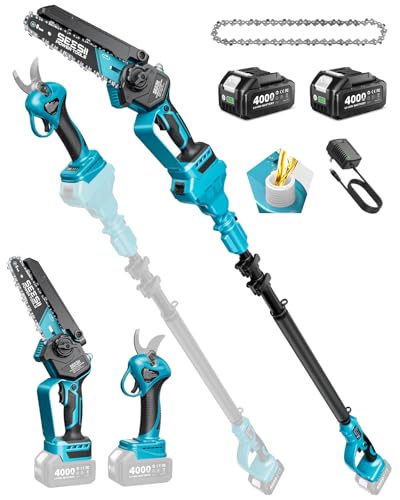
Best for high-volume cutting where a battery mini-chainsaw beats sawing by hand
- Brushless-motor 6-inch mini chainsaw on a pole
- Also converts to a handheld pruner
- Two 4000mAh batteries for extended runtime
- 4-in-1 versatility for different cutting jobs
Why buy it: When there is real volume to cut, the powered head does in seconds what a manual saw does in a sweaty minute — and it detaches into a handheld pruner for ground-level work.

Best for a mid-priced fiberglass pruner that balances reach, weight and cutting options
- Lightweight fiberglass pole resists flex
- Cutting scissors plus a saw blade
- Extendable for high branches
- Strong rating across a large review base
Why buy it: A well-judged middle option: the fiberglass pole keeps weight and flex down at height, and the scissor-plus-saw head handles both thin and thick limbs without paying premium money.

Best for the tallest branches, where extreme reach matters more than anything
- Extends up to a remarkable 27 feet
- Sharp steel blade plus cutting scissors
- Lightweight fiberglass handle sections
- Built for genuinely tall tree work
Why buy it: When the branch is simply too high for anything else, its 27-foot reach gets there — accepting that any pole this long is harder to control, which is the trade-off for the height.
Quick Comparison
| Product | Best for | Rating | Price | Buy |
|---|---|---|---|---|
| 14.5ft Manual Pole Pruner & Saw, Adjustable Length | Best Pole Pruner Overall | — | Check (paid link) | |
| Spear & Jackson Razorsharp Telescopic Tree Pruner | Best for Reach | — | Check (paid link) | |
| Fiskars 2-in-1 Extendable Tree Pruner & Pole Saw (7.9–12ft) | Best Premium Pole Pruner | — | Check (paid link) | |
| SEESII 4-in-1 Cordless Pole Saw & Pruner Combo Kit | Best Powered Pole Pruner | — | Check (paid link) | |
| Walensee Extendable Tree Pruner with Saw & Scissors | Best Value Pole Pruner | — | Check (paid link) | |
| VEVOR Manual Pole Saw, 7.3–27ft Extendable Tree Pruner | Best Maximum Reach | — | Check (paid link) |
How to Choose Between These Pruners
Occasional high branches on a budget? The 14.5ft manual pruner. A proven all-rounder? The Spear & Jackson telescopic. Regular tree work you want to last? The premium Fiskars with its rotating head. Real cutting volume? The powered SEESII pole saw. A balanced mid-priced pick? The fiberglass Walensee. The very tallest limbs? The 27-foot VEVOR.
Two rules matter more than the model. Buy the shortest pole that comfortably reaches your branches — a manageable tool cuts more safely and accurately than a maximum one that flexes and wanders. And respect the hazards: stand clear of where the branch will fall, wear head and eye protection for overhead cuts, and never extend a pole pruner anywhere near power lines. A pole pruner keeps you off a ladder, which is the whole point — use it that way.
How We Rank Pole Pruners
We do not prune a season of trees with each tool. We weight aggregated owner reviews, reading past the launch-window ratings to the reports written a year or two later, where pole flex, blade dulling, locking-mechanism slip and battery decline show up. We judge reach against control, cutting head, pole rigidity and manual-versus-powered fit, and we keep pole pruners distinct from the ground-level pruners and shears on our other pages. Published reach is read as total working height with arm reach added. Star ratings are read for their pattern of complaints, not just the average. Prices were current at the time of writing. Full method on how we rank, with the rest of the guides in the resource library.
The Verdict
The 14.5ft manual pole pruner and saw is the tool we would tell a friend to buy to keep off a ladder: enough reach, a real steel blade, and a price that makes it easy. Move up to the premium Fiskars for regular tree work, the powered SEESII for volume, and the 27-foot VEVOR only when the branches are truly out of reach. Check the current pole pruner price on Amazon → (paid link)