 Garden
Affiliate Disclosure
Some links on this page are affiliate links. As an Amazon Associate, we earn from qualifying purchases — at no extra cost to you. We do not buy, test, or physically handle the products we cover; our rankings come from aggregated owner reviews, ratings and expert consensus. Commissions never change our verdicts. How we rank · full disclosure.
The short version: after weighing six popular pole saws on owner star ratings, review volume, reach, weight at full extension, cutting capacity and the failure patterns that recur across seasons, our #1 pick is the Fiskars 2-in-1 extendable tree pruner and pole saw. It covers both jobs a homeowner actually has — snipping small stems and sawing thicker limbs — with no battery to charge and nothing to maintain between uses.
Pole saws exist to keep you off a ladder, which is the single most valuable thing about them. They also have a hard ceiling: above roughly 15 feet, a homeowner on level ground loses control of both the tool and the falling limb, and the job belongs to an arborist. For branches within arm's reach, see best loppers and best pruning saws. The full picture is on the pruning and hedges hub.
Top Picks at a Glance

Our #1 Pick: Fiskars 2-in-1 Extendable Tree Pruner and Pole Saw
The Fiskars is the pole saw that matches how most people actually prune. A high branch job is rarely one big limb — it is a handful of small stems that want a clean bypass cut and one or two thicker ones that need a saw. This tool has both on the same shaft: a rope-operated bypass pruner head for stems up to about an inch, and a 15-inch double-grind saw blade for anything beyond that. Switching between them costs nothing but a change of grip.
Consensus Score ████████░░ 8.6 — owners consistently cite the combination head as the reason it replaced two tools
The other argument for it is that it is always ready. A pole saw is a tool most households use two or three times a year, and a cordless one used that rarely is a tool with a flat battery. The Fiskars has nothing to charge, nothing to fuel and nothing to service beyond keeping the blade clean and the shaft locks free of grit. Extended it reaches about 12 feet, which puts roughly 18 feet of tree within range for an average adult — comfortably above where a ladder starts being tempting.
Check price on Amazon → (paid link)
Best Pole Saws 2026: The Ranked Field

Best for most homeowners — occasional high branches, no batteries to charge
- Extends from about 7.9 ft to 12 ft
- 15 in. double-grind saw blade plus a rope-pull bypass pruner
- Rotating head reaches awkward angles
- Double locking system on the shaft
Why buy it: a bypass pruner for small stems and a real saw for big ones on the same pole, with nothing to charge or plug in.
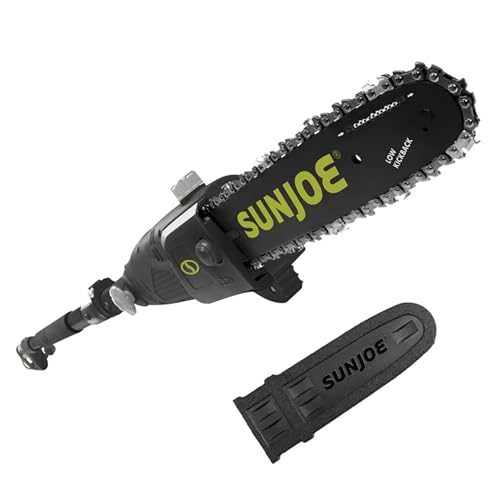
Best for a yard with a lot of branches and a nearby outlet
- 8-amp corded motor, no batteries to manage
- 10 in. Oregon bar and chain with auto-oiler
- Telescoping pole to roughly 14 ft of reach
- Multi-angle head for cutting across a limb
Why buy it: corded power means the last cut of the afternoon is exactly as strong as the first.

Best for trimming out of reach of any extension cord
- 40V battery and charger included
- 8 in. bar with tool-free chain tensioning
- Angled head for cleaner cuts under a limb
- Automatic bar and chain oiler
Why buy it: no cord to drag through a hedge, which is the difference between trimming the back fence and not bothering.

Best for a large property with mature trees and regular limbing work
- 56V system with a 2.5Ah battery and charger
- Telescopic carbon fiber shaft, lighter than steel
- 10 in. bar with high chain speed
- LED cut-line indicator for aiming the cut
Why buy it: the carbon fiber shaft is what makes an hour of overhead work possible rather than merely theoretical.

Best for anyone already invested in 20V MAX batteries
- Runs on existing 20V MAX batteries, no battery included
- 8 in. bar and chain, about 15 ft of reach
- Metal bucking strip for control on the cut
- Detachable pole for storage and transport
Why buy it: if you already own the batteries, this is the cheapest way into a genuinely capable cordless pole saw.

Best for tall hedges and high branches from one battery platform
- Pole saw plus a pole hedge trimmer head
- Shared 40V battery and charger
- Swap heads without tools
- One storage footprint instead of two
Why buy it: a tall hedge and a high branch are the same reach problem, and this solves both with one shaft and one battery.
Quick Comparison
| Product | Best for | Rating | Price | Buy |
|---|---|---|---|---|
| Fiskars 2-in-1 Extendable Tree Pruner and Pole Saw | Best Overall | — | Check (paid link) | |
| Sun Joe SWJ803E 10 in. 8-Amp Electric Multi-Angle Pole Chain Saw | Best Value Powered | — | Check (paid link) | |
| Greenworks 40V 8 in. Cordless Pole Saw with Battery and Charger | Best Cordless | — | Check (paid link) | |
| EGO Power+ PS1001 10 in. Cordless Pole Saw with Battery | Best Premium Cordless | — | Check (paid link) | |
| DEWALT DCPS620B 20V MAX Pole Saw, Tool Only | Best for DEWALT Battery Owners | — | Check (paid link) | |
| Greenworks 40V 8 in. Pole Saw with Hedge Trimmer Attachment | Best Multi-Tool | — | Check (paid link) |

How We Rank
We do not buy, test or physically handle these saws. We rank them by aggregating owner star ratings and review counts across the category, weighting recent reviews above launch-window ones, cross-checking reach, bar length, weight, voltage and oiler design against manufacturer specifications, and reading negative reviews closely for the problems that only appear once a tool has been held overhead for an hour.
Four things drive the order. Weight at full extension, because a pole saw that is comfortable at rest can be unusable at 12 feet — and it is the complaint that dominates negative reviews. Reach that is honest, meaning cutting height rather than pole length plus an optimistic arm. Reliability of the chain and oiler on powered models, since chains coming off the bar is the most common powered-pole-saw failure. And owner satisfaction weighted by review volume. Prices were checked at time of writing and move seasonally. Full method: how we rank.
The Pole Saws, Reviewed
1. Fiskars 2-in-1 Extendable — Best Overall
Covered above. Consensus Score ████████░░ 8.6. Strengths: two heads on one pole, no power source, light enough to control overhead, and a very large review base. Recurring complaints: the pull rope and its return spring are the parts most often reported failing, usually after several seasons. Sawing overhead by hand is genuinely tiring on anything much over three inches. Reviewers also note that the shaft flexes noticeably at full extension, which makes precise cuts harder at maximum reach.
2. Sun Joe SWJ803E — Best Value Powered
The sensible answer for a yard with real work in it. An 8-amp corded motor drives a 10-inch Oregon bar and chain with an automatic oiler, on a telescoping pole that reaches roughly 14 feet of cutting height. Corded power does not sag: the twentieth cut is exactly as strong as the first, which is emphatically not true of budget cordless tools.
Consensus Score ████████░░ 8.3 — owners rate power and price highly, cord management poorly
Recurring complaints: the cord, predictably — dragging an extension lead around a garden while managing a pole overhead is awkward, and several reviewers describe snagging it in shrubs. The chain coming off the bar is the most cited hardware issue, usually traced to tension not being checked before use. The oiler can leak in storage, so it should be stood on cardboard.
3. Greenworks 40V Cordless Pole Saw — Best Cordless
The value entry into cordless, and for many yards the practical winner. A 40V battery and charger are included, the 8-inch bar has tool-free tensioning, and the angled head lets you cut up under a limb rather than sawing awkwardly across it. Without a cord you can walk to the back fence, the far hedge or the neighbor's boundary without planning a route for an extension lead.
Consensus Score ████████░░ 8.2 — owners rate convenience highest, runtime most cautiously
Recurring complaints: runtime on the included 2.0Ah battery is the main one — enough for a session of light limbing, not for clearing a lot of storm damage, and owners doing heavy work buy a second battery. The plastic shaft flexes at full extension. Chain tension needs checking often, and reviewers report the chain derailing when it is not.
4. EGO Power+ PS1001 — Best Premium Cordless
The tool that makes overhead work sustainable. The telescopic shaft is carbon fiber rather than steel or plastic, which cuts a meaningful amount of weight from the end of a long lever — and weight at full extension is the thing that actually limits how long you can work. The 56V system drives a 10-inch bar at high chain speed, and an LED cut-line indicator helps you aim a cut you cannot see clearly from below.
Consensus Score ████████░░ 8.8 — the highest-rated powered saw here among owners with mature trees
Recurring complaints: price, by a wide margin — it costs several times the Sun Joe and buyers with a couple of small trees say so. It is still heavy at full extension despite the shaft, because the battery sits at the operator end. A minority report the oiler over-delivering and coating the shaft. It is a genuine step up in capability at a price that only makes sense on a large property.
5. DEWALT DCPS620B — Best for DEWALT Battery Owners
Sold as a bare tool, which is exactly right if there are already 20V MAX batteries in the garage. An 8-inch bar, around 15 feet of reach and a metal bucking strip that hooks the limb and gives you control while the chain works — a small feature that makes a real difference overhead. The pole detaches for storage and for fitting in a car.
Consensus Score ████████░░ 8.5 — rated very highly by existing DEWALT owners, poorly by those who missed that no battery is included
Recurring complaints: the tool-only listing catches people out, and buying a battery and charger separately changes the value calculation entirely. Runtime depends heavily on which battery you fit — a small pack is disappointing. Reviewers also note it is front-heavy compared with the EGO, and the chain tensioning system draws mixed comments.
6. Greenworks Pole Saw with Hedge Trimmer Attachment — Best Multi-Tool
A sensible package for a property with both tall hedges and high branches, since those are the same reach problem solved with different heads. One 40V battery, one shaft, two tool heads that swap without tools, and one thing to find space for in a shed rather than two.
Consensus Score ███████░░░ 7.9 — good ratings for versatility, mixed on each individual head
Recurring complaints: the usual compromise of multi-tools — neither head is quite as good as a dedicated tool, and reviewers describe the pole hedge trimmer in particular as heavy and awkward at full extension. Battery runtime is split across two demanding jobs. The head connection is the part most often reported developing play. Excellent value if you genuinely need both; a poor buy if you only need one.
How to Choose a Pole Saw
Start with how much cutting you have. A few branches a year is a manual pole saw — it is lighter, cheaper, silent, and it will work in five years without a thought. A dozen branches or a hedgerow is a powered saw, and the choice there is simply whether a cord can reach. If it can, corded is lighter, cheaper and never fades; if it cannot, cordless is worth the premium.
Then weigh the tool, not the specification. Every pole saw feels manageable in a store and heavy at full extension, because the pole is a lever and everything at the far end is multiplied. Shaft material matters more than most buyers expect — carbon fiber and aluminum shafts hold a line at 12 feet where a plastic shaft flexes and wanders. If you have shoulder or back trouble, buy for weight above all else.
Finally, buy the reach you need and no more. Extra pole length adds weight and flex on every single cut, and above about 15 feet of cutting height you are past the point where a homeowner can safely control the tool or predict where the limb goes. That is the line where hiring an arborist stops being an extravagance.

Where Pole Saws Stop Being Safe
Three rules cover nearly every serious accident in home pruning. Never use a pole saw from a ladder. The saw pushes back, the branch falls unpredictably, and the ladder has nowhere to go — this combination is responsible for a large share of the worst injuries in this category. If the branch is out of reach from the ground, it is out of scope.
Never cut anything near a power line. Aluminum and carbon fiber poles conduct, wet fiberglass conducts, and the required clearance is far greater than instinct suggests: OSHA requires unqualified people to stay at least 10 feet from overhead power lines, and work any closer than that is line-clearance work for a specially trained qualified worker. Utility lines are the utility's job or a qualified arborist's job, without exception.
Always plan where the limb goes. Look up, work out the fall path, and stand out of it — never directly beneath the cut. Wear a hard hat and eye protection, because sawdust falls straight into upturned faces and dead limbs shed debris before they let go — OSHA lists a hard hat, safety glasses, hearing protection, heavy gloves and cut-resistant chaps for chain saw work. Use the three-cut method set out by UW-Madison Extension on anything heavy so the limb cannot peel bark down the trunk as it falls.
What Owners Actually Complain About
Five complaints recur across manual and powered models alike. Weight and fatigue at full extension lead by a wide margin, and they are the main reason people stop using a pole saw they bought. Chains derailing is the top powered-tool complaint, and it is nearly always tension that was not checked before starting.
Shaft flex and wobble is third, worst on plastic-shafted budget tools at maximum reach. Oiler leaks are fourth and are mostly a storage nuisance rather than a fault. And rope and spring failure on manual pruner heads is fifth, appearing after several seasons and usually fixable with a replacement part. Choosing a lighter tool with a stiffer shaft, and checking chain tension every single time, removes most of the frustration in this category.
The Verdict
For most homeowners, the Fiskars 2-in-1 is the pole saw to buy — two heads, no power source, and always ready for a job you do three times a year. Lots of cutting and an outlet nearby? The Sun Joe SWJ803E is the best value in powered saws. Need to roam? The Greenworks 40V. Large property and mature trees? The EGO PS1001 is the one you can hold up all afternoon. Already own 20V MAX batteries? The DEWALT DCPS620B.
Check price on Amazon → (paid link)
Next: handle mid-size branches with best loppers, take on the thick ones with best pruning saws, shape the hedge with best hedge trimmers, or get the timing right with when to prune what: a calendar.