 Garden

Affiliate Disclosure
Some links on this page are affiliate links. As an Amazon Associate, we earn from qualifying purchases — at no extra cost to you. We do not buy, test, or physically handle the products we cover; our rankings come from aggregated owner reviews, ratings and expert consensus. Commissions never change our verdicts. How we rank · full disclosure.
The short answer: do not rely on a stake pushed into the bag. Loose potting mix in a fabric bag gives a stake almost nothing to grip, so a mature indeterminate tomato will lever it over in the first real wind. Instead, anchor the support outside the bag: drive a 6 to 8 ft stake into the ground beside the bag, tie the plant to a fence or trellis behind it, drop a string from an overhead beam, or use a cage whose legs rest on the ground and are pegged. Use a 10 to 20 gallon bag for the ballast, and tie loosely in a figure of eight with soft material.
The most common failure is a perfectly good tomato snapping at the stem in a July thunderstorm because the support was inside the bag rather than anchored to the earth. We do not physically handle the products we rank; our picks come from aggregated owner reviews and expert consensus, described in how we rank, with the ranked field in best grow bags.
Six methods that actually hold
| Method | Holds | Cost | Best when |
|---|---|---|---|
| Ground stake beside the bag | Excellent | $5 – $15 | Bag sits on soil, lawn or a bed |
| Tie to a fence, wall trellis or railing | Excellent | $0 – $25 | Bag is against a structure |
| Overhead string (Florida weave style) | Excellent | $5 | Greenhouse, pergola, balcony ceiling, deck beam |
| Cattle panel or arch trellis behind the bags | Excellent for a row | $30 – $90 | Three or more bags in a line |
| Heavy cage with legs pegged into the ground | Good | $15 – $40 | Patio edge where you can peg through |
| Three stakes tripod-style through the bag base | Fair — the best of the in-bag options | $10 – $20 | Hard surface with no way to anchor |
If the bag has to stand on concrete with no anchor point, the tripod is the answer: three 6 ft bamboo or steel stakes pushed right through the bottom fabric at an angle so they splay outward, tied together at the top. The triangulation resists the pivot that kills a single vertical stake. Even then, weight the base — a paver or two laid on the bag edges, or filling the bottom 2 in with gravel — adds meaningful ballast.
Setting it up
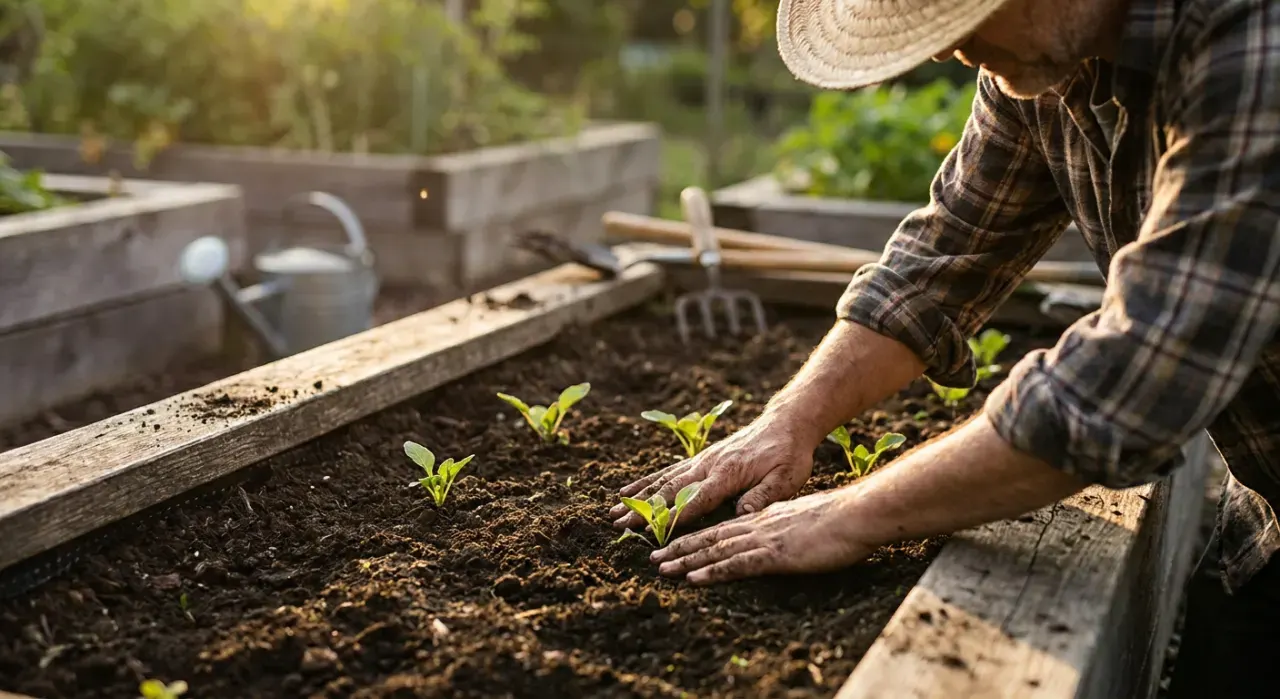
- Choose the bag size first. Ten gallons minimum for indeterminate varieties, 15 to 20 gallons preferred. A 20-gallon bag of damp mix weighs 80 to 120 lb, which is ballast a 5-gallon bag simply does not have.
- Put the support in before or at planting. Driving a stake through an established root ball in July cuts roots and checks the plant for a week. Set it on day one.
- Drive the ground stake 12 to 18 in deep, 3 to 6 in outside the bag rim, angled very slightly toward the plant. Use a 1 in diameter or 2x2 wooden stake, or 1/2 in steel electrical conduit, at 6 to 8 ft above ground for indeterminates and 4 ft for determinates.
- Plant deep. Bury the bottom third to half of the transplant stem — tomatoes root along buried stem, which builds a stronger anchor and a bigger root system. Strip the leaves that would be underground.
- Start tying at 8 to 10 in of growth and add a tie every 8 to 12 in as the plant climbs.
- Tie figure-of-eight, loose on the stem. Snug loop around the stake, open loop around the stem with room for a finger. Soft cloth strips, garden velcro or soft twine only — never wire or zip ties.
- Loosen and check ties every two to three weeks. Stems can double in diameter over a season and a June tie girdles by August.
- Prune indeterminates to one or two leaders, removing suckers weekly. It halves the wind load and improves airflow. Leave determinates alone beyond the lowest leaves.
- Site the bag out of the worst wind — against a wall or fence on the prevailing side. This does more than any hardware.
Match the support to the variety
Half the staking problem is solved at the seed catalog stage, because the two tomato growth habits make completely different demands.
| Determinate (bush) | Indeterminate (vining) | |
|---|---|---|
| Final height | 3 – 4 ft | 6 – 10 ft |
| Growth habit | Stops at a set size, fruits over 3 to 4 weeks | Grows until frost, fruits continuously |
| Bag size | 7 – 10 gal | 15 – 20 gal |
| Support needed | A 4 ft cage or single stake | 6 to 8 ft anchored stake, string or trellis |
| Pruning | Lowest leaves only | Prune to 1 to 2 leaders, remove suckers weekly |
| Wind risk in a bag | Low | High — this is where bags tip |
If a grow bag on a windy balcony or an exposed patio is what you have, choosing a determinate or a compact dwarf variety removes most of the problem before it starts. The label wording to look for is bush, patio, container or determinate; anything described as vining, cordon or indeterminate will need the full anchored setup.
For indeterminates, the string method deserves more attention than it gets among container growers. Drop a length of soft twine from an overhead beam, pergola rafter or a horizontal wire, tie it loosely to the base of the stem or to a stake pushed just into the mix, and wind the growing stem around the string every few days as it extends. The load goes straight up into the structure rather than into the bag, there is nothing to blow over, and it costs a few dollars. It is how commercial greenhouse tomatoes are grown, and it scales down to a patio perfectly well.
What goes wrong
| Problem | Cause | Fix |
|---|---|---|
| Whole bag tips in wind | Bag too small and too light; no external anchor | Move up to 15 to 20 gal; anchor to ground or structure; add pavers on the base |
| Stake leans progressively | Stake set only in the potting mix | Replace with a ground-driven stake outside the bag |
| Stem snaps at a tie point | Tie too tight, or too few ties spaced too far apart | Ties every 8 to 12 in, loose loops, wide soft material |
| Stem shows a girdled scar | Tie not loosened as the stem thickened | Check ties fortnightly through the season |
| Plant flops between ties despite support | Truss weight on an unpruned indeterminate | Prune to one or two leaders; support heavy trusses individually |
| Bag dries out and the plant wilts under load | Bag too small for the plant | Larger bag next season; mulch the surface; consider a saucer |
Fabric grow bags dry faster than plastic pots because they breathe through the sidewalls, and a wilting plant is both more vulnerable to wind damage and more likely to drop blossoms. A 2 in mulch layer on the bag surface, and a saucer under it in the hottest weeks, both help — the trade-off is in do grow bags need saucers.
For sizing, what size grow bag for tomatoes and how many tomato plants in a grow bag settle the two questions that most affect whether staking is even manageable. Fill guidance is in what to fill grow bags with, the comparison in grow bags vs plastic pots, and everything else at the raised beds and planters hub.