 Garden

Affiliate Disclosure
Some links on this page are affiliate links. As an Amazon Associate, we earn from qualifying purchases — at no extra cost to you. We do not buy, test, or physically handle the products we cover; our rankings come from aggregated owner reviews, ratings and expert consensus. Commissions never change our verdicts. How we rank · full disclosure.
Fill grow bags with a soilless container mix, never garden soil or topsoil. The blend that performs most reliably is roughly 60 percent quality potting mix, 30 percent finished compost and 10 percent perlite or pine bark fines by volume, with a slow-release granular fertilizer stirred through at the label rate. That combination stays loose under repeated watering, drains at the rate fabric expects, and holds enough moisture that a 10-gallon bag does not need watering twice a day in July. Garden soil in a bag compacts into a brick within weeks.
What are the actual proportions?
| Component | Share by volume | What it does |
|---|---|---|
| Peat or coco coir based potting mix | 60% | Water holding and structure |
| Finished compost | 30% | Nutrition and biology |
| Perlite, pumice or pine bark fines | 10% | Air space, prevents compaction |
| Slow-release granular fertilizer | Per label | Sustained feed through the season |
| Garden soil or topsoil | 0% | Compacts, carries weed seed and disease |
Push the aerating fraction to 20 percent for tomatoes, peppers and anything grown in a hot southern summer where you will be watering daily. Drop the compost to 20 percent for herbs and Mediterranean plants such as rosemary and lavender, which resent a rich, moisture-retentive mix.
Why does garden soil fail in a fabric bag?
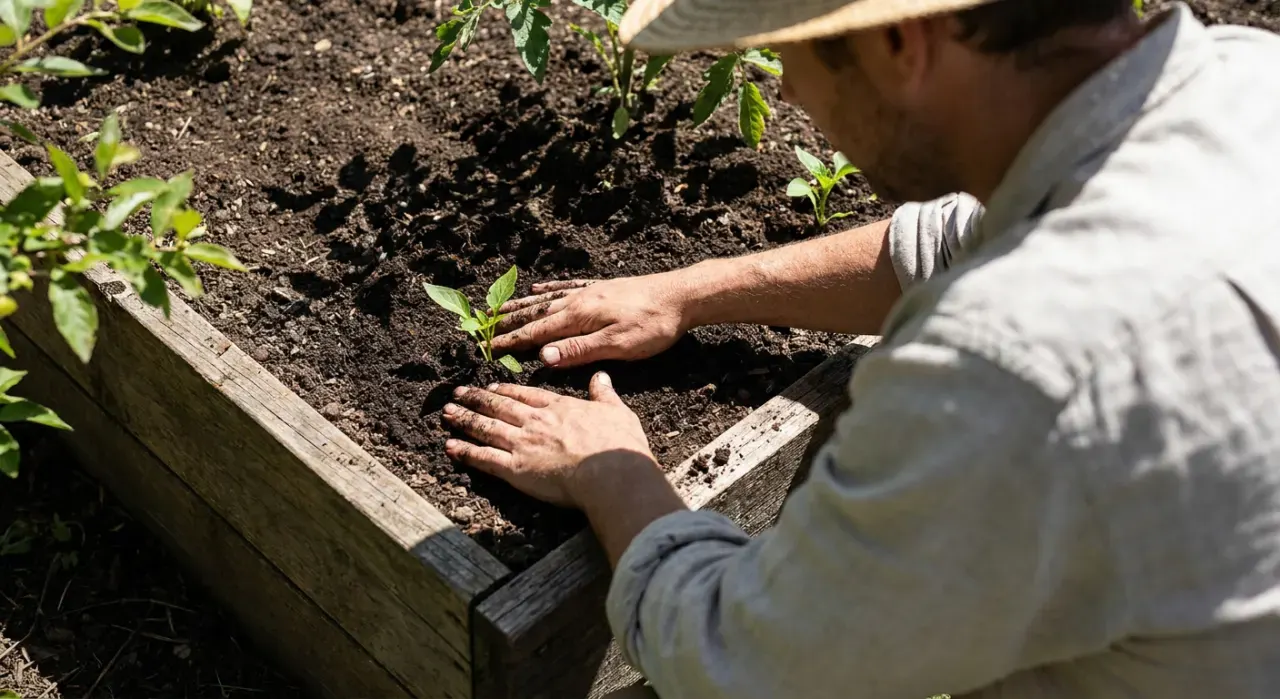
Structure. Field soil holds its air space because of aggregates built by roots, fungi and soil fauna over years, and because it sits in a continuous profile where water can keep moving downward. Lift the same soil into a container and you destroy the aggregates in the shoveling, remove the continuity, and then compact what is left with every watering. Within a few weeks the mineral particles settle into a dense mass with almost no air-filled pore space, and roots in a waterlogged, oxygen-poor mix cannot take up nutrients even when the nutrients are present.
Extension horticulture programs make this point consistently in their container gardening guidance: potting mixes are engineered to hold air at container depth, and soil is not. There is a second, more practical reason too. Garden soil brings weed seed, and it can bring soilborne disease, which in a bag has nowhere to go.
How much do you need to buy?
Work in cubic feet, because that is how mix is sold. A rough conversion: 7.5 gallons is 1 cubic foot. So a 5-gallon bag takes about two thirds of a cubic foot, a 10-gallon bag about 1.3, and a 15-gallon bag about 2. A row of six 10-gallon tomato bags therefore needs about 8 cubic feet, which is four standard 2-cubic-foot bales. Mix settles noticeably after the first two or three waterings, so fill to the rim and plan to top up with an inch of compost once the bag has settled.
How do you keep the cost down?
Buying bulk potting mix by the bale rather than in small retail bags cuts the price per cubic foot substantially, and making your own compost fraction removes the most expensive third of the recipe. What does not work is bulking the mix out with cheap filler at the base: in a bag you are paying for root volume, and giving up four inches of it to wood chips costs more in yield than it saves in mix. The same argument, applied to much larger volumes where it does start to make sense, is in the cheapest way to fill a raised bed.
For crop-specific volume, see what size grow bag for tomatoes, and for the bags themselves our best grow bags roundup ranks the fabrics owners report holding their shape when filled with a heavy, well-watered mix.
We never buy, test or physically handle the products we rank. Recommendations come from aggregated owner reviews, star ratings, review volume and expert consensus — see how we rank.
More from this hub: Raised Beds & Planters · Best grow bags · Best soil mix ratio · Are grow bags reusable · How we rank