 Garden
Affiliate Disclosure
Some links on this page are affiliate links. As an Amazon Associate, we earn from qualifying purchases — at no extra cost to you. We do not buy, test, or physically handle the products we cover; our rankings come from aggregated owner reviews, ratings and expert consensus. Commissions never change our verdicts. How we rank · full disclosure.
The short version: after weighing six popular vertical garden planters on aggregated owner ratings, review volume and the complaints that repeat across listings, our #1 pick is the GreenStalk Original 5-Tier. It holds roughly 4.7 stars across 2,500-plus ratings, fits 30 plants into about two square feet of floor, and its internal watering column fixes the flaw that frustrates owners of every cheap stacking tower — the top tier baking dry while the bottom sits waterlogged. Below is the ranked field, the real gripes, and a comparison table.
Before you buy, check your sun. A tower is only as good as the light hitting it, and the lower tiers get less than the top — the counting method is in how much sun a balcony really gets.
Top Picks at a Glance
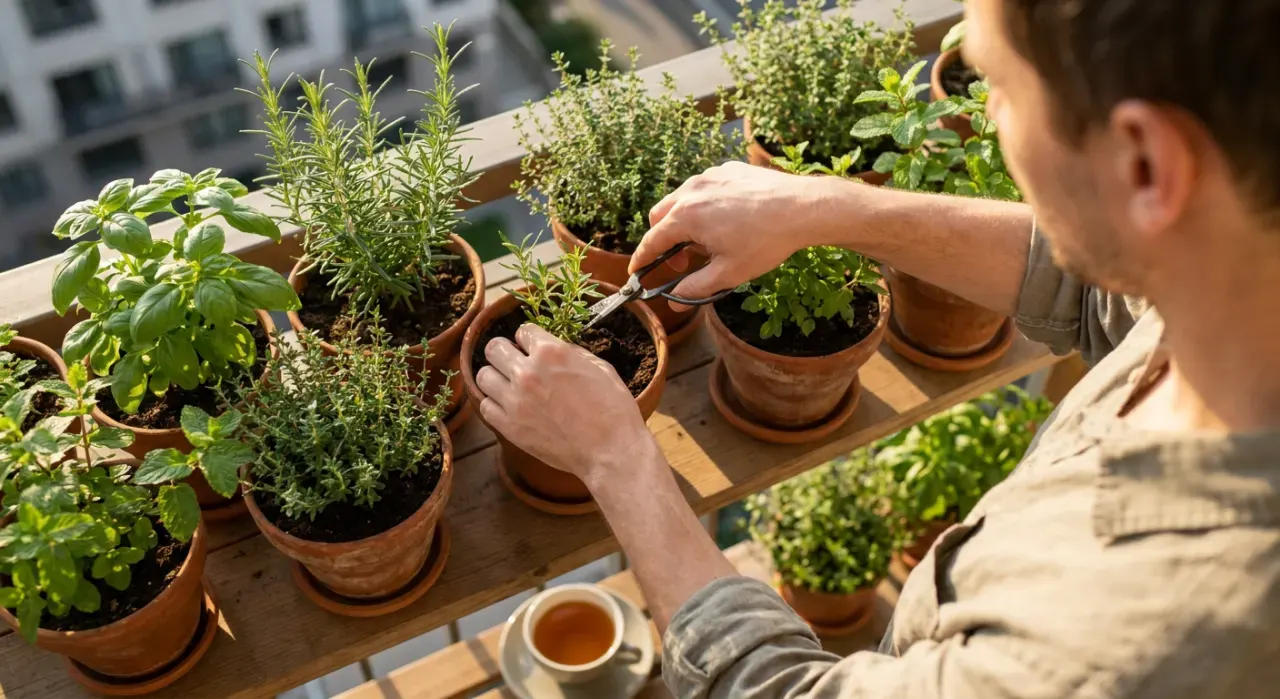
Our #1 Pick: GreenStalk Original 5-Tier Vertical Planter
Every stacking planter promises the same thing — a lot of plants in very little floor space — and almost all of them share the same failure. Water poured into the top runs down the outside of the soil column, so the upper pockets dry out while the lower ones stay saturated, and you end up with a tower that is half-thriving and half-dead by August.
GreenStalk's answer is a patented internal watering column: you fill a central reservoir at the top and water distributes outward into each tier rather than cascading down the stack. Across more than 827 owner ratings, that single design decision is what owners return to again and again — reviewers describe filling it once a day in high summer, once every two or three days in mild weather, and getting even growth from top pocket to bottom.
The rest is well made rather than clever. Thirty planting pockets sit in about two square feet of floor. The plastic is thick, UV-stable, food-grade and BPA-free, and it is manufactured in the USA — owners four and five seasons in report no cracking or fading, which is not the norm in this category. Tiers are sold individually, so you can add height later or split a tall tower into two shorter ones for a low-ceilinged balcony.
Consensus Score ███████████░ 9.2 — from 827 owner ratings.
The honest caveats: it is expensive for a planter, the pockets are shallow enough that deep-rooted crops underperform (buy the deeper Leaf model at #4 for those), and a fully planted, watered five-tier tower is heavy and awkward to move — most owners add the optional rotating base rather than try to turn it by hand.
Check price on Amazon → (paid link)
Best Vertical Garden Planters 2026: The Ranked Field

Best for anyone who wants a vertical garden that waters evenly
- 30 planting pockets in about 2 sq ft of floor
- Patented internal watering column feeds every tier
- UV-stable, food-grade BPA-free plastic
- Made in the USA, tiers sold separately to expand
Why buy it: the internal watering column solves the one problem that ruins every other stacking tower — the top tier drying out while the bottom sits soggy.
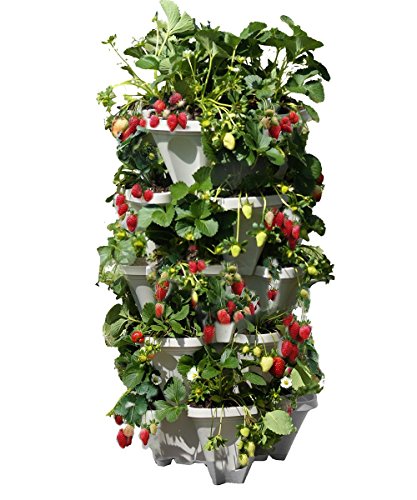
Best for strawberries, herbs and lettuce on a tight budget
- 5 stacking pots, 20 planting pockets
- Food-safe, UV-protected polypropylene
- Lightweight enough to move when planted
- Works with soil or hydroponic media
Why buy it: a tenth the price of the premium towers and still gets twenty plants into two square feet — the cheapest real entry into vertical growing.
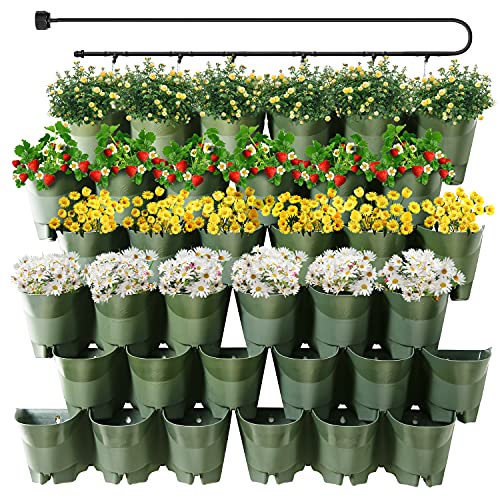
Best for narrow balconies with a usable wall and no floor space
- 36 pockets across modular wall panels
- Built-in drip irrigation with 9 ft hose kit
- Each pot has its own drainage and overflow
- Indoor or outdoor mounting
Why buy it: the drip line does the watering, which is what makes a wall of 36 small pots survivable rather than a daily chore.
Best for deeper-rooted crops — tomatoes, peppers, root vegetables
- Extra-deep tiers for larger root runs
- 24 large planting pockets
- Same internal watering column system
- Rotating base available separately
Why buy it: the deep-pocket version — the only tower here in which a full-size pepper or determinate tomato genuinely performs.

Best for bigger plants and a taller, more stable tower
- 18 in diameter pots, roughly 64 qt total capacity
- About 16 in × 16 in × 38 in assembled
- Thicker walls than the standard Mr. Stacky
- Made in the USA, food-safe and UV-protected
Why buy it: far more soil volume per tier than the small stackers, which means less frantic watering and bigger plants.

Best for herbs, salad and a first try at a green wall
- 9 breathable felt pockets in a 3 × 3 grid
- Hangs from hooks, screws or a fence rail
- Rolls up flat for storage or moving
- Indoor or outdoor use
Why buy it: twenty dollars to find out whether you like vertical growing, and it folds into a drawer if you do not.
Quick Comparison
| Product | Best for | Rating | Price | Buy |
|---|---|---|---|---|
| GreenStalk Original 5-Tier Vertical Planter | Best Overall | — | Check (paid link) | |
| Mr. Stacky 5-Tier Vertical Gardening Planter | Best Value | — | Check (paid link) | |
| Worth Garden 36-Pocket Self-Watering Vertical Wall Planter | Best Wall-Mounted | — | Check (paid link) | |
| GreenStalk Original Leaf 4-Tier Vertical Planter | Best Premium | — | Check (paid link) | |
| Mr. Stacky Large 18 in Stackable Planters, 5-Pack | Best Heavy-Duty Stackable | — | Check (paid link) | |
| Felt 9-Pocket Wall-Mount Vertical Planter Bag | Best Cheap Wall Pockets | — | Check (paid link) |
The Numbers Side by Side
| Planter | Type | Pockets | Floor space | Watering | Best crops |
|---|---|---|---|---|---|
| GreenStalk Original 5-Tier | Stacking tower | 30 | ~2 sq ft | Internal column, top fill | Strawberries, greens, herbs |
| Mr. Stacky 5-Tier | Stacking tower | 20 | ~1.5 sq ft | Top pour, manual | Strawberries, lettuce, herbs |
| Worth Garden 36-Pocket | Wall panel | 36 | None (wall) | Drip irrigation kit | Herbs, salad, trailing flowers |
| GreenStalk Leaf 4-Tier | Deep stacking tower | 24 | ~2.5 sq ft | Internal column, top fill | Peppers, bush tomatoes, roots |
| Mr. Stacky Large 18 in 5-Pack | Stacking tower | 20 large | ~1.8 sq ft | Top pour, manual | Bigger vegetables, flowers |
| Felt 9-Pocket Wall Bag | Wall pockets | 9 | None (wall) | Hand water each pocket | Herbs, salad greens |
How We Rank
We do not buy, test or physically handle any of these planters, and we would rather state that than dress a spec sheet up as experience. Instead we read the category the way a careful shopper would with a week to spare: aggregate star ratings and review volume for every listing, then work through the critical reviews specifically. Vertical planters fail in season two, not week one — plastic goes brittle, pockets crack, drip lines clog — so long-term reviews carry disproportionate weight in our ranking.
Four factors decide the order. Water distribution — the defining problem of the format, and the single biggest predictor of whether an owner is still using the thing a year later. Soil volume per pocket, because shallow pockets limit both what you can grow and how long a plant lasts between waterings. Material durability under UV, freeze and repeated planting. And value per plant site, adjusted for realistic lifespan. Prices were checked at time of writing and change constantly. Full method: how we rank.
What Owners Actually Complain About
This category generates specific, repeated criticism, and knowing it in advance is most of the battle.
Uneven watering in plain stacking towers. The dominant complaint about the Mr. Stacky designs: water poured into the top pot runs down the outside rather than through, so the middle tiers stay dry and the bottom pot floods. Owners work around it by watering each tier individually or by dropping a length of perforated PVC down the center — an effective but fiddly DIY fix that the GreenStalk design makes unnecessary.
Shallow pockets limiting plant choice. Across every tower here, reviewers who tried full-size tomatoes, carrots or squash report disappointment. The pockets simply do not hold enough soil. Owners who stuck to strawberries, greens and herbs are overwhelmingly happy; those who expected a vegetable garden in a column are not.
Drip lines clogging and leaking. On the Worth Garden wall system, the irrigation kit draws mixed reviews — emitters block with sediment, and several owners report joints weeping onto the wall below. Running it off filtered water and flushing the line each season addresses most of it, but plan for maintenance.
Wind toppling planted towers. A recurring balcony problem, particularly with the lighter Mr. Stacky pots. A tall tower with a small base is unstable once plants add sail area. Owners solve it by weighting the bottom pot with gravel, strapping the tower to a rail, or siting it against a wall.
Felt pockets drying and staining. The cheap fabric wall planters dry out very fast in sun and wind, and mounted on a painted wall or fence they leave watermarks. Most owners who love theirs use them in part shade for herbs and salad, and hang them where drips do not matter.
How to Choose a Vertical Planter
Work backward from your constraint. Floor space but no time? A self-watering tower — the GreenStalk — is the only design here that tolerates a missed day in July. Tight budget? The Mr. Stacky 5-tier is genuinely good value if you accept the manual watering routine. No floor at all? A wall system is your only option, and the drip-fed Worth Garden panel is far more sustainable than 36 pockets watered by hand. Want to grow more than herbs and berries? Buy deep tiers — the GreenStalk Leaf or the large 18-inch Mr. Stacky pots. Just testing the idea? Spend twenty dollars on a felt pocket panel first.
Two practical points nearly everyone gets wrong. Use bagged potting mix, never garden soil — a tower packed with heavy soil compacts, drains badly and becomes almost impossible to move. Illinois Extension makes the same point about containers generally: garden soil used by itself so badly impedes drainage and aeration that plants grow poorly or not at all. And plan for weight: wet mix runs roughly 15 to 20 pounds per gallon, so a full five-tier tower can exceed 200 pounds. Keep it near a wall rather than out at the rail, and check the guidance in the balcony garden starter guide before loading up a rented balcony.
What Separates a Good Vertical Planter From a Cheap One
Vertical planters look interchangeable in a listing photo and diverge sharply after one summer. Four things explain the gap.
How water reaches every tier. This is the defining specification of the format, and it is the one most listings gloss over. In a plain stacking tower, water poured into the top pot follows the path of least resistance — down the outside of the soil column and out of the bottom — so the middle tiers receive very little. Designs with an internal watering column, a wicking core or a drip line distribute instead of cascade. If a planter has no distribution mechanism at all, you are signing up to water each tier individually, every day, in July.
Soil volume per pocket. Every problem in a vertical garden gets worse as pocket size shrinks: less water buffer, faster nutrient exhaustion, smaller root systems and a narrower list of crops that will work. The premium towers cost more largely because their tiers hold more mix, and that single difference is what lets a pepper perform in one and sulk in another. Read the stated capacity in quarts, not the pocket count.
Plastic quality and UV stability. These structures live in full sun and hold wet soil, which is a punishing combination. Food-grade, UV-stabilized plastic keeps its color and flexibility for years; cheap polypropylene fades, goes brittle and cracks at the rim in season two or three. In the critical reviews for this category, cracking is the most common second-year failure, and it is almost always a material question rather than a design one.
Stability under load. A tall tower planted out is a sail. Wide, weighted bases and interlocking tiers stay put; narrow bases with loosely stacked pots topple in the first real gust, usually taking the plants with them. Look for interlocking geometry, a base you can ballast with gravel, or an explicit fixing point.
What matters less: pocket count, color options and bundled accessories. Buy for water distribution, soil volume, plastic quality and a stable base — everything else is decoration.
Mistakes That Kill a Vertical Garden
Five errors account for most failures. Watering only the top — in a plain stacking tower, that leaves the middle permanently dry; water each tier or buy a design with an internal column. Planting crops that do not fit — tomatoes, carrots and squash need depth a pocket cannot give. Ignoring the shade gradient — the top tier shades the ones below, so put sun-lovers up high and greens down low, and rotate the tower weekly. Filling it with garden soil — it compacts into a dense, airless mass and doubles the weight; NC State Extension recommends a soilless substrate instead, since field soils retain too much water, have too little pore space and can harbor disease, insects and weeds. And forgetting to feed — small soil volumes exhaust fast, so a slow-release granular feed at planting plus a diluted liquid feed every two weeks is not optional in a tower.
The Verdict
If you can spend it, the GreenStalk Original 5-Tier is the planter owner reviews back most strongly — even watering, durable material, and thirty plants in two square feet. If you cannot, the Mr. Stacky 5-Tier at around a tenth of the price gets you into vertical growing today, provided you accept a more attentive watering routine. Wall-only space points you at the Worth Garden drip panel, and twenty dollars on a felt pocket set is a perfectly sensible way to find out whether the format suits you at all.
Next: match crops to container depth with container sizes by crop, cut the watering workload with best self-watering container pots, or head back to the vertical and small-space gardening hub for the full map.
Check the current price of our top pick on Amazon → (paid link)