 Garden

Affiliate Disclosure
Some links on this page are affiliate links. As an Amazon Associate, we earn from qualifying purchases — at no extra cost to you. We do not buy, test, or physically handle the products we cover; our rankings come from aggregated owner reviews, ratings and expert consensus. Commissions never change our verdicts. How we rank · full disclosure.
Tool boxes fail at the latch and the handle, in that order — so judge those two things and ignore almost everything else. Read a few hundred owner reviews across this category and the pattern is monotonous: molded plastic latch tabs snap, the hinge pin works out of a plastic boss, and the handle splits where it meets the shell. Nobody complains about the box floor. Nobody complains about the volume. They complain about the four square inches of plastic that hold it shut and the two that hold it up.
That is why the highest-rated boxes in the category are the ones with metal-reinforced latches, and why a $30 steel box outlives a $30 plastic one carrying the same tools. It is not a subtle effect and it is visible in the ratings.
Top Picks at a Glance
The Four Things That Break
| Part | How it fails | What to look for instead |
|---|---|---|
| Latches | Molded plastic tabs crack, usually in cold weather | Metal-reinforced latches, or a steel draw latch |
| Handle | Splits at the boss where it meets the shell, under load | Steel handle, or a molded handle spanning the full lid |
| Hinge | Pin migrates out of a plastic boss; lid goes floppy | Metal pin through a reinforced hinge, or a full-length hinge |
| Lid seal | None, so the box fills with sawdust and rain | A stated lid gasket or a deep overlapping lip |
One more thing worth checking on any box that will live outside a house: a padlock eye. It is cheap to mold or weld and a surprising number of boxes omit it. A padlock on a tool box is not security — the shell can be cut and the lid pried — but it stops a child, a curious visitor and an opportunist reaching in, which is usually the actual requirement.
Weight, Honestly
Buyers routinely load a box past what its body was designed to carry and then blame the plastic. These are rough figures for what a full kit weighs.
| Kit | Approx. loaded weight | Right container |
|---|---|---|
| Basic household kit — hammer, drivers, pliers, tape, level | 12–18 lb | 16 in plastic box or a 15 in bag |
| Household kit plus a cordless drill and two batteries | 22–30 lb | Extra large box or a hard-bottom bag |
| Socket set, wrenches, ratchets, extensions | 40–60 lb | Steel box, or split across two boxes |
| Full mechanic kit | 80 lb and up | A chest, not a box — see our chest picks |
Once you are past about 45 lbs, a single carried box is the wrong tool regardless of what it is made of, because the limiting factor becomes your back and one narrow handle. That is the point at which a rolling modular system or a drawer chest earns its price — see our tool chest picks and rolling tool chests.
Our #1 Pick: DEWALT TSTAK Extra Large
This is the highest-rated tool box on the US market across an owner base large enough that its failure modes are thoroughly documented, and what that record shows is a box that mostly does not fail. The latches are metal reinforced rather than molded tabs, the lid has a genuine seal against water and debris, and the removable tray over a deep well is the right internal geometry — small things visible on top, bulky things underneath.
The other half of the argument is the system. A TSTAK box latches to other TSTAK boxes, so the same $60 purchase is a standalone box today and the top of a stack later. That matters because the way tool storage actually grows is by job — a plumbing case, an electrical case, a bike case — rather than by buying one bigger box.
Owner complaints are modest and specific. It is bulkier than the internal volume implies, because the stacking geometry costs space. The removable tray is shallow, so anything taller than a socket rail goes underneath. And the latches, while far better than average, are still the part that eventually needs care — owners who force a closed latch on an overfilled box are the ones who report breaking one. Do not overfill it and it will outlast several cheaper boxes.
Check price on Amazon → (paid link)
The Ranked Field

Best for one box that holds a homeowner tool kit and still latches in five years
- Removable tray over a deep well
- Metal-reinforced latches rather than molded plastic tabs
- Stacks and locks to the wider TSTAK system
- Water and debris resistant lid seal
Why buy it: the highest-rated tool box on the US market across an enormous owner base, and the reason is the one part everybody else cheapens — the latches.
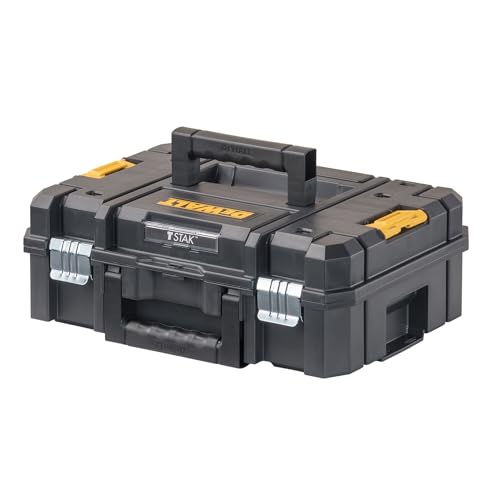
Best for a second box for one job — plumbing, electrical, a bike kit
- 13 in flat-top case that becomes a base for another module
- Deep single compartment with a removable tray
- Same metal-reinforced latches as the larger TSTAK boxes
- Side handles for carrying a stack
Why buy it: sorting tools by job rather than by type is the change that actually saves time, and cheap modular cases are how you do it without buying a chest.

Best for wrenches, sockets and anything heavy enough to crack plastic
- Steel body with a hip-roof lid and a lift-out tray
- Metal draw latch and a padlock eye
- 16 in length with a folding steel handle
- Powder-coat finish
Why buy it: steel does not fail at the handle boss, which is where every loaded plastic tool box eventually splits — and the padlock eye means it can actually be locked.
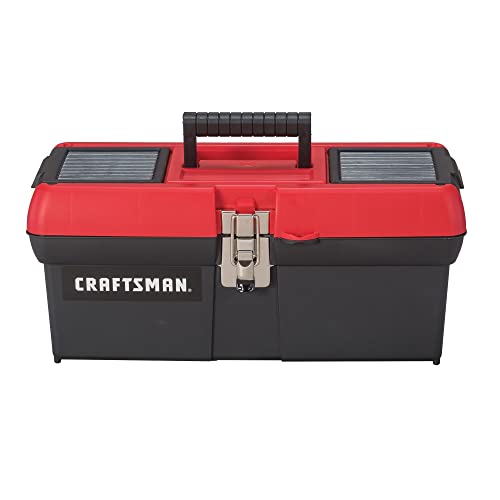
Best for a first tool box, a car box, or one per floor of the house
- 16 in structural resin body with a removable tray
- Padlock eye for a small padlock
- Molded side handles plus a top handle
- Water-resistant lid lip
Why buy it: cheap enough to own three, which beats one big box you have to carry everywhere — and the padlock eye is unusual at this price.

Best for a homeowner kit that gets carried up stairs and around a house
- 16 external and internal pockets
- Reinforced hard bottom that keeps its shape
- Wide open mouth with a full-length zipper
- Padded shoulder strap plus grab handles
Why buy it: a bag beats a box for household work because everything is visible at once — the reason a tool box gets emptied onto the floor is that the tools are stacked, not stored.

Best for a genuine kit that has to move between a garage, a vehicle and a job
- Rolling base with large wheels and a telescoping handle
- Impact-resistant polymer with IP65 sealing
- Stacks and latches with the wider PACKOUT range
- Stated capacity of 250 lb across the stack
Why buy it: the highest-rated modular system on the market, and the only approach here that scales — you buy one base and add cases as the kit grows instead of replacing the box.
Quick Comparison
| Product | Best for | Rating | Price | Buy |
|---|---|---|---|---|
| DEWALT TSTAK Extra Large Tool Box with Removable Tray, Water and Debris Resistant | Best Overall | — | Check (paid link) | |
| DEWALT TSTAK II 13 in Flat Top Tool Storage Case, Stackable Organizer | Best Small Stackable | — | Check (paid link) | |
| BIG RED 16 in Hip Roof Portable Steel Tool Box with Metal Latch | Best Metal | — | Check (paid link) | |
| CRAFTSMAN 16 in Lockable Tool Box with Removable Tray | Best Budget | — | Check (paid link) | |
| UUP 15 in Heavy Duty Tool Bag with 16 Pockets and Hard Bottom | Best Tool Bag | — | Check (paid link) | |
| Milwaukee PACKOUT Rolling Modular Stackable Tool Box Storage System | Best Modular System | — | Check (paid link) |
The Field, Reviewed
1. DEWALT TSTAK Extra Large — Best Overall
Covered above. Owners praise: latch quality, the lid seal, the tray-over-well layout, and stacking with the wider system. Owners gripe about: external bulk relative to internal volume, a shallow tray, and latches that suffer if the box is overfilled. Check price (paid link).
2. DEWALT TSTAK II 13 in — Best Small Stackable
The one to buy second. A flat-top case becomes the base for another module, which is how you end up sorting by job instead of by tool type — and sorting by job is the change that actually saves time on a household repair.
Owners praise: the same latches as the larger boxes, the flat top for stacking, and a deep compartment for its footprint. Owners gripe about: the tray is small, the flat lid means nothing tall fits under it, and the system encourages buying more. Check price (paid link).
3. BIG RED 16 in Steel Hip Roof — Best Metal
The traditional shape, and it persists because it works. Steel does not split at the handle boss, the hip-roof lid gives clearance for a taller tool, the draw latch is metal, and there is a padlock eye. For sockets, wrenches and anything with real mass, this is the more durable $30 than any plastic equivalent.
Owners praise: durability under weight, the metal latch, the padlock eye, and the lift-out tray. Owners gripe about: it rusts at chips and scratches, no lid seal so it takes in dust, and the folding handle is uncomfortable when fully loaded. Check price (paid link).
4. CRAFTSMAN 16 in Lockable — Best Budget
The right answer for a first box, a box for the car, or a box per floor of a house. Structural resin body, removable tray, side and top handles, and a padlock eye at a price where most boxes have neither the eye nor the tray.
Owners praise: the price, the padlock eye, the tray, and that it survives normal household use. Owners gripe about: molded latches are the weak point, it flexes noticeably when heavily loaded, and the handle is the part that will eventually give. Check price (paid link).
5. UUP 15 in Heavy Duty Tool Bag — Best Tool Bag
For household work a bag genuinely beats a box, and this is the highest-rated example. Sixteen pockets hold tools upright and visible, the reinforced hard bottom stops the bag collapsing into a sack, and the wide zippered mouth means you can see the whole contents at once instead of digging through layers.
Owners praise: the pocket count, the hard bottom holding its shape, the shoulder strap, and that nothing gets lost at the bottom. Owners gripe about: no weather protection, the zipper is the wear point, and sharp tools will eventually cut through a pocket. Check price (paid link).
6. Milwaukee PACKOUT Rolling System — Best Modular System
The most capable option here and the most expensive. A rolling base with large wheels and a telescoping handle, IP65 sealing, and a latching system that holds a stack together over rough ground. Buy it if the kit is large and genuinely mobile; skip it if the tools live on a bench.
Owners praise: build quality, the latching, the wheels on rough surfaces, and that it scales by adding cases. Owners gripe about: price, weight of the base itself, and the same system lock-in every modular range creates. Check price (paid link).
Organize by Job, Not by Tool Type
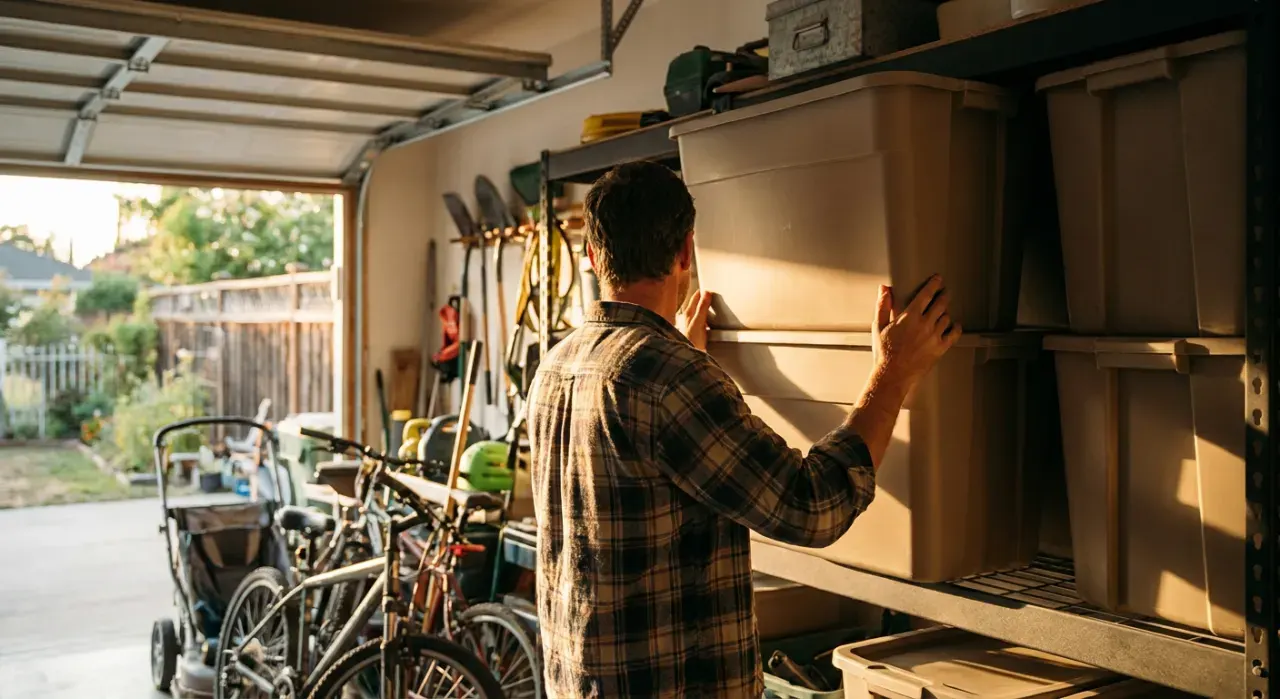
The single change that makes tool storage work is counterintuitive: stop sorting by category and sort by task. A drawer of screwdrivers is tidy and useless. A small box containing everything needed to fix a running toilet — adjustable wrench, channel locks, a flapper, plumber tape, a rag — gets you to the bathroom in one trip.
- House box — hammer, drivers, tape measure, level, utility knife, pliers, a small assortment of fasteners.
- Drill box — cordless drill, two batteries, charger, driver bits, drill bits, anchors.
- Plumbing box — adjustable wrench, channel locks, plumber tape, spare flapper and washers, a basin wrench.
- Electrical box — voltage tester, wire strippers, linesman pliers, wire nuts, electrical tape, a headlamp.
- Vehicle box — a socket set, tire gauge, jumper cables, gloves, a flashlight. Steel, and leave it in the trunk.
Five inexpensive boxes are more useful than one expensive one, and this is where cheap modular cases pay for themselves.
What Owners Actually Complain About
Latches. The defining complaint of the category. Molded tabs crack, especially in cold, and especially when the box is overfilled so the lid has to be forced.
Handles. Second place. Split at the boss under load, on plastic boxes carrying metal tools.
Hinge pins. Work loose from plastic bosses and the lid goes floppy. Metal-pinned hinges avoid it.
No lid seal. Boxes stored in a garage or a truck bed fill with dust, sawdust and water. A gasket or a deep overlapping lip is worth paying for.
Trays that do not fit anything. Shallow trays and tall tools. Check the tray depth against your longest driver before assuming it solves your organization problem.
How We Rank
We do not buy or load these boxes. Rankings come from aggregated owner ratings across the most-owned tool boxes and bags on the US market, weighted toward reviews written after months of use where latch, hinge and handle failures appear, and cross-checked against published specifications. Four things carry the weight: latch construction, since it is the documented first failure; handle and hinge design; weather sealing, because a box in a garage or a truck bed takes in everything; and internal geometry, meaning whether the tray and well arrangement matches real tools rather than a rendering. Prices were checked at the time of writing. Full method: how we rank.
The Verdict
Buy the DEWALT TSTAK extra large as the one box to own, and add the TSTAK II 13 in when you want to split tools by job. Choose the BIG RED steel box instead if the load is sockets and wrenches, because steel does not split at the handle. For general work around a house the UUP tool bag is genuinely the better tool. And if the kit is large and mobile, the Milwaukee PACKOUT rolling system is the one that scales instead of being replaced. Check price on Amazon → (paid link)
More from this hub: storage & organization · best tool chest · best rolling tool chest · how to organize a garage · how to install a garage pegboard · how we rank.