 Garden


Affiliate Disclosure
Some links on this page are affiliate links. As an Amazon Associate, we earn from qualifying purchases — at no extra cost to you. We do not buy, test, or physically handle the products we cover; our rankings come from aggregated owner reviews, ratings and expert consensus. Commissions never change our verdicts. How we rank · full disclosure.
No — a hot garage is close to the worst place in the house to store batteries. Heat accelerates every chemical process inside a cell, which means faster self-discharge, faster permanent capacity loss and a higher chance of alkaline leakage. Manufacturers generally specify normal room temperature for storage, roughly 50 to 77°F, and an attached garage in a hot US summer routinely exceeds 100°F. Lithium-ion tool packs stored at around 104°F at full charge can lose in the region of 35 percent of their capacity in a year, against a few percent at 77°F, according to the widely cited storage tables published by Battery University.
What temperature can each battery type actually take?
Every chemistry has an operating range and a narrower storage range, and the storage range is the one that matters for a garage. Figures below are typical manufacturer guidance; check the specific documentation for your own cells and tool packs.
| Battery | Ideal storage | Manufacturer limit, typical | What heat does |
|---|---|---|---|
| Alkaline AA / AAA / C / D | 50–77°F | Avoid sustained above 85°F | Faster self-discharge; leakage risk rises sharply |
| Lithium primary (AA, CR123, coin) | 50–77°F | Up to ~140°F short term | The most heat-tolerant common cell, but still ages faster |
| Lithium-ion tool packs | 50–70°F, at 40–60 percent charge | Commonly 40–104°F for storage | Permanent capacity loss; accelerated at full charge |
| NiMH rechargeables | 50–77°F | Avoid above 95°F | Very high self-discharge when warm |
| Lead-acid (car, mower, marine) | Cool, above freezing, kept charged | Tolerates heat but life shortens | Grid corrosion and water loss |
| Button and coin cells | 50–77°F | Room temperature | Self-discharge; keep sealed and away from children |
A garage in Phoenix, Dallas or Orlando can hold 110 to 130°F under the roof on a July afternoon, and an uninsulated attic considerably more. Neither is a storage environment for anything on that list.
How much capacity does a tool battery actually lose?
Two variables control lithium-ion aging in storage: temperature and state of charge, and they compound. Battery University publishes the reference table most of the industry cites, showing recoverable capacity after one year of storage. At 77°F a pack held at 40 percent charge loses roughly 4 percent, while one held at 100 percent loses around 20 percent. At 104°F the same two cases run to roughly 15 percent and 35 percent.
The practical translation for a homeowner with cordless tools:
- Store packs indoors — a closet, a basement, a utility room. Not the garage, not the truck bed, not a shed.
- Store at around half charge for anything you will not touch for a season. Most modern chargers do not have a storage mode, so run the pack down on a job and take it off at roughly two bars.
- Never charge a pack that is hot from use or from the sun. Let it come back to room temperature first; most quality chargers will refuse anyway.
- Do not leave packs in a hot vehicle. A closed car in summer sun reaches well above the storage limit within an hour.
What about ordinary alkaline batteries?
Alkaline cells fail differently: they leak. As they age and discharge, the internal reaction produces hydrogen, pressure builds, and the vent seal eventually releases potassium hydroxide — the white crystalline crust that destroys the contacts of whatever they were in. Heat speeds the reaction that generates the gas, so a pack of spares in a hot garage has a meaningfully higher chance of leaking in the package than the same pack in a kitchen drawer.
Shelf life follows the same pattern. A quality alkaline AA is typically rated for around 10 years at room temperature; at sustained high temperature that falls substantially. Store spares in a cool interior cupboard, keep them in the original packaging so terminals cannot bridge, and take batteries out of any device that will sit unused — seasonal decorations, flashlights in an emergency kit, a camera you use twice a year.
Where should you store batteries instead?
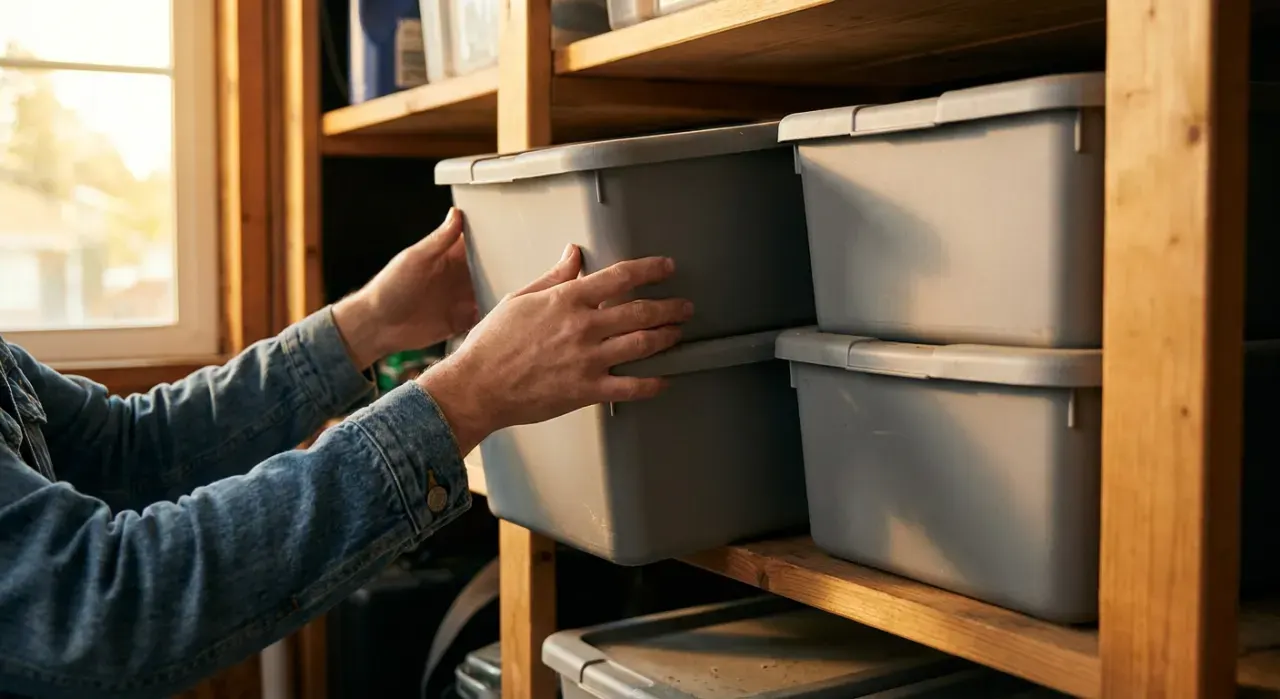
Somewhere that stays between about 50 and 77°F year round, dry, out of direct sun, and out of reach of children. In most US homes that is an interior closet, a pantry shelf, a laundry room cupboard or a basement that does not flood. Avoid the garage, the attic, an uninsulated shed, a car and a windowsill.
| Location | Suitable? | Why |
|---|---|---|
| Interior closet or cupboard | Yes — best | Stable temperature, dry, out of sun |
| Basement, dry | Yes | Cool and stable; watch humidity |
| Kitchen drawer | Yes, in a case | Fine unless next to an oven or dishwasher |
| Attached garage | No | Summer highs above 100°F are routine |
| Detached shed or attic | No | The hottest space on most properties |
| Vehicle glovebox or trunk | No | Extreme swings in both directions |
| Refrigerator | Unnecessary | No real benefit; condensation on removal |
A shallow labeled bin on an interior shelf solves this for a few dollars — sorted by size, terminals protected, and one place to check before a store run. Our storage bin picks cover the small-parts formats that work for this, and if the garage is where things end up by default, how deep garage shelving should be covers building the interior space that replaces it.
Dispose of old batteries properly rather than in household trash: lithium-ion, button and rechargeable cells go to a battery recycling drop-off, and the EPA advises against putting lithium-ion batteries in curbside recycling because of fire risk in collection trucks. We never buy or physically handle the products we rank — recommendations come from aggregated owner reviews and published expert consensus. See how we rank.
More from this hub: Storage & Organization · Garage shelving depth · Best storage bins · Best garage shelving · How we rank