 Garden

Affiliate Disclosure
Some links on this page are affiliate links. As an Amazon Associate, we earn from qualifying purchases — at no extra cost to you. We do not buy, test, or physically handle the products we cover; our rankings come from aggregated owner reviews, ratings and expert consensus. Commissions never change our verdicts. How we rank · full disclosure.
The single change that most often doubles a small closet’s capacity is double-hanging: two rods at roughly 40 and 80 inches from the floor instead of one at 66. Shirts, jackets and folded-over pants only need about 40 inches of drop, so a single rod at conventional height wastes nearly half the closet’s volume as empty air underneath. Add a 12 to 14 inch deep shelf tower down one side for folded items, reserve one short section of full-height long-hang for dresses and coats, and a six-foot reach-in comfortably holds a full wardrobe.
Measure first: the four numbers you need
Before buying anything, get these on paper.
- Interior width, wall to wall, measured at the back rather than at the door opening.
- Usable height, floor to ceiling inside the closet, minus anything in the way such as a light fixture.
- Depth, back wall to the inside of the closed door. Twenty-four inches is standard; a hanger needs roughly 22 inches to hang square.
- Your actual clothes. Push everything to one end of the existing rod and measure the linear feet it occupies, separating long items from short ones. This number decides the whole layout and it is almost always smaller than people assume.
Also note where the studs are, because whatever you install has to fasten into them — a loaded closet rod plus shelf generates real load, and the method is in anchoring into studs and concrete.
The standard heights, and why each one is what it is
| Element | Height from floor | Vertical space it needs |
|---|---|---|
| Long-hang rod (dresses, coats) | 66–68 in | 60–68 in of drop below |
| Double-hang, lower rod | 40–42 in | 38–40 in of drop |
| Double-hang, upper rod | 80–84 in | 38–40 in of drop |
| Shelf above a rod | 12 in above the rod | — |
| Shelf tower shelves | 12–16 in apart | — |
| Shoe shelves | 7–8 in apart | — |
| Top shelf (rarely used) | 84–90 in | — |
The lower double-hang rod at 40 to 42 inches is the number that decides whether the layout works. Set it too high and you sacrifice the clearance below; set it too low and folded pants brush the floor. Full detail on rod height is in standard closet rod height, and the load a rod will actually take in how much weight a closet rod holds.
Three layouts for a closet under six feet
Layout A — the standard conversion (closets 4 to 6 ft wide). Divide the width roughly 70/30. The larger section gets double-hang rods at 40 and 80 inches. The smaller section gets a shelf tower, 12 to 14 inches deep, with shelves 12 to 16 inches apart for folded items and a couple of tighter shelves at the bottom for shoes. A full-width shelf runs above everything at about 84 inches for luggage and seasonal storage. This is the highest-capacity arrangement for most wardrobes.
Layout B — the coat-and-dress version. Same as A but reserve a 24 to 30 inch section of the hanging area as full-height long-hang for dresses, coats and suits. You lose some capacity and gain the ability to hang long garments without them dragging. Most households need less long-hang than they think; measure before allocating it.
Layout C — the very narrow closet (under 4 ft). Skip the tower. Run double-hang across the full width, add the high shelf, and put folded storage in stacking bins on the closet floor or on a shelf above the top rod. Trying to fit a tower into a narrow closet leaves a hanging section too short to be useful.

Best for a reach-in closet where you want to move rods and shelves later without re-drilling the wall
- A hang track carries the load into studs, so uprights can sit anywhere
- Shelf and rod heights adjust without new holes
- Adjusts across a range of closet widths
- Wire shelving needs shelf liners if you fold on it
Why buy it: the reason people re-do a closet twice is that the first version was fixed in place — a track system makes the second version a fifteen-minute change.
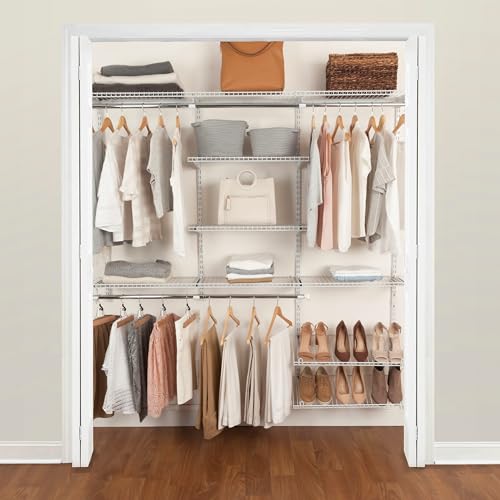
Best for converting a single-rod reach-in to double-hang plus a shelf tower in one purchase
- Expands to fit a range of widths without cutting
- Includes the hardware for a double-hang layout out of the box
- No-cut design suits renters restoring the closet later
- Owners consistently describe it as the fastest of the kit systems to install
Why buy it: double-hanging shorter garments is the single change that most often doubles usable capacity, and a kit removes the layout arithmetic.
Depth, and the mistake that wastes half a shelf
A standard reach-in is 24 inches deep. That figure exists for hanging, not for shelving — a hanger needs about 22 inches to sit square. Shelves do not want that depth.
Twelve to 14 inches is the right shelf depth for folded clothing. Beyond about 16, items at the back become invisible and unreachable, and you get a shelf that behaves like a shallow one with a dead zone behind it. If your closet is deeper than 24 inches, the extra depth is better used for shallow shelves on the side walls, a shoe rack on the floor, or hooks on the back of the door than for deeper shelves. The equivalent pantry question is covered in standard pantry shelf depth.
Wire shelving ventilates and is easy to move; wood looks better and holds a flat surface. If you use wire for folded clothes, add liners — ridged sweaters and toppling stacks are the standard complaint and the fix costs a few dollars.
Where the extra capacity actually comes from
Five places, roughly in order of how much they return.
- The dead air under a single rod. Double-hanging is the big one, and it is most of the gain.
- The floor. Usually a heap of shoes. A shoe rack or a row of bins converts it into organized storage and makes vacuuming possible.
- The top 12 inches. Above a conventional shelf there is often a foot of unused height. A second high shelf takes luggage and seasonal bins.
- The back of the door. Over-door hooks and racks hold bags, belts, scarves and shoes in space that is otherwise structurally unusable.
- The side walls. In a deeper closet, shallow shelves or hooks on the side walls catch small items that would otherwise sprawl across a main shelf.
Add slim velvet hangers while you are in there. They take roughly half the rod space of chunky plastic ones, which on a six-foot rod is a meaningful amount of extra hanging length for very little money.

The five mistakes that waste a small closet
- One rod at 66 inches and nothing else. The builder default, and it leaves nearly half the closet volume as empty air. Double-hanging is the fix, and it is usually a two-hour job.
- Shelves too deep. Anything past 16 inches creates a back row nobody can see or reach, so a deep shelf functions as a shallow one with a junk drawer behind it.
- Allocating too much long-hang. Most wardrobes need 24 to 36 inches of full-height hanging, not half the closet. Measure your actual long garments before deciding.
- Ignoring the floor and the door. Between a shoe rack on the floor and an over-door organizer, a small closet gains a meaningful amount of storage for under $50 and no drilling.
- Buying the system before measuring. Kits are sold by width range, and a closet with an off-center light fixture, a sloped ceiling or an intruding pipe will not accept the standard configuration. Measure everything, including obstructions, first.
Installing it
Two approaches, and the choice matters more for future flexibility than for the first install. A track system hangs everything from a horizontal rail lagged into studs, so uprights, shelves and rods can be moved later without new holes. Fixed brackets are cheaper and stronger per shelf but lock the layout in place.
Whichever you use, the hang rail or the brackets must go into studs — a closet full of clothing is heavier than it looks, and drywall anchors are not adequate for a loaded rod. Step-by-steps are in how to install a closet rod and how to add shelves to a closet, with a full build in how to build a closet organizer.
Before you commit, mock the layout up with painter’s tape on the closet wall and hang a few real garments at the proposed heights. Ten minutes of tape catches the problems — a lower rod that fouls the baseboard, a shelf that blocks the light — that are expensive to discover after drilling.
The ranked systems are in best closet organizer system, and budget expectations in how much a closet organizer costs.
We never buy, test or physically handle the products we rank. Every recommendation is drawn from aggregated owner reviews, star ratings, review volume and published expert consensus — see how we rank.
More from this hub: Storage & Organization · Best closet organizer · Labeling and bin systems · Best under-bed storage · How we rank