 Garden

Affiliate Disclosure
Some links on this page are affiliate links. As an Amazon Associate, we earn from qualifying purchases — at no extra cost to you. We do not buy, test, or physically handle the products we cover; our rankings come from aggregated owner reviews, ratings and expert consensus. Commissions never change our verdicts. How we rank · full disclosure.
The short answer: deep clean carpets every 12 to 18 months in an ordinary household, every 6 to 12 months with pets, small children or heavy traffic, and every 6 months where someone has asthma or a dust mite allergy. The interval is not just about appearance — most major carpet manufacturers require documented professional hot-water extraction at least every 12 to 24 months as a condition of the wear warranty, and a missed schedule with no receipts is the usual reason a claim is refused.
We do not buy or physically handle the machines we rank; our recommendations come from aggregated owner reviews and expert consensus, described in how we rank. The wider category sits at the vacuums and floor care hub.
What interval fits my household?
Start from the 12 to 18 month baseline and adjust for what actually walks across the carpet. Traffic and grit matter more than time: the abrasive soil that destroys carpet fiber is tracked-in mineral grit, which cuts the pile like sandpaper every time somebody steps on it. That is also why a shoes-off household can push toward the longer end of every range below.
| Household | Deep clean | Vacuum | Note |
|---|---|---|---|
| One or two adults, no pets, shoes off | 18 – 24 months | Weekly | Longest safe interval; still check warranty terms |
| Typical family, no pets | 12 – 18 months | 2× weekly | Standard baseline |
| Children under 5 | 9 – 12 months | 2 – 3× weekly | Spills reach the backing more often |
| One or more shedding pets | 6 – 12 months | Every 1 – 2 days in pet areas | Enzyme treatment for accidents, not shampoo |
| Asthma or dust mite allergy | Every 6 months | Daily on carpet | Sealed HEPA vacuum matters more than the deep clean |
| Stairs and entry halls only | Every 6 months | 2 – 3× weekly | Traffic lanes soil 3 to 4 times faster than open floor |
| Rental turnover | Between tenancies | — | Keep receipts for both warranty and deposit disputes |
Why do carpet warranties dictate the schedule?
Because the mills tie wear coverage to documented maintenance. The major US manufacturers — Shaw, Mohawk and their brands — specify professional hot-water extraction at intervals in the 12 to 24 month range in their residential warranty documents, and they ask for dated receipts from the cleaning service if a claim is made. Some go further and require the cleaning to be done without detergents that leave residue, or by a cleaner certified to the IICRC S100 standard for professional carpet cleaning.
The practical consequence is simple: keep the receipts in the same folder as the flooring paperwork. Homeowners who clean diligently but rent a machine each time frequently find they have no qualifying documentation at all, which is a poor discovery to make eight years into a twenty-year warranty.
What actually keeps carpet clean between deep cleans?
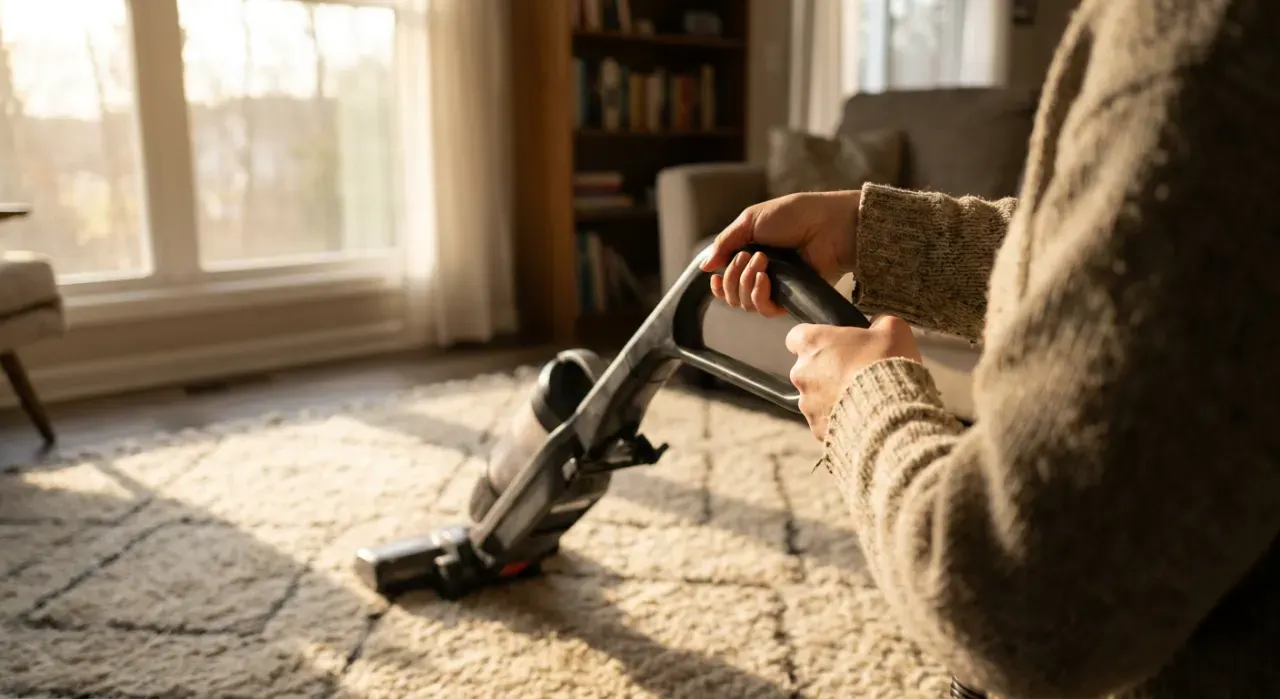
Vacuuming, by a wide margin. Deep cleaning removes what has bonded to the fiber; vacuuming removes the loose grit before it does damage, and it is the only step that meaningfully extends carpet life. Everything else on this list is a distant second.
- Vacuum traffic lanes twice a week and the whole floor weekly, with slow passes — a fast pass over a carpet recovers a fraction of what a slow one does, because the fibers need time to release the soil.
- Set brush height to the carpet. A brushroll set too low burnishes the pile and stalls the motor; too high and it never agitates. Most owners never adjust it once.
- Walk-off mats at every exterior door. Studies of soil transport in buildings consistently find that most tracked-in soil is captured in the first 12 to 15 feet of walking surface — a long mat at the door does more than any product you spray.
- Blot spills immediately, never rub. Rubbing drives the spill into the backing and distorts the fiber twist permanently.
- Skip powder deodorizers. They lodge in the backing where no vacuum reaches them and several carpet mills specifically advise against them.
- Rotate furniture a few inches once or twice a year so wear and light exposure even out.
What goes wrong when carpets are cleaned badly?
Two things, and both are avoidable. The first is over-wetting: a machine that applies more water than it recovers soaks the jute or synthetic backing and the pad beneath. That leads to slow drying, wicking of old stains back to the surface as the water evaporates upward, and in the worst cases delamination or a musty smell that never fully leaves. Getting the carpet dry within 24 hours is the guardrail, since sustained moisture on organic material is what allows mold to establish.
The second is detergent residue. Surfactants left in the pile stay sticky and attract soil, which is why a carpet cleaned with too much soap looks visibly dirtier three weeks later than it did before. Professionals counter this with a clear-water rinse pass or a low-pH rinse; with a rental machine, the equivalent is using half the recommended solution and running one or two extra passes with clean water only.
If your carpet still looks tired immediately after a proper deep clean, the problem is usually pile wear rather than soil — permanent flattening in traffic lanes does not come back. Keeping the grit out is what prevents it, which comes back to vacuuming: see how often should you vacuum a house with pets for frequency, best vacuum for pet hair and best vacuum cleaner for machines, and how often should you replace a vacuum belt if the brushroll has stopped agitating properly.