 Garden


Affiliate Disclosure
Some links on this page are affiliate links. As an Amazon Associate, we earn from qualifying purchases — at no extra cost to you. We do not buy, test, or physically handle the products we cover; our rankings come from aggregated owner reviews, ratings and expert consensus. Commissions never change our verdicts. How we rank · full disclosure.
The short answer: laminate has a compressed wood-fiber core that swells permanently if water reaches it, and vinyl plank is solid polymer that cannot swell but dents more easily and telegraphs imperfections in the subfloor. That single sentence decides most rooms. Kitchens, bathrooms, laundries, basements and entries go vinyl. Bedrooms, living rooms, hallways and offices with heavy furniture can go laminate and will look harder-wearing for it. Everything below is the detail behind that call — and where the conventional pros-and-cons lists get it wrong.
The Core Is the Whole Argument
Both products are a printed decorative layer under a clear wear layer, sitting on a core. The core is where they diverge completely.
Laminate's core is fiberboard. The North American Laminate Flooring Association describes it as wood fibers compressed under intense heat and pressure — high-density fiberboard, effectively — with a melamine backing beneath and the print and wear layer above (NALFA, What Is Laminate). That construction is why laminate is dimensionally stable, why it is dent-resistant, and why it is cheap. It is also why water ends it. Moisture that gets past the surface — at a seam, at the perimeter expansion gap behind the baseboard, or up through a slab without a vapor barrier — is absorbed by the fiberboard, which swells and does not come back. The visible symptom is a plank edge that peaks up in a ridge along a joint, with the wear layer chipping off the raised edge. There is no repair; the affected planks come out.
Vinyl plank's core is polymer. Rigid-core plank comes in two forms, both covered by ASTM F3261, the specification for resilient flooring with a rigid polymeric core. SPC is stone-plastic composite — limestone powder in PVC, dense, typically 4 to 6 mm. WPC is wood-plastic composite — a foamed core, typically 5.5 to 8 mm, lighter and softer. Neither absorbs water. A vinyl plank can sit in a bucket for a month and be unchanged.
That is the asymmetry. Laminate has one fatal vulnerability and is otherwise tough. Vinyl has no moisture vulnerability at all and is otherwise softer.

Head to Head, Specifically
| Laminate | Vinyl plank (SPC/WPC) | |
|---|---|---|
| Core | Compressed wood fiber (HDF) | Solid or foamed PVC composite |
| Water on the surface | Wipe it up promptly and it is fine | Ignore it and it is fine |
| Water reaching the core | Permanent swelling, planks must be replaced | No effect on the plank at all |
| Dent resistance | Better — hard surface over a dense core | Worse — appliance feet and casters mark it |
| Scratch rating | AC1–AC5 (EN 13329); NALFA LF-01 end-use levels | Wear layer in mil: 6 / 12 / 20 / 28 |
| Subfloor flatness needed | Moderate — thicker plank bridges small variation | Tight, often ~3/16 inch over 10 feet |
| Sound underfoot | Louder, hollow without good underlayment | Quieter, especially WPC with attached pad |
| Warmth underfoot | Cool | WPC warmer; SPC similar to laminate |
| Direct sunlight | Stable; responds to humidity, not heat | Expands with heat — sun-flooded rooms can gap |
| Refinishing | Not possible | Not possible |
| Typical material cost per sq ft | About $1–$4 (mid-2026, varies by region) | About $2–$5 (mid-2026, varies by region) |
Why Vinyl Dents, and What Actually Causes It
This is the complaint that catches new vinyl owners off guard, because "waterproof" is the headline and softness is the fine print. Vinyl is a thermoplastic. Under a sustained point load it creeps — the mark from a refrigerator foot or a piano caster appears over weeks, not seconds, and often does not recover.
The specific offenders: appliance leveling feet (small hard pads carrying hundreds of pounds), office chair casters, small-diameter furniture glides, dropped tools, and walking an appliance across a new floor instead of laying plywood down first. WPC is worse than SPC here because a foamed core compresses; a 20 mil wear layer helps with scuffing but does nothing for a dent, which is a core problem.
The fix is mundane and effective: wide furniture pads rather than small felt dots, a hard-floor mat under any caster chair, and plywood or hardboard runway when appliances move.

Why Vinyl Telegraphs the Subfloor, and Laminate Less So
A 5 mm SPC plank is rigid but thin. It cannot bridge a hump the way a 3/4 inch hardwood board does, and it cannot bridge one the way a 12 mm laminate plank does either. Every ridge of dried joint compound, every proud screw head, every high spot in an old plywood deck eventually shows through — first as a shiny spot where all the foot traffic concentrates, then sometimes as a cracked plank at the peak.
Manufacturers usually specify flatness within about 3/16 inch over 10 feet for rigid-core plank, which is tighter than most framed floors arrive at. Checking with a long straightedge, grinding high spots and filling low ones is the hour that determines whether the floor looks right in year three. Laminate is more forgiving here, particularly at 10 mm and 12 mm, but it is not immune — a hollow-sounding spot in a laminate floor is a low subfloor, not a defective plank.
Room by Room
| Room | Choose | Reason |
|---|---|---|
| Kitchen | Vinyl plank (SPC) | Dishwasher and sink risk; spills happen daily |
| Full bathroom | Neither — tile or sheet vinyl | Plank seams are a water path; NALFA rules laminate out entirely |
| Laundry room | Vinyl plank or sheet vinyl | Appliance supply lines are the real risk |
| Basement | Vinyl plank (SPC) over a vapor barrier | No wood fiber to swell; stable over a slab |
| Entry / mudroom | Vinyl plank, 20 mil wear layer | Snowmelt and grit; grit is abrasive, water is constant |
| Living room | Either; laminate AC4 if furniture is heavy | Dent resistance matters more than moisture here |
| Bedrooms | Laminate 8 mm AC3, or WPC vinyl for quiet | Low traffic, no water; comfort and sound decide it |
| Sunroom / south-facing glass | Laminate, or SPC specifically rated for it | Vinyl expands with heat and can gap in strong sun |
| Over radiant heat | SPC vinyl, or laminate rated for radiant | Check the manufacturer's surface temperature cap |
They Also Want Different Cleaning
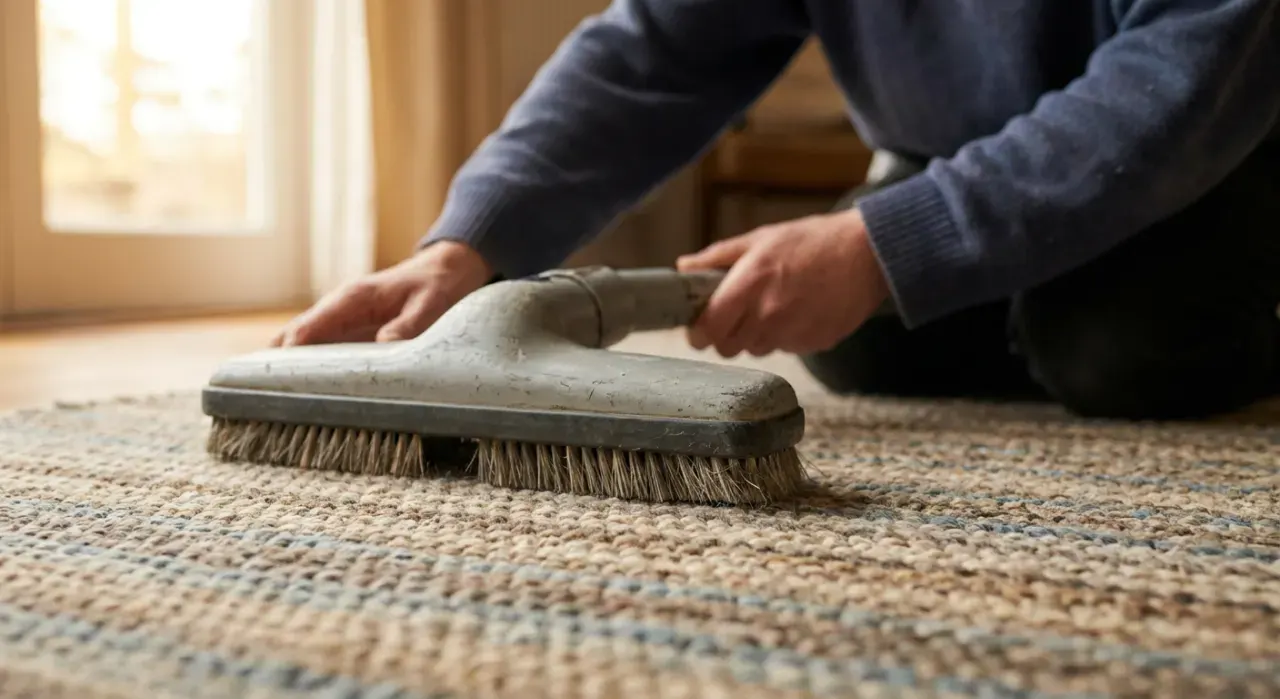
This matters more than it sounds, because the wrong routine destroys either floor faster than traffic does. Both hate excess water and both hate steam — but not equally, and the manufacturer's own documentation is the authority. Shaw's laminate care guidance is blunt: "Do not wash or wet mop the floor with soap, water, oil-soap detergent or any other liquid," and it asks owners to vacuum with a hard surface attachment rather than a beater bar and to hold indoor humidity between 35 and 65 percent (Shaw Floors, laminate care).
Vinyl is more tolerant of damp mopping, and interestingly a few product lines are explicitly cleared for steam: Mannington states that it "approves the use of residential steam based cleaners that are designed for use on hard surface floors" for its ADURA luxury vinyl range, while adding "Never flood the floor with water" (Mannington ADURA care). On the laminate side the same company approves steam only for one specific collection. The lesson is not "steam is fine" — it is that steam is a per-product permission you have to look up, and the default answer for laminate is no.
Full routines are in our guides to cleaning laminate floors and cleaning vinyl plank floors, and if you are choosing a vacuum for either, hard-floor vacuums covers the brush-roll problem.
How to Decide in Sixty Seconds
- Is a plumbing failure or standing water plausible in this room? Yes → vinyl plank. That outranks everything else.
- Is it a full bathroom? Neither — tile or sheet vinyl, because plank seams are a water path.
- Is there very heavy furniture, an appliance, or a caster chair? Leans laminate, or SPC vinyl with wide pads.
- Is the subfloor known to be uneven and are you not going to level it? Leans laminate at 10–12 mm.
- Does the room get strong direct sun for hours? Leans laminate, or an SPC explicitly rated for it.
- Is footfall noise or comfort the priority? WPC vinyl with an attached pad.
- Still tied? Buy the one with the better wear specification you can afford — AC4 laminate or a 20 mil vinyl — because that, not the category, decides how it looks in a decade.
One Buying Note That Applies to Both
Neither product is a good online purchase in plank form. Both are freight, both are priced by the carton in a way that obscures cost per square foot, both arrive with crushed carton corners and therefore damaged tongues, and both are printed products that need color-lot matching across cartons — a lot change halfway across a room shows as a permanent band. Buy the planks where you can hold a sample under your own lighting and confirm the cartons came from one run. Order the underlayment, transition strips, install kit and a shear cutter online, where those genuinely ship well: our laminate spec and accessory guide and vinyl plank guide cover both sides.
We never buy, install or physically handle the flooring we write about. Guidance comes from published standards, manufacturer care and warranty documentation, and aggregated owner reviews — see how we rank.
More from this hub: Vacuums & Floor Care · is vinyl plank waterproof? · how long vinyl plank lasts · best waterproof vinyl plank · how we rank.