 Garden

Affiliate Disclosure
Some links on this page are affiliate links. As an Amazon Associate, we earn from qualifying purchases — at no extra cost to you. We do not buy, test, or physically handle the products we cover; our rankings come from aggregated owner reviews, ratings and expert consensus. Commissions never change our verdicts. How we rank · full disclosure.
The short version: after weighing six popular faucet timers on owner star ratings, review volume, weather sealing, battery behavior and the failure modes that show up after a full season outdoors, our #1 pick is the Orbit B-hyve XD 1-Port. It does the smart things well — app scheduling, rain skipping, run logs — and it does the unglamorous thing that matters more: the physical buttons still water the yard when your phone is dead or the app has logged you out.
A timer is the cheapest way to stop killing plants while you are away, and the cheapest way to stop overwatering while you are home. EPA WaterSense labels weather-based and soil moisture-based controllers on the same logic — applying water only when plants need it — and reckons as much as half of outdoor water is wasted through overwatering. It pairs naturally with a drip system — see best drip irrigation kit — and with a good hose, covered in best garden hose. The full picture is on the watering and irrigation hub.
Top Picks at a Glance
Our #1 Pick: Orbit B-hyve XD 1-Port
The B-hyve XD gets the balance right. It is a weather-sealed, battery-powered timer that screws onto a standard faucet, pairs to a phone over Bluetooth for scheduling, and uses local weather data to skip a cycle when it has rained. That last feature is the one owners describe noticing on the water bill, because the classic failure of a dumb timer is watering enthusiastically through a thunderstorm.
Consensus Score ████████░░ 8.6 — reviewers repeatedly credit the physical buttons as the reason they kept it
What separates it from the rest of the smart field is graceful degradation. Every category of connected garden hardware has a wall of one-star reviews from people locked out of a device by an app update, a login, or a hub that dropped off the network. The XD keeps a manual water button and a manual off, so worst case it behaves like a $30 timer rather than a brick. The IPX-5 rated housing also survives being hit by the sprinkler it is controlling, which is not universal.
Check price on Amazon → (paid link)
Best Hose Timers 2026: The Ranked Field
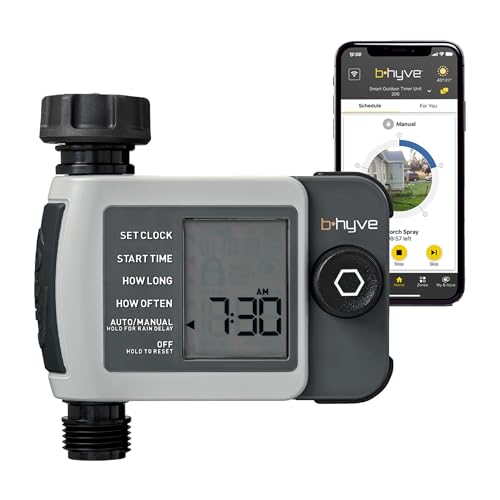
Best for most yards — a single faucet you want watered while you are away
- Bluetooth control from the B-hyve app
- WeatherSense skips watering after rain
- IPX-5 weather-sealed housing
- Manual buttons work without a phone
Why buy it: it is the rare smart timer that still functions as a plain timer when the app, the phone or the hub is not cooperating.

Best for checking or changing the schedule from another state
- Includes plug-in Wi-Fi hub for remote access
- Automatic schedule from local weather data
- Watering history and run logs in the app
- Works with voice assistants
Why buy it: the hub is what turns a Bluetooth timer into something you can actually manage from a vacation.

Best for a fixed schedule you set once in spring and leave alone
- LCD screen with dial-based programming
- Built-in rain delay button
- Runs on two AA batteries
- Water-resistant housing
Why buy it: no app, no pairing, no account — you turn a dial, and it waters.

Best for anyone who wants zero electronics on the faucet
- Fully mechanical — no batteries at all
- Daily on/off cycle set with pins
- Manual override for hand watering
- Simple brass-threaded faucet connection
Why buy it: nothing on it can lose a battery, a signal or a schedule in the middle of August.

Best for running beds, containers and a soaker line on different schedules from one faucet
- Four independently programmed outlets
- Up to four start times per zone per day
- Rain delay and manual watering modes
- Backlit screen for evening programming
Why buy it: containers need water daily and a lawn does not — this is the cheapest way to stop treating them the same.

Best for two hoses, two schedules, one app
- Two independently controlled outlets
- Bluetooth app control with WeatherSense
- Weather-sealed IPX-5 body
- Battery powered, no outlet needed
Why buy it: a drip line and a sprinkler need completely different run times, and this splits them without a second timer.

Quick Comparison
| Product | Best for | Rating | Price | Buy |
|---|---|---|---|---|
| Orbit 24511 B-hyve XD 1-Port Smart Hose Watering Timer | Best Overall | — | Check (paid link) | |
| Orbit 21004 B-hyve Smart Hose Timer with Wi-Fi Hub | Best Premium Wi-Fi | — | Check (paid link) | |
| Orbit 62061 Programmable Digital Hose Watering Timer | Best Value | — | Check (paid link) | |
| Melnor Mechanical Daily Water Timer | Best Mechanical | — | Check (paid link) | |
| Melnor 73280 Digital 4-Zone Hose Timer | Best Multi-Zone | — | Check (paid link) | |
| Orbit 24632 B-hyve XD 2-Port Smart Hose Timer | Best Two-Zone Smart | — | Check (paid link) |
How We Rank
We do not buy, test or physically handle these timers. We rank them by aggregating owner star ratings and review counts across the category, weighting recent reviews above launch-window ones, cross-checking sealing ratings, battery type, zone count and connectivity against manufacturer specifications, and reading negative reviews closely for the failures that only appear after a full outdoor season.
Four things drive the order. Reliability of the valve, because a timer that fails open floods a yard and a timer that fails shut kills a garden — both are catastrophic in a way a bad nozzle is not. Graceful degradation: does it still work without a phone, an account or a network? Owner satisfaction weighted by review volume, since connected products attract polarized ratings and small samples mislead badly. And seasonal durability — sealing, battery life and freeze behavior. Prices were checked at time of writing and move seasonally. Full method: how we rank.
The Timers, Reviewed
1. Orbit B-hyve XD 1-Port — Best Overall
Covered above. Consensus Score ████████░░ 8.6. Strengths: straightforward Bluetooth scheduling, weather-based skipping, weather-sealed body, and manual controls that work independently of the app. Recurring complaints: Bluetooth range is short, so scheduling means walking to the faucet unless you add the hub. A minority report the app requiring a re-pair after a firmware update. Battery life is the usual story — a full season on good alkalines, much less on cheap ones or in extreme heat.
2. Orbit B-hyve with Wi-Fi Hub — Best Premium Wi-Fi
The same core timer plus a plug-in hub that bridges it to your home network, which is what makes remote control real. From the app you can change a schedule from anywhere, look at watering history to see whether a cycle actually ran, and let the system build a schedule from local weather and your own soil and plant settings. For anyone who travels in summer, that history log is the feature that earns its keep.
Consensus Score ████████░░ 8.2 — owners consistently rate the remote history and rain skipping highest
Recurring complaints: the hub needs to be within reasonable range of the timer through exterior walls, and reviewers whose faucet is at the far corner of a house report constant dropouts. Setup is fiddlier than the Bluetooth-only version, and account and firmware issues generate a visible share of the negative reviews. It is a good system with a genuine dependency on your Wi-Fi.
3. Orbit 62061 Programmable Digital — Best Value
The unglamorous answer, and for a lot of gardens the right one. A dial and an LCD screen let you set start time, duration and frequency in about a minute, a rain-delay button postpones the next cycle by hand, and that is the whole product. No account, no app, no pairing, and nothing to update.
Consensus Score ███████░░░ 7.8 — the consensus favors it for simplicity and price, not for features
Recurring complaints: the housing is only water-resistant, and owners who let a sprinkler soak it report screens failing. It has no weather awareness at all, so it will water through rain unless you press the delay button. Reviewers also report the dial detents wearing vague after a couple of seasons. Fine as a set-and-forget timer, weak if you fiddle with it often.
4. Melnor Mechanical Daily Timer — Best Mechanical
A pure mechanical timer with no electronics whatsoever: you set pins for the daily on and off, water pressure drives the mechanism, and there is no battery to die at the worst possible moment. For a vegetable bed on a soaker hose that wants the same 30 minutes every morning, it is genuinely all the timer you need, and it costs about the same as a bag of compost.
Consensus Score ███████░░░ 7.5 — owners rate it well for what it is and poorly when they expected more
Recurring complaints: it is a daily cycle only — no every-other-day, no multiple start times, no rain response. Reviewers describe the timing drifting by several minutes over a week. The plastic faucet collar is the common breakage point, especially if the hose hangs off it unsupported. Set expectations correctly and it does not disappoint.
5. Melnor 73280 Digital 4-Zone — Best Multi-Zone
Four independently programmable outlets from one faucet, which solves the real problem in a mixed garden: containers want a short drink daily, a raised bed wants a long soak twice a week, and the lawn wants something different again. Each zone takes up to four start times a day, and a backlit screen makes evening programming possible without a flashlight.
Consensus Score ███████░░░ 7.7 — highly rated by owners running drip and sprinklers together, mixed elsewhere
Recurring complaints: programming four zones is genuinely fiddly, and the manual is widely criticised. Running several zones simultaneously drops pressure noticeably, so schedules need staggering. The most common hardware complaint is a zone that stops closing fully — a grit problem that an inline filter washer largely prevents.
6. Orbit B-hyve XD 2-Port — Best Two-Zone Smart
The XD with a second outlet, and the sensible upgrade for anyone running a drip line and a sprinkler off one faucet. Drip needs long, low-flow cycles; sprinklers need short, high-flow ones, and trying to serve both from a single schedule always shortchanges one. Same weather sealing, same weather-based skipping, same manual buttons.
Consensus Score ████████░░ 8.4 — owners rate it essentially as highly as the 1-port, with the same caveats
Recurring complaints: it is bulky on a crowded faucet, and reviewers with a splitter already installed report clearance problems. It shares the 1-port's short Bluetooth range. Running both ports at once halves effective pressure, so schedules should not overlap — a point that catches out a surprising number of owners.

How to Choose a Hose Timer
Start with how many different things you water. One hose on one schedule needs a single-port timer and nothing more. A drip line plus a sprinkler needs two ports. Containers plus beds plus lawn realistically needs four, and buying a four-zone timer is far cheaper than buying three timers and a splitter. For scale, EPA WaterSense reckons a household with an automatic irrigation system that is not properly maintained and operated can waste up to 25,000 gallons a year.
Then decide how much connectivity you actually want. If you are home most of the summer, a plain digital timer with a rain-delay button does the job for thirty dollars. If you travel, the ability to check that a cycle ran is worth real money. Whatever you choose, insist on manual controls that work without a phone. Finally, fit a filter washer at the faucet — grit in the valve is the single most common cause of a timer that will not shut off, and the fix costs almost nothing.
What Owners Actually Complain About
Four complaints dominate the category. Failing to shut off is the most serious and the most cited: a timer stuck open runs a hose all night, and the usual causes are a dying battery or grit in the diaphragm. Batteries dying mid-season is second, and it is worse than it sounds because many timers give no warning — replacing them every spring on principle is cheap insurance.
App and connectivity frustration is third, concentrated on hub-based systems: dropped networks, forced re-pairing and account logins between a gardener and their own faucet. And freeze damage is fourth, entirely preventable by removing the timer in fall, draining it and pulling the batteries. Owners who do those three things — fresh batteries, filter washer, winter removal — report a fraction of the problems everyone else does.
The Verdict
For most gardens, the Orbit B-hyve XD 1-Port is the timer to buy — smart enough to skip the rain, simple enough to work without a phone. Travelling a lot? Add the Wi-Fi hub version. Running drip and sprinklers together? The 2-port XD, or the Melnor 4-zone if you have more than two schedules. Want nothing to go wrong? The Melnor mechanical has no electronics to fail.
Check price on Amazon → (paid link)
Next: give the timer something efficient to run with best drip irrigation kit, cover the lawn with best lawn sprinkler, or work out when it should run at all in best time of day to water.