 Garden

Affiliate Disclosure
Some links on this page are affiliate links. As an Amazon Associate, we earn from qualifying purchases — at no extra cost to you. We do not buy, test, or physically handle the products we cover; our rankings come from aggregated owner reviews, ratings and expert consensus. Commissions never change our verdicts. How we rank · full disclosure.
The impact sprinkler is the oldest design still in mainstream use, and it is still here for a reason: there is almost nothing inside it to break. A spring-loaded arm is knocked aside by the water stream and snaps back against the head, indexing it a few degrees around with each strike. That tick-tick-tick is the entire mechanism. No gear train, no turbine, no plastic drive — which is why an impact sprinkler tolerates gritty well water, mineral-heavy municipal water and pressure down around 25 psi, all of which finish off a gear-drive rotor.
The trade-off is shape. Impact sprinklers throw circles. If your lawn is a rectangle, an oscillating sprinkler wastes less water; if it is broadly square, open, or you are watering a paddock, pasture or new sod, the impact head covers more ground per unit and keeps doing it for a decade.
Top Picks at a Glance

Why the design lasts
An oscillating sprinkler drives a plastic gear train off the water flow. A gear-drive rotor does the same thing with a sealed gearbox. Both are precision assemblies with tight clearances, and both are vulnerable to two things: abrasive particles in the water and mineral scale that builds on internal surfaces.
The impact head has neither problem. The only moving part in the water path is a heavy pivoting arm with a wide clearance, and the nozzle is a simple orifice that can be poked clear with a paperclip. Owners routinely report brass impact heads working after a decade outdoors — the recurring complaints are about corroded bearings, worn springs and heads that will not rotate because of grit, all of which are cleanable rather than terminal.
Our #1 Pick: Rain Bird 25PJDAC
This is a bare head, not a complete sprinkler, and that is the point. It screws onto a tripod, a step spike, a riser or a sled base of your choosing, and it is made of brass, bronze and stainless steel throughout — the specification that separates a head you own for ten years from one you replace every second season.
The arc adjusts from 20° to 360° with trip collars you slide by hand, and the diffuser pin lets you break up the stream for close-in watering rather than blasting a hard jet at the near ground. Rated radius is 20 to 41 feet depending on pressure and nozzle, which covers most residential situations from a single position.
What owners consistently say about it is unglamorous and exactly what you want to hear: it keeps working. The recurring criticisms are that it is sold as a head only, so newcomers are surprised there is no base in the box, and that the near-field coverage is thin unless you use the diffuser — an inherent property of the design rather than a fault, because the arm has to have a coherent stream to strike.
Check price on Amazon → (paid link)
The Ranked Field

Best for anyone who wants one sprinkler head to outlast the lawn
- Brass, bronze and stainless steel construction throughout
- Adjustable 20° to 360° arc via trip collars
- 20–41 ft spray radius depending on pressure
- Diffuser pin breaks the stream for close-in coverage
Why buy it: there is no plastic gear train inside to strip, which is the single reason impact sprinklers routinely outlive three oscillating models.

Best for big open areas, new sod and watering over tall plantings
- Brass impact head on an adjustable metal tripod
- Height adjusts through roughly 22 to 48 inches
- Full or part-circle coverage
- Weighted, spreading legs for stability
Why buy it: raising the head above the grass line is what stops long grass or a vegetable bed from swallowing the stream in the first six feet.

Best for a fixed position you water the same way every week
- All-metal head and spike, no plastic in the water path
- Adjustable arc from part-circle to full 360°
- Spike pushes into soil so the hose cannot drag it
- Standard 1/2 in. thread for tripod or riser mounting
Why buy it: a spike-mounted head stays exactly where you set it, which matters more than any spec once you have dialed in the arc.

Best for covering a lot of ground for the least money
- Zinc impact head on a height-adjustable tripod
- Full and part-circle patterns
- Diffuser pin for close-in watering
- Folds flat for storage
Why buy it: zinc instead of brass costs a little corrosion resistance and saves a third of the price, which is the right trade for seasonal use.
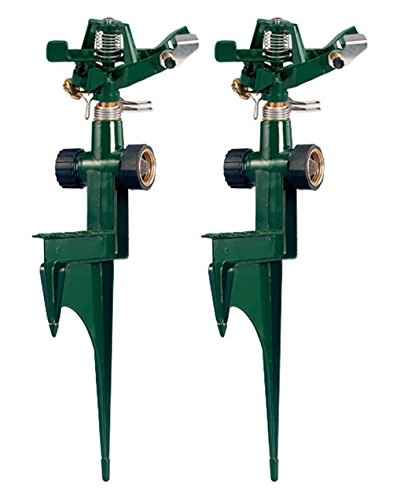
Best for L-shaped yards and anywhere two circles beat one
- Two zinc impact heads on metal step spikes
- Step spike drives in with a boot, no digging
- Adjustable arc on each head
- Connect in series with a Y-splitter or run separately
Why buy it: two overlapping circles cover an awkward yard far more sensibly than one big pattern that hits the driveway on every pass.

Best for permanent systems on hard water or marginal pressure
- Pop-up body with a brass impact drive
- 24–45 ft radius, adjustable 20° to 360°
- Tolerates dirty water and well supply better than gear rotors
- Fits standard 3/4 in. riser
Why buy it: it is the head to specify where silty well water or heavy mineral scale would clog a gear-drive rotor within a season.

Quick Comparison
| Product | Best for | Rating | Price | Buy |
|---|---|---|---|---|
| Rain Bird 25PJDAC Brass Impact Sprinkler, Adjustable 20°–360°, 20–41 ft | Best Overall | — | Check (paid link) | |
| Orbit 1/2 in. Brass Impact Sprinkler on Adjustable Metal Tripod | Best for Large Yards | — | Check (paid link) | |
| STYDDI Heavy Duty All-Metal Impact Pulsating Sprinkler, Adjustable Rotating Circular | Best Spike Mount | — | Check (paid link) | |
| Orbit Tripod Lawn Zinc Impact Sprinkler, 360° Rotating with Adjustable Height | Best Value Tripod | — | Check (paid link) | |
| Orbit 56351N Zinc Impact Sprinkler on Metal Step Spike, 2-Pack | Best Two-Pack | — | Check (paid link) | |
| Rain Bird AG-5 All Gallonage Pop-Up Impact Sprinkler, Adjustable 20°–360°, 24–45 ft | Best In-Ground Impact | — | Check (paid link) |
Choosing a mount matters as much as the head
| Mount | Height | Best for | Weakness |
|---|---|---|---|
| Step spike | ~6–10 in. | Fixed positions in soft soil | Will not clear tall grass or plantings |
| Sled base | Ground level | Moving around a lawn quickly | Drags when the hose is pulled |
| Tripod | 22–48 in. | Large areas, vegetable beds, new sod | Tips on uneven ground unless the legs are weighted |
| In-ground riser | Pop-up | Permanent systems, well water | Requires a plumbed zone and backflow protection |
Height is the underrated variable. A head at ankle level watering a lawn that has grown to four inches loses a surprising amount of its near-field pattern to the grass itself, and a head trying to water over a row of tomatoes at ground level simply cannot. That is the whole argument for a tripod.
Setting the arc and the throw
Impact sprinklers are the easiest heads in irrigation to adjust because everything is mechanical and visible.
- Arc: slide the two trip collars around the ring at the base. Apart widens, together narrows. Every part-circle setting from about 20° to nearly 360° is available.
- Full circle: disengage the reversing trip — on most heads by lifting or rotating a small pin so the arm never trips the reverse.
- Radius: lower the diffuser pin into the stream. It breaks the jet up, shortens the throw and improves close-in coverage at the same time.
- Rotation speed: adjust the spring tension on the arm. Slower rotation means a heavier application depth per pass.
If a head refuses to index around, it is nearly always grit under the bearing or a spring set wrong, not a dead sprinkler. In-ground pop-up impacts and gear rotors are adjusted quite differently — that is covered in how to adjust sprinkler heads.
How long to run one
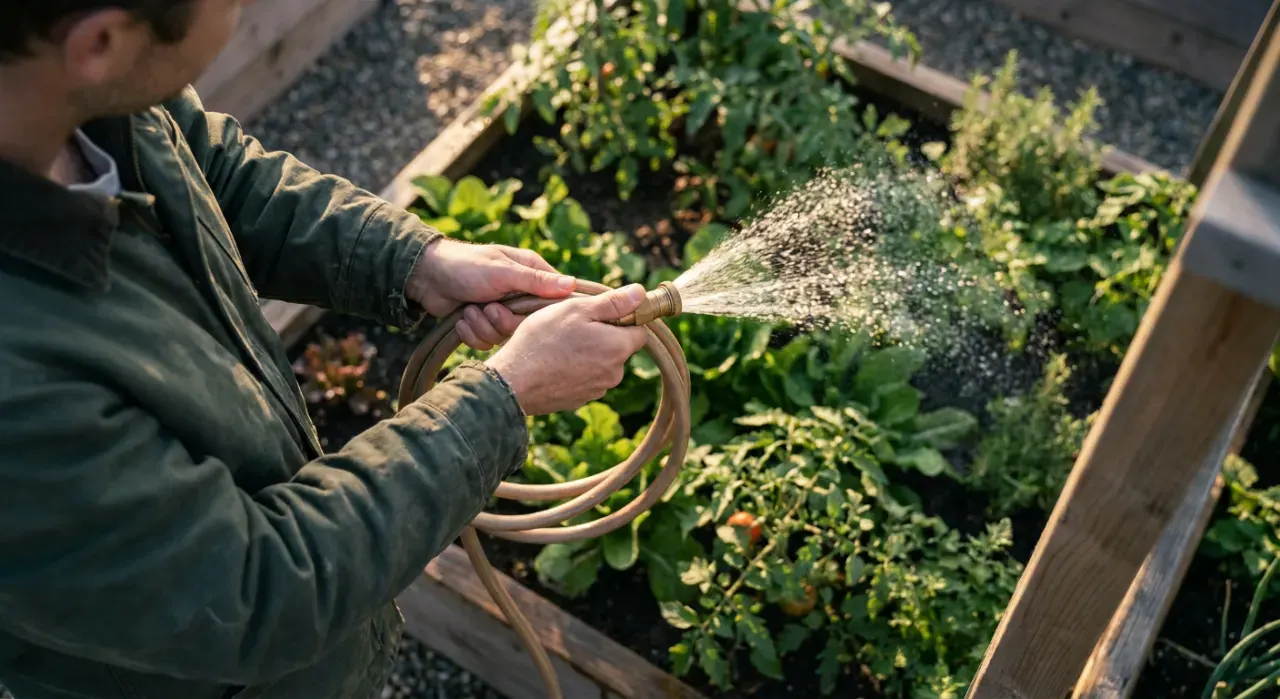
Impact sprinklers apply water slowly, typically 0.3 to 0.5 inches per hour, so expect 60 to 100 minutes to put down half an inch. That slow, coarse-droplet application is a genuine advantage on clay and on slopes, where faster patterns run off before they infiltrate, and it resists wind drift far better than a fine mist.
Most lawns want roughly 1 to 1.5 inches per week including rainfall, in one or two deep soakings rather than daily light watering, which grows shallow roots. EPA WaterSense sets the baseline at about an inch a week including rain, and Clemson's extension service is explicit that established turf should never be watered every day. Water between about 4am and 9am — evaporation is lowest and the blades dry as the sun rises, whereas evening watering keeps the canopy wet overnight and feeds brown patch and dollar spot. Measure your own output with a catch-can test and convert it with our sprinkler run time calculator.
How We Rank
We do not buy, run or physically handle these sprinklers. Rankings come from aggregated owner ratings across the most-owned impact sprinklers, weighted toward long-ownership reviews where corrosion, stuck arms and failed springs show up, and cross-checked against published specifications for radius, arc range and materials. Four things carry the weight: materials in the water path, since brass and bronze are the reason this category lasts; arc adjustability, which is what separates a useful head from a fixed circle; mount stability, because a tipped tripod waters a fence; and low-pressure tolerance, the main practical reason people choose impact over gear drive. Prices were checked at the time of writing. Full method: how we rank.
What Owners Actually Complain About
Tripods tipping. The commonest gripe, and usually a setup problem — spread the legs fully, set them across the hose pull rather than along it, and weight them on hard ground.
The arm sticks. Grit under the bearing. Impact heads are designed to be taken apart; a rinse and a refit fixes almost every case.
Zinc heads corroding. Zinc alloy saves money and gives up corrosion resistance. In coastal air or hard water, pay for brass.
Dry ground close to the head. Inherent to the design — the arm needs a coherent stream, so the first few feet get less. Use the diffuser pin, or overlap two heads.
Noise. The tick-tick-tick is loud enough to carry through an open bedroom window. That is a reason to run it at 5am and a reason not to.
The Verdict
Buy the Rain Bird 25PJDAC if you want a head that will still be working when you have replaced everything else in the shed, and pair it with the mount that suits your yard. Buy the Orbit brass tripod if you water big open areas or over tall plantings and want it ready to go in a minute. Take the Orbit zinc two-pack on step spikes if your yard is awkward and two overlapping circles beat one large one. And specify the Rain Bird AG-5 if you are plumbing a permanent zone fed by a well or by water hard enough to scale a gear rotor. Check price on Amazon → (paid link)
More from this hub: watering & irrigation · gear drive vs impact sprinkler · best oscillating sprinkler · best lawn sprinkler · how much water a sprinkler uses per hour · how we rank.