 Garden

Affiliate Disclosure
Some links on this page are affiliate links. As an Amazon Associate, we earn from qualifying purchases — at no extra cost to you. We do not buy, test, or physically handle the products we cover; our rankings come from aggregated owner reviews, ratings and expert consensus. Commissions never change our verdicts. How we rank · full disclosure.
A typical garden hose sprinkler uses 180 to 600 gallons of water per hour — most commonly around 300 to 400. That range comes from flow rates of roughly 3 to 10 gallons per minute, which is what a household faucet and hose can deliver at ordinary pressure. Oscillating sprinklers usually sit at 3 to 5 gpm (180–300 gallons an hour), impact sprinklers at 2 to 5 gpm (120–300 an hour), and a single in-ground rotor zone at 3 to 8 gpm. The only figure that matters is yours, and a five-gallon bucket and a stopwatch will give it to you in thirty seconds.
How much does each type of sprinkler use?
Flow varies more with your water pressure than with the sprinkler model, so treat these as bands rather than specifications. Every one of them assumes a normal residential supply of 40 to 60 psi at the sprinkler.
| Sprinkler | Flow | Gallons per hour | Application depth |
|---|---|---|---|
| Oscillating sprinkler | 3–5 gpm | 180–300 | 0.3–0.6 in/hr |
| Impact sprinkler | 2–5 gpm | 120–300 | 0.3–0.5 in/hr |
| Rotating / circular sprinkler | 2–4 gpm | 120–240 | 0.3–0.5 in/hr |
| In-ground rotor zone (3–5 heads) | 3–8 gpm | 180–480 | 0.4–0.8 in/hr |
| In-ground spray zone (6–10 heads) | 4–9 gpm | 240–540 | 1.5–2.0 in/hr |
| Soaker hose, 50 ft | 0.5–1.5 gpm | 30–90 | n/a — subsurface |
Notice that the gallons per hour and the application depth are two different questions. A spray zone and a rotor zone can use similar gallons per hour while wetting completely different areas, which is why the spray zone finishes in 20 minutes and the rotor zone takes an hour.
How do you measure your own sprinkler's usage?
Two methods, both quick, and they tell you different things.
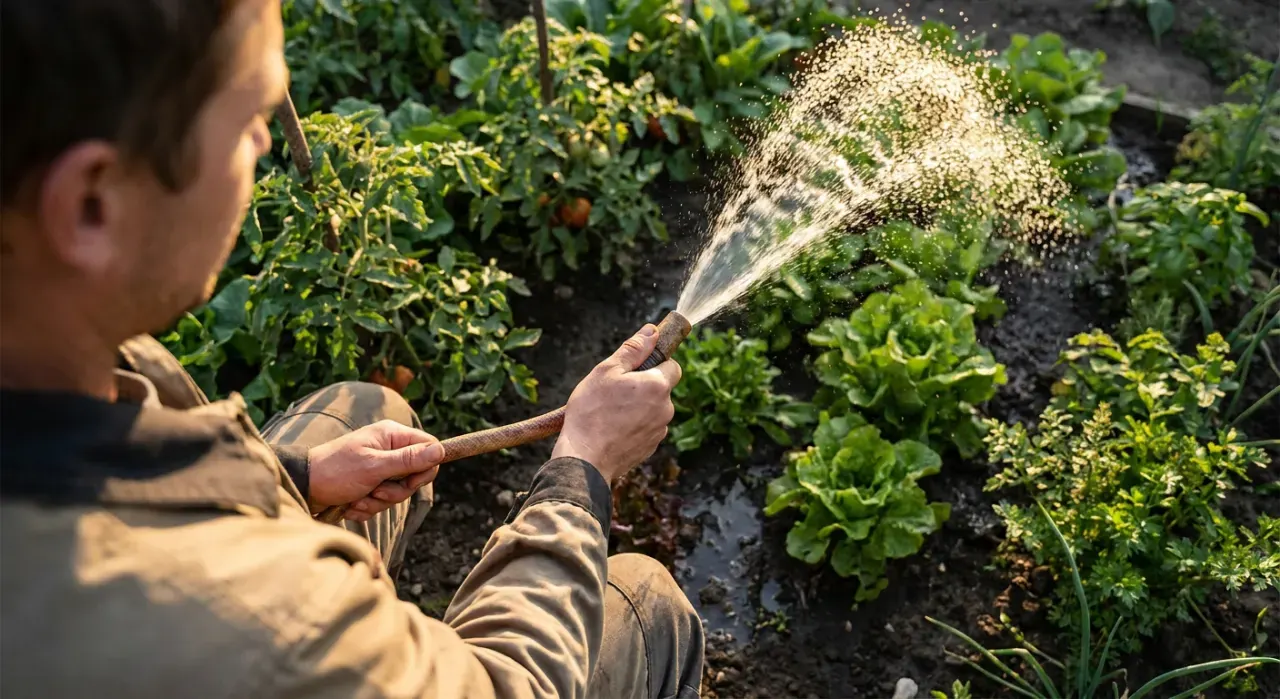
The bucket test measures flow. Take the sprinkler off, open the faucet to your usual setting, and time a five-gallon bucket. Divide 300 by the seconds taken to get gallons per minute — 300 divided by 40 seconds is 7.5 gpm, or 450 gallons an hour. Our water flow rate calculator does the conversion.
The catch-can test measures depth. Set five or six straight-sided cans across the pattern, run the sprinkler for exactly 15 minutes, measure each with a ruler and average. Multiply by four for the hourly application rate. This is the number you actually schedule from, because lawns are watered to a depth, not to a volume. Feed it into our sprinkler run time calculator to get minutes per session.
How many gallons does your lawn actually need?
Fixed arithmetic: 623 gallons delivers one inch of water over 1,000 square feet. An acre-inch is 27,154 gallons and an acre is 43,560 square feet, so the number does not vary by sprinkler, region or season.
| Lawn area | Gallons for 1 in. | Hours at 350 gal/hr |
|---|---|---|
| 1,000 sq ft | 623 | ~1.8 |
| 2,500 sq ft | 1,558 | ~4.5 |
| 5,000 sq ft | 3,116 | ~8.9 |
| 10,000 sq ft | 6,232 | ~17.8 |
Those hours look alarming and they are meant to. One hose sprinkler cannot cover a 10,000 square foot lawn in a single position, so the real schedule is several positions of an hour or two each. It is also why in-ground systems exist above roughly 6,000 square feet.
What does an hour of sprinkling cost?
Water is billed per 1,000 gallons in most of the US, and rates vary enormously between utilities — as of mid-2026, roughly $3 to $10 per 1,000 gallons is a fair national spread once volumetric water and any sewer component are counted, with many utilities applying steeper tiers above a summer threshold. At $6 per 1,000 gallons, a sprinkler using 350 gallons an hour costs about $2.10 an hour, and a 5,000 square foot lawn receiving one inch a week costs roughly $19 a month.
Two caveats worth checking on your own bill. Many utilities charge sewer volume based on winter water use, so summer irrigation may not add sewer charges; some offer a separate irrigation meter that formalizes this. And tiered rates mean the marginal cost of the last thousand gallons can be several times the first. Our irrigation water cost calculator runs your own rate.
How does drip irrigation compare?
Dramatically lower, because drip does not water air, pavement or the gaps between plants. A single 1 gallon-per-hour emitter uses what its name says; a 50-foot bed with 25 emitters uses 25 gallons an hour, against 180 to 300 for a hose sprinkler covering similar ground. That is not a fair like-for-like comparison — the sprinkler is wetting a whole area and the drip line is wetting root zones — but for beds, hedges, containers and vegetables, root zones are all that need wetting.
| Method | Typical use per hour | Water reaching roots |
|---|---|---|
| Hose sprinkler on a lawn | 180–600 gal | Moderate — evaporation and drift losses |
| In-ground spray zone | 240–540 gal | Moderate; better if pressure-regulated |
| Soaker hose, 50 ft | 30–90 gal | High |
| Drip line, 25 emitters at 1 gph | 25 gal | Very high |
The practical takeaway is not that sprinklers are wasteful — a lawn genuinely needs area coverage — but that watering beds with a lawn sprinkler is where most household irrigation is squandered. Beds belong on drip, on their own zone. See how much water drip irrigation saves.
How much of it actually reaches the lawn?
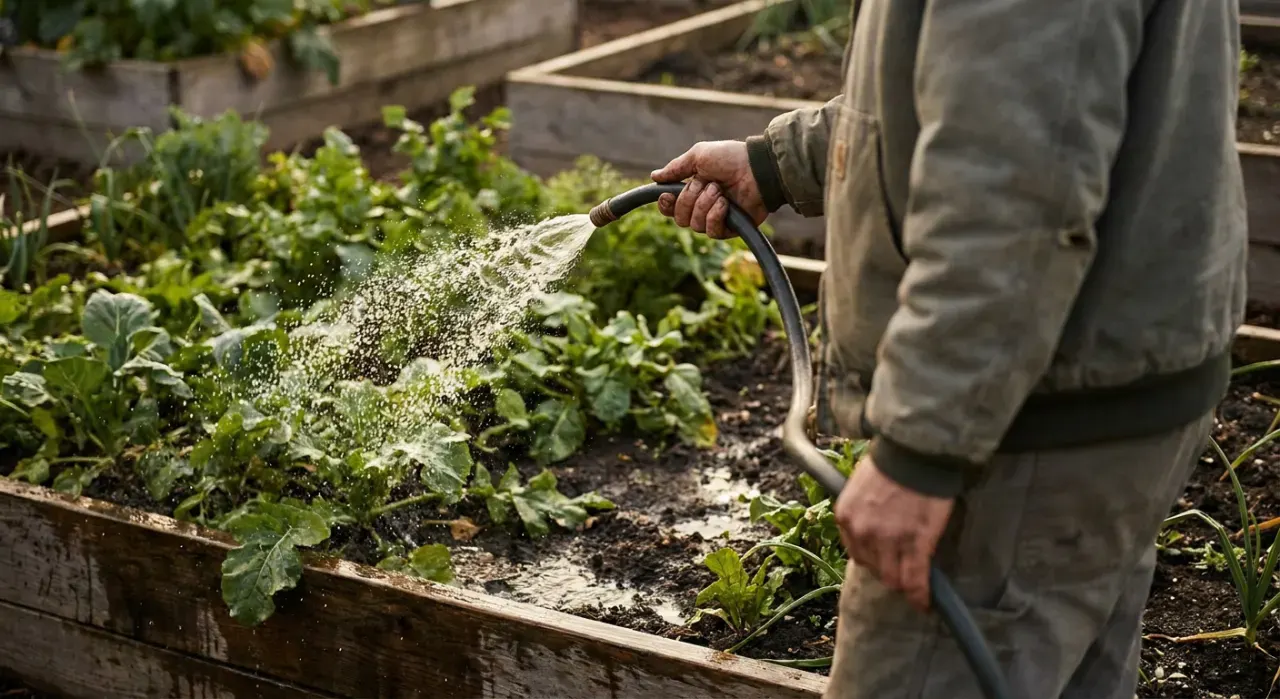
Less than the meter says, and timing is the biggest lever you control. Watering in the middle of the day loses a meaningful share to evaporation and, more importantly, to wind drift — water that leaves the pattern never reaches the grass at all. EPA WaterSense advises against midday watering for exactly this reason and puts the baseline requirement at about one inch a week including rainfall. Watering between 4am and 9am cuts those losses and lets blades dry as the sun rises, which also reduces disease pressure.
The other lever is not watering when you do not need to. Rain counts toward the weekly inch, so a rain gauge or a weather-linked controller removes whole sessions from the schedule at no cost to the lawn.
Where to go next
See how much water an oscillating sprinkler uses and how much a soaker hose uses per hour for the type-specific figures, and how often to water your lawn for the schedule those numbers feed. For hardware, our ranked best oscillating sprinklers and best impact sprinklers compare current models. Everything sits under the watering and irrigation hub.
We never buy or physically handle the products we rank — recommendations come from aggregated owner reviews and expert consensus. Full method: how we rank.