 Garden

Affiliate Disclosure
Some links on this page are affiliate links. As an Amazon Associate, we earn from qualifying purchases — at no extra cost to you. We do not buy, test, or physically handle the products we cover; our rankings come from aggregated owner reviews, ratings and expert consensus. Commissions never change our verdicts. How we rank · full disclosure.
Water established lawn once or twice a week, not daily — about 1 to 1.5 inches total per week including rainfall, delivered in deep soakings. That usually means two sessions of roughly half to three-quarters of an inch each, run in the early morning. Daily light watering is the single most common lawn-care mistake in the United States: it keeps moisture in the top inch of soil, so roots stay in the top inch, and the lawn burns the first week you go away. EPA WaterSense sets the baseline at about one inch a week including rainfall, varying with climate, weather and grass type.
Why deep and infrequent beats little and often
Grass roots grow toward water. If the only moisture is in the top inch, that is where the root mass stays, and a lawn rooted in the top inch has perhaps a day of reserve before it wilts. Soak the profile to six inches and roots follow, giving the same lawn several days of buffer, better heat tolerance and markedly better resistance to the shallow-root diseases.
Clemson's Home and Garden Information Center is direct about it: never water the grass every day except while a new lawn is establishing, and stretch the interval between waterings to push roots down. The practical test is a screwdriver. Push a long screwdriver into the lawn an hour after watering; if it slides in easily to six inches, the soaking was deep enough. If it stops at two, you watered the thatch.
How many days a week, exactly?
| Situation | Sessions per week | Per session | Notes |
|---|---|---|---|
| Established lawn, loam soil, mild weather | 1 | ~1 in. | The simplest schedule that works |
| Established lawn, summer heat | 2 | 0.5–0.75 in. | Two soakings hold better than one in hot weather |
| Sandy soil | 2–3 | 0.4–0.5 in. | Sand drains fast and holds little |
| Clay soil or any slope | 1–2, split into cycles | 0.5 in. in 2–3 cycles | Cycle and soak, or it runs off |
| New seed, before germination | 2–3 per day | 5–10 min. | Keep the top inch damp, never soggy |
| Dormant lawn in drought | Every 2–3 weeks | 0.25–0.5 in. | Keeps crowns alive, does not green it up |
How long should each run be?
Frequency and duration are one decision, not two: you pick the weekly depth first, then divide it by how fast your sprinklers deliver. Output rates vary enormously between head types, which is why a neighbor's run time is useless to you.
| Sprinkler type | Typical output | Minutes for 0.5 in. |
|---|---|---|
| Fixed spray heads | 1.5–2.0 in/hr | 15–20 |
| Gear-drive rotors | 0.4–0.8 in/hr | 35–75 |
| Rotary nozzles | 0.4–0.6 in/hr | 50–75 |
| Oscillating hose sprinkler | 0.3–0.6 in/hr | 50–100 |
| Impact sprinkler | 0.3–0.5 in/hr | 60–100 |
Measure yours properly with a catch-can test: set five or six straight-sided cans across the zone, run for exactly 15 minutes, measure each with a ruler, average them and multiply by four for the hourly rate. The spread between cans is as informative as the average — a wide spread means poor overlap, and no run time fixes a dry patch caused by coverage. Our sprinkler run time calculator turns a catch-can average into minutes per zone, and how long to run a lawn sprinkler goes deeper on the method.
Soil decides how you split the week
Soil type barely changes the weekly total; it changes how you deliver it. Sandy soil takes water quickly and holds very little, so it prefers two or three shorter sessions rather than one long one — a single inch on sand mostly ends up below the root zone. Loam is the forgiving case and takes one or two deep runs happily. Clay absorbs slowly, often well under a quarter inch an hour, so a long continuous run puts water down the driveway rather than into the root zone.
On clay and on any slope, use cycle and soak: split a 40-minute run into two 20-minute cycles an hour apart, or three shorter ones. Every digital controller supports multiple start times for exactly this. The visual cue is unmistakable — if water is running off the edge of the lawn before the zone finishes, the cycle is too long, whatever the schedule says.

Frequency changes through the season
An inch a week is a midsummer figure for actively growing turf. In cool spring and fall weather, evapotranspiration falls and half an inch a week is often plenty — many lawns need no supplemental water at all in a wet spring. In a serious heat wave in a hot, dry region, cool-season grass may want an inch and a half.
Grass type matters too. Warm-season grasses — bermuda, zoysia, St. Augustine, centipede — need noticeably less water than cool-season fescue and Kentucky bluegrass to look the same. Michigan State Extension's guidance on how much water a lawn needs is worth reading if you are in a transition-zone climate where the answer genuinely changes month to month.
And check local restrictions. Many municipalities set both watering days and permitted hours, and those rules override any general recommendation.
Grass type changes the number more than most people expect
The one-inch rule is a cool-season figure, and about half the country does not grow cool-season grass. Warm-season species evolved for heat and use water considerably more efficiently, which shows up directly in the schedule.
| Grass | Type | Peak-season need | Notes |
|---|---|---|---|
| Tall fescue | Cool-season | 1.0–1.25 in/wk | Deep rooted for a cool-season grass; tolerates a missed week |
| Kentucky bluegrass | Cool-season | 1.0–1.5 in/wk | Goes dormant readily and recovers from rhizomes |
| Perennial ryegrass | Cool-season | 1.0–1.5 in/wk | Shallow rooted; the first to show stress |
| Bermuda | Warm-season | 0.75–1.25 in/wk | Very drought tolerant once established |
| Zoysia | Warm-season | 0.5–1.0 in/wk | The lowest water use of the common lawn grasses |
| St. Augustine | Warm-season | 0.75–1.5 in/wk | Thirstier than other warm-season types in sandy soil |
| Centipede | Warm-season | 0.5–1.0 in/wk | Dislikes overwatering more than underwatering |
Two practical consequences. If you overseeded a warm-season lawn with ryegrass for winter color, your watering schedule has to change with the season, not just with the weather. And if you are in the transition zone — roughly Kansas through Virginia — you may have both types in the same yard, which is a legitimate reason to run them on separate zones.
New sod and new seed are a different schedule entirely
Everything above applies to established turf. Newly laid sod and fresh seed need the surface kept damp, because there are no roots yet to reach anything deeper.
- Days 1–7 after sod: water daily, sometimes twice on hot days, enough that the soil under the sod stays moist. Lift a corner to check — if the soil beneath is dry, you are underwatering regardless of how wet the top looks.
- Weeks 2–3: drop to every other day and lengthen each session, forcing roots down into the soil below.
- Week 4 onward: move to the established schedule of one or two deep soakings a week.
- Seed: short cycles two or three times daily until germination, then the same three-to-four-week taper.
The taper is the step that gets skipped, and skipping it is why a lawn that looked perfect in May struggles in July — it never grew roots below the first inch.
Time of day still matters
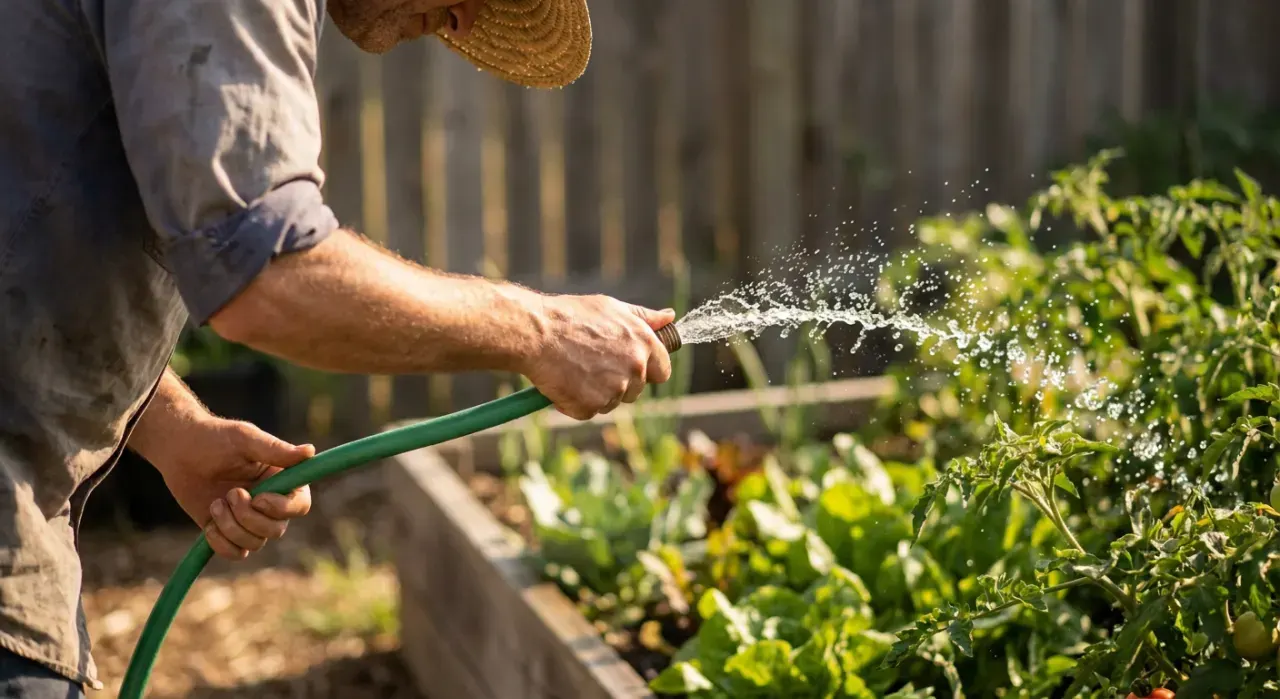
Water between about 4am and 9am. Evaporation losses are lowest, wind is usually calmest, and the blades dry quickly once the sun rises — which matters because prolonged leaf wetness is what feeds brown patch and dollar spot in cool-season turf. Clemson's guidance notes that morning irrigation lets blades dry fast, reducing the chance of fungal spores germinating on the leaf. Evening and overnight watering does the opposite. Full reasoning in the best time of day to water a lawn.
How to tell the lawn actually needs water
Three reliable signs, all better than a calendar. Footprints stay visible — healthy turf springs back, water-stressed turf holds the impression. Color shifts from green toward a dull blue-gray before it browns. Blades fold lengthwise to reduce surface area. Any of these means water now; none of them means skip a scheduled session, especially after rain. That is what a rain gauge or a weather-linked controller is for.
Where to go next
To automate a dawn schedule, see the best hose timers and how a hose timer works. For the hardware itself, our ranked best lawn sprinklers and best oscillating sprinklers compare current models. See also how much to water a garden and the irrigation water cost calculator. Everything sits under the watering and irrigation hub.
We never buy or physically handle the products we rank — recommendations come from aggregated owner reviews and expert consensus. Full method: how we rank.