 Garden
Affiliate Disclosure
Some links on this page are affiliate links. As an Amazon Associate, we earn from qualifying purchases — at no extra cost to you. We do not buy, test, or physically handle the products we cover; our rankings come from aggregated owner reviews, ratings and expert consensus. Commissions never change our verdicts. How we rank · full disclosure.
The short answer: the best rain gauge is the AcuRite 00850A3 magnifying rain gauge at around $12. It suits almost every gardener because it solves the problem that decides whether a gauge actually gets used — a magnifying lens moulded into the acrylic body roughly doubles the apparent scale, so you read a tenth of an inch standing up rather than kneeling in wet grass. If you want a reading that matches the official climate record, the Stratus RG202 is the gauge the national volunteer observer network uses.
One thing matters more than which gauge you buy, though: where you put it. A perfect instrument mounted against a wall under-reads by 20 to 40 percent. Siting is covered below, and it takes two minutes to get right.
Where to Put It — This Matters More Than the Gauge
Rain does not fall neatly into a small opening when there is anything nearby to disturb the airflow. A building, a fence or a tree creates eddies that carry droplets past the gauge rim, and the result is consistently low readings.
The rule used by the National Weather Service and by volunteer observer networks is simple: the gauge should be at least twice as far from any obstacle as that obstacle is tall.
| Nearby object | Its height | Minimum distance |
|---|---|---|
| Garden fence | 6 ft | 12 ft |
| Shed | 8 ft | 16 ft |
| House | 20 ft | 40 ft |
| Mature shade tree | 40 ft | 80 ft |
Three more rules that cost nothing. Mount the rim level — a tilted gauge presents a smaller effective opening to vertical rain. Set it 3 to 5 feet above the ground: lower and you collect splash from the soil, higher and wind effects grow. And never mount it on a house wall or under an eave, which is where most people put one and is the single biggest source of bad readings.
If your yard is small and nothing meets the doubling rule, get as close as you can and accept that your readings are relative rather than absolute — useful for comparing this week to last week, less useful for comparing with the airport.

Top Picks at a Glance
Our #1 Pick: AcuRite 00850A3 Magnifying Rain Gauge
The reason this gauge outsells the rest of the category combined is not accuracy — plenty of $10 gauges are accurate. It is that you can read it.
The front face of the acrylic body is moulded as a magnifying lens, which roughly doubles the apparent width of the scale and the apparent height of the water column. In practice that means you can stand on the path and read a tenth of an inch, instead of crouching down over a thin plastic tube in wet grass. Gauges that require kneeling get read for a fortnight and then ignored; this one gets read all season, which makes it the more accurate instrument in the only sense that matters.
The rest is well judged. Five inches of capacity handles all but exceptional storms. Graduations are in tenths of an inch, which is the resolution garden decisions actually need — nobody irrigates differently for 0.42 versus 0.45 inches. The acrylic body tolerates a light freeze considerably better than a glass tube, though it should still be emptied before hard frost. It comes with both a ground stake and a mounting bracket, so it can go in a bed or on a post.
At around $12, the sensible move is to buy two: one in the vegetable garden and one at the far end of the yard. Summer thunderstorms are genuinely patchy, and two gauges 100 feet apart routinely disagree by a quarter inch.
Honest limitations: it must be emptied by hand after every rain, the acrylic clouds slightly after a few seasons of UV exposure, and it does not measure snow usefully. None of that stops it being the right first gauge for nearly everyone.
Check price on Amazon → (paid link)
The Ranked Field
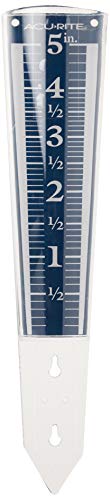
Best for almost every gardener — accurate, cheap and readable from the porch
- 5 inch capacity in 1/10 inch graduations
- Magnifying lens doubles the apparent scale
- Acrylic body that survives a freeze better than glass
- Stake or mounting bracket included
Why buy it: the magnifier is the whole reason this outsells everything else — you can read a tenth of an inch without walking over and bending down.
Best for anyone who wants a measurement that matches the official record
- 4 inch collector matching the US standard gauge design
- Inner tube reads to 1/100 inch
- Overflow cylinder measures up to 11 inches
- Doubles as a snow gauge with the funnel removed
Why buy it: this is the gauge design the CoCoRaHS volunteer network uses, so your reading is directly comparable to the national data set.

Best for reading rainfall from indoors without going outside
- Tipping-bucket collector empties itself
- Indoor display updates roughly every 60 seconds
- Stores rainfall history by day, week and month
- Programmable rainfall alarms
Why buy it: a self-emptying tipping bucket means you get a running seasonal total without ever remembering to reset anything.

Best for reading the gauge from a window or across the yard
- 21 inches tall with a high-visibility float
- Readable from around 50 feet away
- Freeze-proof, made in the USA
- Stake or mount to a post or fence
Why buy it: a colored float rising up a giant scale is legible from the kitchen window, which is the only place most people want to read it from.

Best for rainfall plus temperature on one indoor display
- Self-emptying tilting cups measure rainfall
- Rainfall history covering the last several months
- Indoor and outdoor temperature
- 12 or 24 hour clock display
Why buy it: rainfall and temperature together tell you far more about what your garden actually experienced than either does alone.

Best for a gauge you are happy to have in a front bed
- Decorative metal frame with a glass tube
- Water cascades to a visible level indicator
- Stakes into a bed or border
- Tube lifts out for cleaning
Why buy it: the only gauge here that people put in a front garden deliberately, and it still reads accurately.
Quick Comparison
| Product | Best for | Rating | Price | Buy |
|---|---|---|---|---|
| AcuRite 5 inch Capacity Easy-to-Read Magnifying Rain Gauge 00850A3 | Best Overall | — | Check (paid link) | |
| Stratus RG202 Long Term Professional Rain and Snow Gauge | Best Accuracy | — | Check (paid link) | |
| AcuRite 00899 Wireless Digital Rain Gauge with Self-Emptying Collector | Best Wireless | — | Check (paid link) | |
| Headwind EZRead 21 inch Giant Professional Outdoor Rain Gauge | Best Read From a Distance | — | Check (paid link) | |
| La Crosse Technology 724-1710 Wireless Rain Gauge Weather Station with Thermometer | Best Weather Station | — | Check (paid link) | |
| La Crosse 705-109 Waterfall Rain Gauge | Best Decorative | — | Check (paid link) |
How We Rank
We do not buy or calibrate rain gauges. We read the owner-review record at volume and weigh it against the measurement fundamentals. Four things carry the most weight here. Readability, which sounds trivial and is the strongest predictor of whether a gauge is still being used in year two. Collector geometry — a sharp, level rim with a known aperture, since a rounded or flared rim causes splash-out in heavy rain. Freeze survival, tracked through reviews written after a first winter, where cracked tubes dominate. And maintenance friction, meaning whether the gauge empties itself, cleans easily, and stays legible after a few seasons of sun. Prices were checked at time of writing. Full method on how we rank.
The Rain Gauges, Reviewed
1. AcuRite 00850A3 Magnifying Rain Gauge — Best Overall
Covered above. What owners consistently praise: that it is genuinely readable from a distance, the price, the sturdy acrylic body, and that both a stake and a bracket are included. Recurring complaints: the acrylic yellows and clouds after several seasons in strong sun; the stake is short and works loose in soft ground, so many owners fix it to a post instead; and it must be emptied manually or the next reading is cumulative. A minority report cracking after a hard freeze — empty it before winter. Check price (paid link).
2. Stratus RG202 Long Term Professional Rain and Snow Gauge — Best Accuracy
This is the serious instrument, and the reason to own one is that rainfall counts toward the weekly total: EPA WaterSense measures landscape demand as about an inch a week including rain. The Stratus follows the classic US standard gauge design: a 4-inch collector funnels rain into a narrow inner tube where the same volume stands ten times higher, giving readings to a hundredth of an inch. When the inner tube overflows, the excess is caught in an outer cylinder that carries the total to about 11 inches. Remove the funnel and inner tube and it works as a snow gauge — you melt the catch and pour it into the inner tube for water equivalent.
The reason to care: this is the gauge design used by the Community Collaborative Rain, Hail and Snow Network, the volunteer observer network whose data feeds into National Weather Service products. Your reading is directly comparable to that dataset rather than approximately comparable.
Recurring complaints: at around $45 it costs several times the AcuRite; the three-part assembly means more to clean and more to lose; and reading the inner tube properly requires bending down and getting your eye level with the meniscus, which is the opposite of the AcuRite's appeal. Buy it if you want data, not if you want convenience. Check price (paid link).
3. AcuRite 00899 Wireless Digital Rain Gauge — Best Wireless
A tipping-bucket collector outside and a display indoors. Rain funnels onto a tiny see-saw bucket which tips and empties each time it fills with a set volume, and each tip is counted. The advantage is that it never needs emptying and it keeps a running history by day, week and month, so a seasonal total accumulates without you doing anything. Rainfall alarms can be set, which is genuinely useful if you are managing irrigation.
Recurring complaints: tipping buckets under-read intense downpours, because rain keeps arriving during the fraction of a second the bucket is tipping — this is a known characteristic of the design, not a defect; the collector needs cleaning, since leaf debris and insects jam the mechanism and the gauge then silently reads zero; and battery life in the outdoor unit is the most common gripe. Check it after any storm that reads suspiciously low. Check price (paid link).
4. Headwind EZRead 21 inch Giant Rain Gauge — Best Read From a Distance
The readability idea taken to its logical end. A 21-inch tube with an enormous scale and a brightly colored float that rises with the water, legible from around 50 feet — which is to say, from the kitchen window. Made in the USA, built freeze-proof, and it stakes into a bed or mounts to a fence post.
Recurring complaints: the resolution is coarser than a proper gauge, so it reads to quarter or eighth inches rather than hundredths; it is visually prominent, which some people want and others do not; and the float can stick if the tube gets dirty, so it needs an occasional rinse. For deciding whether to water, coarse resolution is entirely sufficient. Check price (paid link).
5. La Crosse Technology 724-1710 Wireless Rain Gauge Weather Station — Best Weather Station
Rainfall and temperature on one indoor display, with self-emptying tilting cups outside and history covering the last several months. The pairing is more useful than it first appears: an inch of rain in 85°F weather with wind is a different event for a garden than an inch in 60°F overcast, and having both numbers in front of you improves watering decisions.
Recurring complaints: the wireless link drops at longer distances or through masonry walls, which is the most common gripe; the display is dated; and the same tipping-cup under-reading applies in heavy rain. Several owners note the outdoor sensor needs a clear sky view and suffers if sited under any overhang. Check price (paid link).
6. La Crosse 705-109 Waterfall Rain Gauge — Best Decorative
The one people put in a front bed on purpose. A decorative metal frame holds a glass tube, and the water level reads against a visible indicator. It measures properly while looking like a garden ornament, which is a genuine niche — plenty of gardeners will not put a plain plastic tube where visitors see it.
Recurring complaints: glass is the wrong material for freezing climates, and cracked tubes after a hard frost are the dominant complaint; the metal frame rusts at the welds over a few seasons; and it has less capacity than the practical gauges, so a big storm overflows it. Bring it in for winter. Check price (paid link).

Turning a Reading Into a Watering Decision
A gauge is only useful if it changes what you do. The working rule for most US gardens in the growing season is roughly one inch of water per week, from rain and irrigation combined — the same figure EPA WaterSense gives, noting a landscape typically requires one inch of water a week including rainfall.
| Gauge reads this week | What to add | Roughly, per 100 sq ft |
|---|---|---|
| 1.0 in or more | Nothing | — |
| 0.5 in | 0.5 in | ~31 gallons |
| 0.25 in | 0.75 in | ~47 gallons |
| 0 in | 1.0 in | ~62 gallons |
One inch of water over 1,000 square feet is about 620 gallons — which is why deep, infrequent watering beats a daily sprinkle — EPA WaterSense attributes as much as 50 percent of outdoor water use to wind, evaporation and runoff caused by inefficient irrigation methods and systems. Adjust upward for new plantings, containers and sandy soil, and downward for established natives, clay soil and shade. To find out how long your sprinkler takes to deliver an inch, put empty tuna cans around the zone and time how long they take to fill to one inch — see how long to run a lawn sprinkler.
What Owners Actually Complain About
Cracked after the first freeze. The dominant complaint across the category. Water expands as it freezes and splits tubes. Empty and store anything not explicitly freeze-proof.
Readings that seem too low. Almost always siting. A gauge under an eave, against a fence or beside a shrub will consistently under-read. Move it before blaming it.
Digital gauges reading zero after a storm. Debris or an insect jamming the tipping bucket. Rinse the collector twice a season.
Stakes that fall over. Supplied stakes are short and soft ground does not hold them. Fix the gauge to a fence post or drive a length of rebar and cable-tie it.
Clouded plastic. UV degradation over several seasons. Cheap enough to replace; a reason to consider the metal-framed or professional options if you want a decade.
The Verdict
For a gauge you will actually read all season, the AcuRite 00850A3 is the one the owner-review record supports most strongly, and at around $12 you should buy two and put them at opposite ends of the yard. Want data that lines up with the official record? The Stratus RG202. Want to never go outside? The AcuRite 00899 wireless, cleaned twice a season. Want to read it from the kitchen? The Headwind EZRead. And whichever you buy, site it twice as far from anything as that thing is tall — that single decision affects your readings more than the price of the gauge. Check price on Amazon → (paid link)
Next: the full watering and irrigation hub · how much to water a garden · best hose timers · best rain barrels · how we rank.