 Garden


Affiliate Disclosure
Some links on this page are affiliate links. As an Amazon Associate, we earn from qualifying purchases — at no extra cost to you. We do not buy, test, or physically handle the products we cover; our rankings come from aggregated owner reviews, ratings and expert consensus. Commissions never change our verdicts. How we rank · full disclosure.
The short version: the Rachio 8-zone is the best sprinkler controller for most in-ground systems, because it is the one that asks about soil, slope and sun exposure for each zone and then actually waters them differently. The Orbit B-hyve 6-zone does most of the same work for around half the money and mounts outdoors. If you already own a compatible Rain Bird, the LNK2 WiFi module makes it smart without replacing anything.
Below the picks, there is a section on the question that matters more than the ranking: whether a smart controller is worth buying at all. The answer is genuinely "it depends," and it depends on things you can check in ten minutes.
Top Picks at a Glance

Our #1 Pick: Rachio 8-Zone Smart Sprinkler Controller
Nearly every controller sold as "smart" does the same headline trick — it reads a weather feed and skips a cycle when rain is forecast. That is worth having, but it is a blunt instrument, and it is why plenty of owners install one and see very little change in their water bill.
What separates the Rachio in the owner-review record is the setup interview. It asks, per zone, what the soil is, what the slope is, how much sun the area gets, what type of head is installed and what is planted. It then builds a watering schedule from those inputs rather than applying one seasonal percentage across the whole system. A clay bed in shade and a sandy strip along a south-facing driveway are two different watering problems, and the Rachio is the mainstream controller that treats them that way.
Two honest caveats. The base unit is designed for indoor mounting, so a garage-free house needs the weatherproof enclosure as an extra purchase, and reviewers who mounted it far from the router report reconnection nuisances — the unit is 2.4 GHz only, like most of this category. Neither is a reason to avoid it, but both belong in the budget and the plan.
Check price on Amazon → (paid link)
The Ranked Field

Best for the typical suburban in-ground system with four to eight zones
- 8 zones, indoor mounting with an optional outdoor enclosure
- Weather Intelligence skips cycles from local forecast and rainfall data
- Per-zone setup for soil type, slope, sun exposure and head type
- Works with Alexa, Google Assistant and IFTTT; open local API
Why buy it: the zone-by-zone setup is the reason it saves water rather than just automating waste — it builds a different schedule for a shaded clay bed than for a sunny sand slope.

Best for a garage or outside wall where a weatherproof case matters
- Weather-resistant case rated for outdoor mounting
- WeatherSense adjusts run times from local weather
- Bluetooth control works even when the WiFi drops
- EPA WaterSense labeled
Why buy it: roughly half the price of the Rachio with the same core behavior, and the only pick here you can hang on an exterior wall without buying an enclosure.
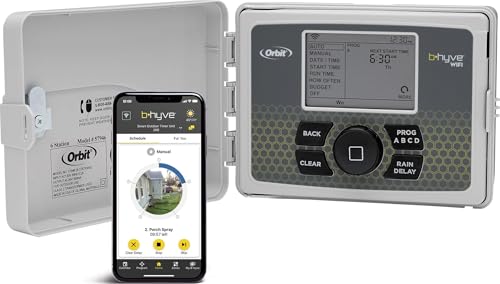
Best for larger properties running eight to twelve zones
- 12 zones in the same weather-resistant outdoor case
- Bluetooth plus WiFi, with schedules stored on the unit
- Manual zone run and rain delay from the front panel
- Master valve and pump start terminal
Why buy it: twelve zones for less than most eight-zone competitors, and it keeps running its schedule when the router does not.

Best for anyone with a compatible Rain Bird ESP-TM2 or ESP-Me already on the wall
- Plugs into the front of a compatible Rain Bird controller
- Adds app control, weather-based skips and seasonal adjust
- Keeps the existing wiring, valves and enclosure
- No rewiring of zone terminals
Why buy it: the cheapest honest route to a smart system if you already own the right Rain Bird — you are buying the brain, not a whole new box.

Best for a first smart controller on a small system without a subscription
- 6 zones with app scheduling and weather service
- 2.4 GHz WiFi, no hub required
- Plant, soil and sun exposure inputs per zone
- Free weather service with no ongoing fee
Why buy it: the least money that still buys genuine weather-based skipping rather than a timer you can poke from your phone.

Best for beds, drip lines and hose sprinklers on a property with no buried system
- Screws onto a standard 3/4 in. hose faucet
- Includes the WiFi hub that bridges the timer to the app
- Rain skip and freeze skip from the same Rachio weather data
- Expandable to multiple valves on one hub
Why buy it: brings the smart-skip logic to renters and to yards that will never have a buried system, which is most of the country.

Quick Comparison
| Product | Best for | Rating | Price | Buy |
|---|---|---|---|---|
| Rachio WiFi Smart Sprinkler Controller, 8-Zone | Best Overall | — | Check (paid link) | |
| Orbit B-hyve Smart Indoor/Outdoor Sprinkler Controller, 6-Zone | Best Value | — | Check (paid link) | |
| Orbit B-hyve Smart Indoor/Outdoor Sprinkler Controller, 12-Zone | Best for Big Systems | — | Check (paid link) | |
| Rain Bird LNK2 Smart WiFi Module, 2nd Generation | Best Upgrade for an Existing Controller | — | Check (paid link) | |
| Netro 6-Zone Smart Sprinkler Controller | Best Budget Smart Controller | — | Check (paid link) | |
| Rachio Smart Hose Timer with WiFi Hub | Best Without an In-Ground System | — | Check (paid link) |
Are Smart Sprinkler Controllers Actually Worth It?
This is the question underneath the whole category, and the marketing answer — "save up to 50 percent" — is not a number anyone should plan around. Here is the honest version.
The case for. EPA WaterSense reports that outdoor water use accounts for more than 30 percent of total household water use on average, and as much as 60 percent in arid regions, and that a household with an automatic irrigation system that is not properly maintained and operated can waste up to 25,000 gallons of water annually. A controller that skips a cycle after two inches of rain, and that shortens runs in October instead of watering July amounts into November, removes a real and recurring chunk of that. EPA's WaterSense labeling program for irrigation controllers exists precisely because the savings are measurable enough to certify.
The case against. If your system currently runs on a dumb timer that you already adjust seasonally and shut off when it rains, you are the person a smart controller saves least. And if your zones have broken heads, sunken bodies, mixed spray and rotor heads on one circuit, or nozzles that throw water onto the driveway, a smart controller will simply automate that waste with better logging. Every dollar spent on fixing coverage returns more than a dollar spent on the controller.
The payback math, done honestly
Run the arithmetic on your own numbers rather than a brochure's. A 5,000 square foot lawn given one inch of water needs roughly 3,100 gallons per application. If a smart controller skips six applications across a season that you would otherwise have run, that is about 18,600 gallons. At a combined water and sewer rate of $8 per thousand gallons — a middling US figure, though rates range from under $3 to over $20 depending on the utility — that is around $150 a season, and the controller pays for itself in year one. At $3 per thousand gallons on an unsewered well-adjacent rate, it is $56 a season and payback runs to three years. Neither is wrong; they are different utilities. The irrigation water cost calculator will do this with your actual rate and zone count.
How to Choose
Start with zone count, and add headroom. Buy at least two terminals more than you currently use. Splitting an overloaded zone is the most common irrigation repair there is, and it needs a spare terminal.
Decide where it will physically live. If there is no garage, basement or utility room, either buy a controller rated for outdoor mounting — which in this list means the Orbit B-hyve units — or budget for an enclosure. Mounting an indoor controller under an eave is a warranty problem waiting to happen.
Check what happens when the internet dies. The controllers here that hold their schedule locally and can be operated without the cloud are meaningfully safer long-term purchases than any unit whose only interface is an app.
Look for the WaterSense label if your utility offers a rebate. Many US water districts rebate $50 to $100 on labeled controllers, which changes the payback math immediately. Check your provider's conservation page before you order.
Do not buy a controller to fix a design problem. If a zone browns out at the far end, the issue is flow or head spacing, not scheduling. Work out what your system can actually carry with the sprinkler zone capacity calculator and measure your supply with the water flow rate calculator first.

What Owners Actually Complain About
WiFi, by a wide margin. Every controller in this category is 2.4 GHz only, and they get mounted in garages, basements and meter pits — the three worst signal locations in a house. A large share of one-star reviews are network complaints rather than irrigation complaints. Check signal strength at the mounting spot with a phone before you buy, and budget for a mesh node if it is marginal.
App changes. Owners across brands report interfaces being redesigned and features moving. This is the cost of a cloud-connected appliance and it is not going away.
Over-eager rain skips. A light shower that wets the surface without reaching root depth can still trigger a skip on some units. Most controllers let you raise the rainfall threshold; it is worth finding that setting in the first week rather than the third dry August.
Wiring confusion on replacement. Almost always because the old terminal strip was not photographed first. Take the picture.
Freeze damage to outdoor units. Controllers in unheated spaces survive; the valves and backflow assembly they control often do not. That is a separate job — see how to winterize a sprinkler system.
How We Rank
We do not buy, install or operate these controllers. Rankings come from aggregating owner star ratings and review volume across the smart-controller category, weighting long-ownership reviews more heavily than launch-window ones, and cross-checking zone counts, radio specifications, enclosure ratings and local-control behavior against manufacturer documentation. Four things carry the weight: scheduling intelligence, meaning whether the unit models each zone or applies a blanket adjustment; reliability without the cloud; installation reality, including enclosure needs and terminal count; and owner satisfaction weighted by review volume. Prices were checked at the time of writing and move seasonally. Full method: how we rank.
The Verdict
For most in-ground systems, buy the Rachio 8-zone — the per-zone modeling is the feature that converts weather data into water saved. Buy the Orbit B-hyve 6-zone if the controller has to live outdoors or the budget is tight, the B-hyve 12-zone if you have a big property, and the Rain Bird LNK2 module if a compatible Rain Bird is already on the wall. If there is no buried system at all, the Rachio Smart Hose Timer brings the same skip logic to a faucet.
Check price on Amazon → (paid link)
Next: set it up properly with how to program a sprinkler timer, understand the plumbing behind it in what is a sprinkler zone, or price the whole job in how much a sprinkler system costs. Hub: watering and irrigation.