 Garden


Affiliate Disclosure
Some links on this page are affiliate links. As an Amazon Associate, we earn from qualifying purchases — at no extra cost to you. We do not buy, test, or physically handle the products we cover; our rankings come from aggregated owner reviews, ratings and expert consensus. Commissions never change our verdicts. How we rank · full disclosure.
There is no such thing as "the best sprinkler system" you can put in a cart. A residential irrigation system is a controller, a set of valves, buried pipe, heads and — non-negotiably — a backflow prevention assembly. What people mean when they search this is usually one of three different questions: which DIY kit should I start with, which controller should I upgrade to, or which heads should I buy. This page ranks all three, because that is how the money is actually spent.
One thing to settle before any of it: an in-ground system connected to your drinking water requires a code-compliant backflow preventer, and in most US jurisdictions it must be tested when installed and every year after. That is covered properly below, because it is the part of this category with a genuine public health consequence.
Top Picks at a Glance

The rule you cannot skip: backflow prevention
An irrigation system tied into a potable supply is a cross-connection. When pressure in the street drops — a main break, a hydrant opened for a fire, a pump shutting down — water can be drawn backward out of the lower-pressure side. In an irrigation system that means water that has been sitting in buried pipe and valve boxes, in soil carrying fertilizer, herbicide and pet waste, moving into the drinking water.
The EPA's Cross-Connection Control Manual documents repeated, verified cases of drinking water contamination traced to backflow, and the agency's cross-connection control fact sheet lists lawn irrigation among the most common residential hazards.
What this means in practice: most water utilities require an approved assembly — commonly a pressure vacuum breaker mounted at least 12 inches above the highest head, or a reduced pressure principle assembly where the hazard rating is higher — plus a certified test at installation and annually thereafter, typically $50 to $200 per test. Some cities require a licensed plumber to make the tap. Local code governs and varies widely; call your water utility's cross-connection control program before you buy parts. No sprinkler kit on this page, or anywhere else, exempts you from it.
Our #1 Pick: Rain Bird 32ETI DIY Kit
This ranks first with an important caveat: it is not a whole-property system and does not pretend to be. What it is, is the least painful way for a homeowner to find out whether they want an in-ground system at all.
The kit ships with rotor heads, tubing, fittings and a timer, and it connects to an outdoor faucet using hose thread rather than requiring a permitted tap into the mains. You trench one zone, learn how head spacing and pressure actually behave in your yard, and end up with a real buried zone watering perhaps 700 to 1,300 square feet. If you then want four more zones, you have learned the trade on a $120 mistake budget rather than a $3,000 one. Rain Bird publishes an official installation video for this exact kit, which is unusual and genuinely useful.
The consistent owner criticism is coverage: the rated area assumes pressure and flow that many spigots do not deliver, and households on soft supply report heads throwing well short. Measure your pressure and flow before you order — the water flow rate calculator takes thirty seconds and prevents most of the disappointment in this category.
Check price on Amazon → (paid link)
The Ranked Field

Best for a first in-ground zone without cutting into the mains supply
- Rotor heads, tubing, fittings and a timer in one box
- Connects to an outdoor faucet with hose thread
- Covers roughly 700–1,300 sq ft depending on layout
- Rain Bird publishes a full install video for this kit
Why buy it: it is the only realistic way to learn in-ground irrigation on one zone before deciding whether to commit to a permitted mains tap.

Best for an existing system that waters the day after it rains
- Eight zones with app-based scheduling
- Local weather intelligence skips and delays automatically
- Zone-by-zone soil, slope and head-type settings
- EPA WaterSense labeled
Why buy it: the schedule engine models soil type and head output per zone rather than just running the timer you set, which is where the water saving actually comes from.

Best for upgrading a mechanical timer on a budget
- Six zones in a weatherproof enclosure, indoor or outdoor
- WeatherSense adjusts from local forecast data
- Full manual control at the panel if WiFi drops
- EPA WaterSense labeled
Why buy it: about half the price of the Rachio with the same core benefit — it stops watering when it has rained, which is the bulk of the saving.

Best for open lawn areas more than about 20 feet across
- Adjustable 40°–360° arc with a fixed left stop
- 22–52 ft radius depending on the nozzle fitted
- Interchangeable nozzle tree in the box
- Self-flushing wiper seal on retraction
Why buy it: the most-installed residential rotor in the country, which means every irrigation counter in America stocks the parts and every contractor knows it.

Best for beds, side strips and lawn areas under about 15 feet across
- Variable arc nozzle adjusts 0°–360° by hand
- 8–15 ft radius, co-molded wiper seal
- Heavy-duty retraction spring
- Standard 1/2 in. female thread inlet
Why buy it: the industry default spray body, and the variable arc nozzle means one part number covers every corner and edge on the property.
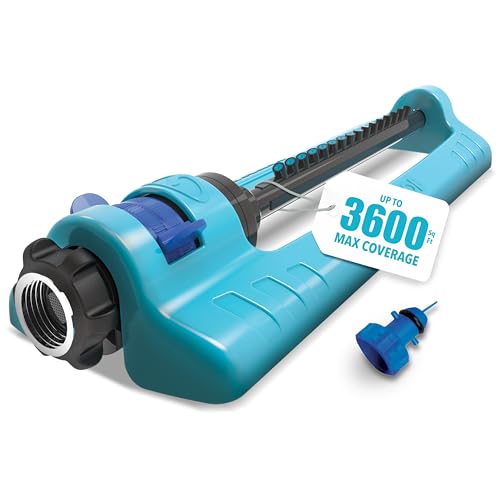
Best for renters, small lawns and anyone not ready to trench a yard
- 16 clog-resistant nozzles on an adjustable tube
- Weighted metal base resists walking
- Range, width and flow adjust separately
- Pairs with any hose timer for automation
Why buy it: paired with a hose timer this automates watering for under $60 and no permit, which suits a great many properties better than an in-ground system does.

Quick Comparison
| Product | Best for | Rating | Price | Buy |
|---|---|---|---|---|
| Rain Bird 32ETI DIY Self-Install In-Ground Automatic Sprinkler System Kit | Best DIY In-Ground System | — | Check (paid link) | |
| Rachio WiFi Smart Sprinkler Controller, 8-Zone Irrigation Remote Control | Best Controller | — | Check (paid link) | |
| Orbit B-hyve Smart Indoor/Outdoor Sprinkler Controller, 6-Zone, WiFi | Best Value Controller | — | Check (paid link) | |
| Hunter PGP-ADJ 3/4 in. Rotor Lawn Sprinkler Head, 22–52 ft, 4 in. Pop-Up | Best Rotor Head | — | Check (paid link) | |
| Rain Bird 1804VAN 1800 Series 4 in. Pop-Up Sprinkler Head, 5 Pack, Adjustable Nozzle | Best Spray Head | — | Check (paid link) | |
| Aqua Joe Oscillating Sprinkler with Adjustable Spray, 16 Clog-Resistant Nozzles, Metal Base | Best No-Dig Alternative | — | Check (paid link) |
Why the controller is the upgrade that pays
If you already have a working system, replacing heads rarely changes your water bill. Replacing the controller does. A fixed-schedule timer runs the same minutes in a wet April as in a dry August, and the single largest source of residential irrigation waste is watering that was not needed — most visibly, systems running the morning after a thunderstorm.
Weather-linked controllers pull local forecast and rainfall data and skip or shorten cycles accordingly. The better ones also model each zone: soil type, slope, sun exposure and head type, so a shaded rotor zone and a sunny spray zone get genuinely different schedules rather than one schedule scaled up and down. The EPA notes that residential outdoor water use in the US amounts to nearly 8 billion gallons a day, and that the average household uses more water outdoors than for showering and laundry combined.
The Rachio does the zone modeling more thoroughly; the Orbit B-hyve does the core job — skipping unnecessary cycles — for roughly half the money. The recurring complaint across both, and across every brand in the category, is WiFi: controllers mounted in a detached garage at the edge of the signal drop off the network. Both keep working on their last schedule and both have manual panel control, but check your signal at the mounting point before you buy.
Choosing heads: rotors, sprays, or neither
| Head type | Radius | Application rate | Use it for |
|---|---|---|---|
| Gear-drive rotor (Hunter PGP) | 22–52 ft | 0.4–0.8 in/hr | Open lawn over ~20 ft across |
| Fixed spray body (Rain Bird 1804) | 8–15 ft | 1.5–2.0 in/hr | Beds, strips, small lawns |
| Rotary nozzle on a spray body | 13–24 ft | 0.4–0.6 in/hr | Mid-size areas, slopes and clay |
| Impact sprinkler | 20–45 ft | 0.3–0.5 in/hr | Low pressure, hard water, above ground |
| Drip line | n/a | Very low | Beds, hedges, vegetables — always its own zone |
The rule that matters more than any brand choice: never put rotors and spray heads on the same zone. Sprays apply water three to four times faster, so no run time serves both. Zone sizing is worked through properly in how many sprinkler heads per zone, and our sprinkler zone calculator checks a proposed layout against your measured flow.

How We Rank
We do not buy, install or physically handle these products. Rankings come from aggregated owner ratings across the most-owned models in each component category, weighted toward long-ownership reviews where seal failures, stalled rotors and controller connectivity problems appear, and cross-checked against manufacturer specifications for radius, flow and pressure range. Four things carry the weight: real-world coverage at ordinary household pressure rather than laboratory pressure; durability, particularly wiper seals and gear trains; parts availability, because a head you cannot get a nozzle for is a liability; and water efficiency, where the EPA WaterSense label is a meaningful signal on controllers. Prices were checked at the time of writing. Full method: how we rank.
What Owners Actually Complain About
DIY kits under-delivering coverage. Overwhelmingly the top complaint, and usually a pressure problem rather than a defect. Rated areas assume inlet pressure that many spigots do not supply.
WiFi dropouts on smart controllers. Garage and side-yard mounting points sit at the edge of household coverage. Both leading brands keep running their last schedule offline, but the app going dark annoys people.
Wiper seals leaking on pop-up bodies. The usual cause is grit from an unflushed install, which is why flushing every lateral before fitting nozzles matters so much.
Rotors stalling. Almost always too many heads on the zone rather than a bad head. Cap one head and see whether the rest improve.
Freeze damage. Systems left charged over a hard winter crack valves and fittings. See how to winterize an irrigation system.
The Verdict
If you are starting from nothing and want to test the idea, the Rain Bird 32ETI is the honest entry point. If you already have a system, put the money into a Rachio 8-zone or the cheaper Orbit B-hyve controller before you touch anything underground — that is the change you will see on the bill. For heads, Hunter PGP-ADJ rotors on open lawn and Rain Bird 1804VAN spray bodies on everything tight is the combination most contractors install for good reason. And if your lawn is under a few thousand square feet, an oscillating sprinkler on a timer is not a compromise — it is the correct answer.
Whatever you build, sort out the backflow assembly with your water utility first. Check controller prices on Amazon → (paid link)
More from this hub: watering & irrigation · how to install a sprinkler system · best pop-up sprinkler heads · best lawn sprinkler · how to adjust sprinkler heads · how we rank.