 Garden

Affiliate Disclosure
Some links on this page are affiliate links. As an Amazon Associate, we earn from qualifying purchases — at no extra cost to you. We do not buy, test, or physically handle the products we cover; our rankings come from aggregated owner reviews, ratings and expert consensus. Commissions never change our verdicts. How we rank · full disclosure.
The short answer: use drip if the beds are permanent, if plants are spaced irregularly, if you have hard water, or if the run is longer than about 50 feet. Use soaker hose for dense straight rows — a vegetable garden, a hedge line, a strawberry bed — where every foot of soil wants water and the run is short. Drip costs roughly two to three times as much and lasts three to five times longer, delivers a known volume per plant, and does not gradually clog the way porous rubber does.
Both are low-pressure, low-waste systems that put water at the root zone instead of on the foliage, and both are enormous improvements over standing there with a nozzle. The difference is control and lifespan, and the honest answer for a lot of gardens is soaker in the vegetable rows and drip everywhere else.
We never buy or physically handle the products we rank; our verdicts come from aggregated owner reviews, star ratings and expert consensus, described in how we rank. The wider picture is at the watering and irrigation hub.
Head to Head
| Drip irrigation | Soaker hose | |
|---|---|---|
| Cost per foot | $0.30 to $0.80 tubing, plus head assembly | $0.20 to $0.50 |
| Typical starter cost | $60 to $150 for a bed system | $20 to $40 for one hose |
| Setup time | 2 to 4 hours first time | 15 minutes |
| Max practical run | 100 to 200 ft per line | 50 to 100 ft |
| Evenness along the run | Excellent with pressure-compensating emitters | Poor beyond about 50 ft |
| Control per plant | Yes — 0.5, 1 or 2 GPH emitters | No — waters the whole length |
| Clogging | Low with a 150 mesh filter | High, especially in hard water |
| Lifespan | 8 to 15 years | 2 to 5 years |
| Repairable | Yes, couplings and goof plugs | Barely |
| Best for | Mixed beds, shrubs, containers, long runs | Dense rows, hedges, short runs |
How Each One Actually Works
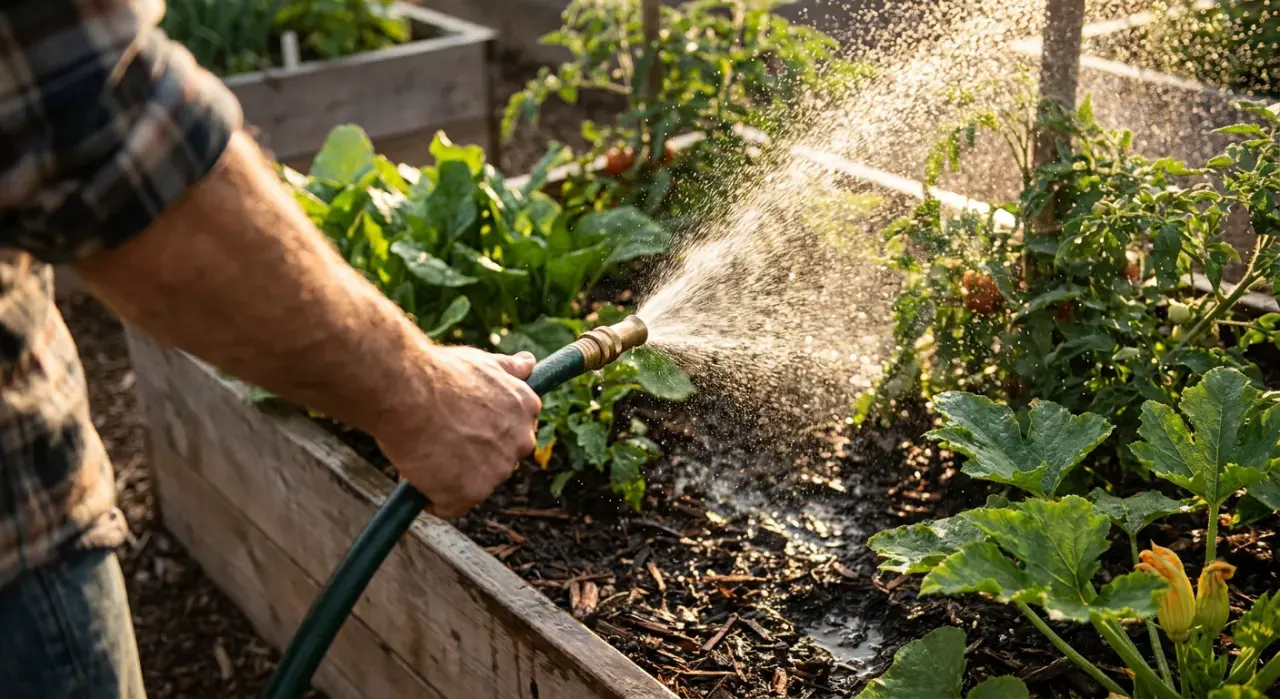
Soaker hose is porous rubber, usually made from recycled tires, that weeps water along its entire length. There is no metering and no engineering inside it — flow out of any given inch depends on the pressure at that inch. That is elegant when the run is short and every foot of soil wants water, and it is the source of every one of its limitations.
Drip irrigation is solid tubing with discrete outlets. Either inline emitters molded into the tubing at fixed spacing — 6, 12 or 18 inches — or a half-inch mainline with quarter-inch micro-tubing carrying individual emitters to individual plants. Each emitter is rated in gallons per hour, typically 0.5, 1 or 2 GPH, so you know exactly how much water each plant is getting. Pressure-compensating emitters deliver that rated flow across a range of pressures, which is what keeps the far end of a 150-foot run as wet as the near end.
Control: Knowing What Each Plant Gets
This is the substantive advantage of drip and it is easy to underestimate. With 1 GPH emitters, a 90-minute cycle delivers 1.5 gallons per plant. You can put two emitters on a tomato and one on a pepper. You can put nothing at all on the drought-tolerant shrub at the end of the bed. A container garden can run on quarter-inch line with one emitter per pot.
Soaker hose gives you one variable: how long you leave it on. Everything the hose passes gets the same treatment, which is fine in a row of beans and wasteful in a mixed border where a lavender and a hydrangea are three feet apart. It also means you cannot easily water a plant that is 4 feet off the line without routing the whole hose past it.
The practical consequence is that soaker hose suits gardens laid out in rows and drip suits gardens laid out as compositions. Vegetable growers with 4 by 8 raised beds often prefer soaker for exactly this reason: the whole bed is the root zone.
Evenness and Run Length
Water leaving a soaker hose along the first 20 feet is water that is no longer available to pressurize the last 20 feet. On a 100-foot run at typical household pressure, the far end is measurably drier — and the usual response, running it longer, over-waters the near end without fixing the far one.
Keep soaker runs to 50 feet as a working rule. If you need more, split at the faucet and run two shorter lines, or use a half-inch solid feeder line to carry water to the far end of the garden and start the soaker there.
Drip does not have this problem in the same way, because each emitter is a calibrated restriction rather than a leak. Pressure-compensating emitters hold their rated flow from roughly 10 to 50 PSI, which keeps a long line even. Non-compensating emitters are cheaper and fine on short, flat runs. On sloped ground, pressure compensation is worth paying for — otherwise the downhill emitters deliver noticeably more than the uphill ones.
Clogging, Hard Water and Lifespan
Soaker hose clogs from the inside. Mineral deposits from hard water and fine sediment from the supply lodge in the pore structure of the rubber wall, and because the pores are the product, there is no way to clean them out. Owners in hard-water regions consistently report a clear drop in output within two to four seasons, and this is the most common reason soaker hose gets replaced.
Two things slow it substantially. An inline filter washer at the faucet — a few dollars — catches the sediment. And covering the hose with 2 to 3 inches of mulch protects the rubber from UV, which is the other half of what kills it; exposed soaker hose goes stiff and splits in a few summers of direct sun.
Drip clogs at the emitters, which are small orifices, but the standard head assembly is designed to prevent exactly that: a 150 mesh filter at the faucet catches particles before they reach the line. Emitters that do block can be pulled and replaced individually, and the mainline can be flushed by opening the end cap and letting it run for a minute at the start and end of each season. A drip system that is filtered, regulated, flushed and mulched routinely runs 8 to 15 years.
Cost Over Time
For a 4 by 8 raised bed:
| Drip | Soaker | |
|---|---|---|
| Initial outlay | $60 to $150 | $20 to $40 |
| Replacements in 10 years | 0 to 1 line | 2 to 4 hoses |
| 10-year total | $60 to $200 | $60 to $160 |
Over a decade the two land in the same neighborhood, which is why the decision is usually not about money. It is about whether you want control and evenness, or whether you want to lay a hose down in fifteen minutes and get on with your day. The head assembly — regulator, filter, backflow preventer, timer — is a one-time cost that then supports any amount of tubing you add later, which is why drip gets relatively cheaper the bigger the garden.
Where Each One Belongs
Choose soaker hose for: vegetable rows, raised beds where the whole soil volume is planted, hedge lines, strawberry and berry rows, short runs under 50 feet, and any bed you might reconfigure next year. It is cheap, instant and reversible.
Choose drip for: mixed ornamental beds with plants at different spacings and different needs, shrubs and trees, containers and hanging baskets, sloped ground, hard-water areas, runs over 50 feet, and anything you want on a timer and largely forgotten. It is the system that scales.
Run both if it fits. A single faucet with a splitter can feed a drip head assembly for the ornamental beds and a soaker line for the vegetable rows, each on its own schedule if you use a dual-outlet timer. That is a common and entirely sensible setup.
What Both Systems Need
Regardless of which you pick, three things apply. A backflow preventer at the faucet is required by most local plumbing codes on any irrigation connection and stops garden water siphoning back into household supply. A timer converts either system from a chore into infrastructure, and it is the single highest-value component in the whole setup — see best hose timer. And mulch on top protects the tubing from UV and roughly halves evaporation from the soil surface, which is doing more for your water bill than the tubing choice ever will.
Also get the volume right rather than guessing at run times. Most beds want the equivalent of about an inch of water per week, delivered deeply. Working that out for your emitters is covered in how much to water a garden, and if you go the drip route, the build from faucet to emitter is in how to set up drip irrigation. Ready-made kits with the head assembly included are ranked in best drip irrigation kit.