 Garden

Affiliate Disclosure
Some links on this page are affiliate links. As an Amazon Associate, we earn from qualifying purchases — at no extra cost to you. We do not buy, test, or physically handle the products we cover; our rankings come from aggregated owner reviews, ratings and expert consensus. Commissions never change our verdicts. How we rank · full disclosure.
The short answer: no. Shower filters do not soften hard water. Hardness is dissolved calcium and magnesium, and removing it requires ion exchange with a regenerating resin bed, which is a whole-house water softener costing $800 to $3,000 installed. The KDF, carbon and vitamin C media used in shower filters target chlorine, and the minerals pass straight through them. If your problem is white scale, soap that will not lather, spotting on glass, or a film on skin, a shower filter will not change any of it.
This is the single most oversold claim in the category, so it is worth being blunt about. We do not test filters ourselves; rankings come from aggregated owner reviews, certification records and manufacturer specifications, as explained in how we rank. More fixture guidance is at the bathroom hub.
Why can a shower filter not remove hardness?
Calcium and magnesium are dissolved ions, not particles, so no mechanical filter catches them. Removing them requires either swapping them for sodium or potassium ions on a resin bed, which is what a softener does and which must be regenerated with salt every few days, or forcing water through a reverse osmosis membrane at pressure. A shower filter has neither: it holds a few ounces of media in a housing water passes through in a fraction of a second, and it never regenerates. Contact time alone rules it out even before chemistry does.
| Technology | Removes hardness? | Removes chlorine? | Typical cost |
|---|---|---|---|
| Shower filter (KDF + carbon) | No | Yes | $30 to $70 |
| Vitamin C shower filter | No | Yes | $25 to $60 |
| Salt-based whole-house softener | Yes | No | $800 to $3,000 installed |
| Template-assisted crystallization (salt-free conditioner) | No, but reduces scale formation | No | $500 to $1,500 |
| Reverse osmosis (point of use) | Yes | Yes | $200 to $600 |
| Magnetic or electronic descalers | Not demonstrated | No | $50 to $300 |
Salt-free conditioners are worth understanding correctly: they do not remove hardness, they convert dissolved minerals into microscopic crystals that are less likely to adhere to pipes and fixtures. Independent evidence for magnetic and electronic descalers remains weak, and neither the EPA nor the Water Quality Association endorses them as softening.
How hard is your water, and does it matter?
Hardness is measured in grains per gallon or milligrams per liter. The US Geological Survey classifies water as soft below 60 mg/L, moderately hard at 61 to 120, hard at 121 to 180, and very hard above 180. Most public utilities publish hardness in their annual Consumer Confidence Report, which the EPA requires them to provide, so that is the free first step. Test strips cost about $10 if you are on a well.
- Under 3 grains per gallon: soft. No treatment needed.
- 3 to 7 gpg: moderately hard. Occasional descaling handles it.
- 7 to 10 gpg: hard. Softening starts to pay for itself in appliance life.
- Over 10 gpg: very hard. Scale on heating elements and fixtures becomes a real maintenance cost.
What does a shower filter actually help with?
Chlorine, chloramine to a lesser degree, hydrogen sulfide odor, and sediment. Those are genuine and repeatable results, and the chlorine claim is the one covered by NSF/ANSI 177, the certification standard specific to shower filters. If your complaint is a pool smell that gets stronger in steam, a filter fixes it. If your complaint is that soap will not lather and there is white crust on the nozzles, it will not. Distinguishing the two before buying saves both money and disappointment, and the full breakdown is in do shower filters actually work.
What can you do about hard water in a shower short of a softener?
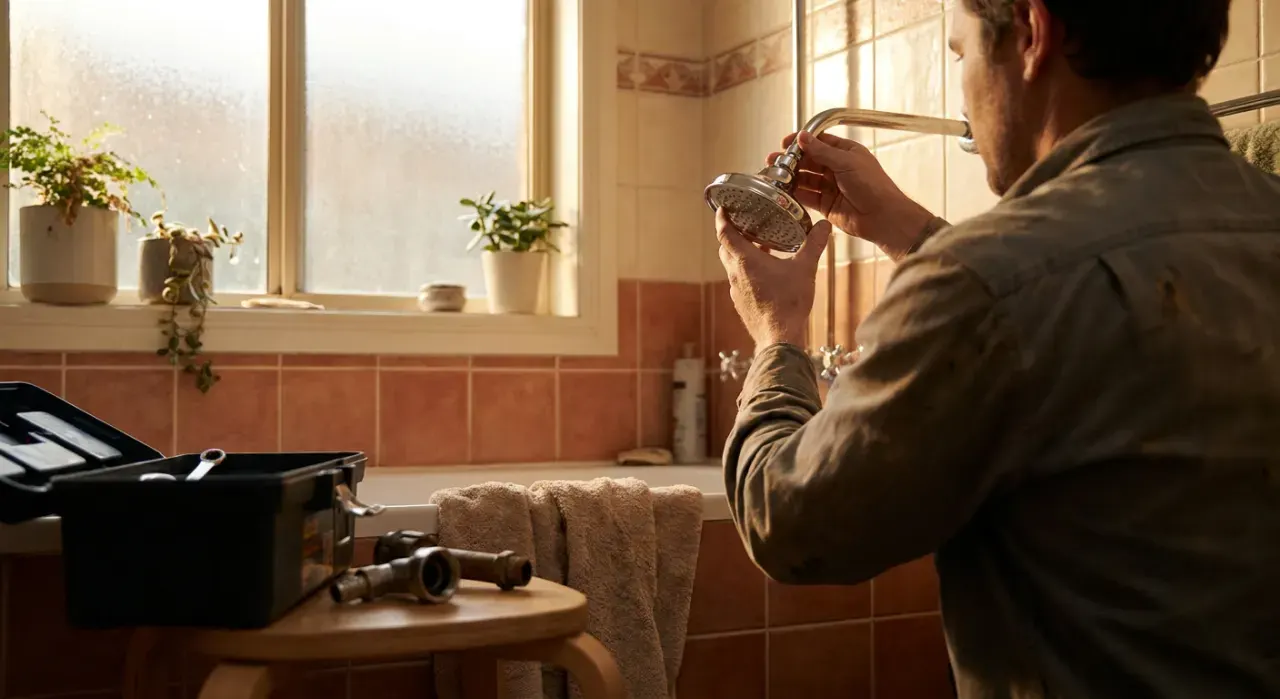
Several things help without plumbing work. Choose a shower head with flexible silicone nozzle tips you can rub clean with a thumb, which is the single most effective anti-scale feature at this price level. Soak the head in white vinegar for an hour every one to two months, either by unscrewing it or by tying a bag of vinegar around it. Squeegee glass doors after showering, which cuts visible spotting far more than any product. Use a liquid body wash rather than bar soap, since soap scum is a reaction between soap and hardness minerals and liquid formulations produce much less of it. Head options are compared in best shower head.
If low pressure is part of the picture, note that scale in the nozzles is a common cause, covered in how to fix low water pressure in a shower and do shower filters reduce water pressure. For chlorine specifically, see do shower filters remove chlorine, and current picks are in best shower filter.