 Garden
Affiliate Disclosure
Some links on this page are affiliate links. As an Amazon Associate, we earn from qualifying purchases — at no extra cost to you. We do not buy, test, or physically handle the products we cover; our rankings come from aggregated owner reviews, ratings and expert consensus. Commissions never change our verdicts. How we rank · full disclosure.
The short answer: soak the shower head in undiluted white vinegar — 30 minutes for light spotting, two to four hours for normal buildup, up to eight hours or overnight if it is badly crusted — then scrub the nozzles with an old toothbrush, poke any stubborn holes clear with a needle or paperclip, and run the shower on hot for two minutes to flush the loosened debris out. It costs under two dollars, takes about ten minutes of actual work, and needs no tools if you use the bag method. This is a job for anyone; nothing here requires a plumber.
The white crust blocking the nozzles is calcium and magnesium carbonate left behind as water evaporates — the same mineral scale that spots your glass door. Vinegar is roughly five percent acetic acid, which dissolves carbonate scale readily and rinses away clean. That is the entire chemistry, and it is why the cheapest jug in the grocery store works exactly as well as anything sold specifically for the job.
Tools and Materials
- White vinegar — one quart is plenty. Distilled white, not cider or balsamic, which stain.
- A heavy-duty freezer bag (quart or gallon) and a rubber band or zip tie — only if the head stays on the arm.
- An old toothbrush and a sewing needle, safety pin or straightened paperclip.
- A microfiber cloth for drying and buffing.
- An adjustable wrench and a rag, plus PTFE thread tape, only if you are removing the head.
- Baking soda, optional, for a paste on stubborn exterior deposits.
Total cost is two to four dollars if you own none of it. Skip the descaling products sold at four times the price — they are dilute acids doing what the vinegar already does.
Method A: Head Stays On the Arm (the bag soak)
This is the right method for fixed wall-mount heads, rain heads on ceiling drops, and anything that looks like it will fight you on the threads.
- Fill the bag with vinegar. One to two cups is usually enough. You want the face plate fully submerged when the bag is raised, and no more — extra vinegar is only extra weight.
- Raise the bag over the head until the entire spray face is under the liquid, then secure the neck of the bag to the shower arm with a rubber band or a zip tie. Wrap it twice; one loop slips.
- Take the weight off the head. A full gallon bag weighs about eight pounds hanging off a plastic ball joint. Run a loop of string from the bag up over the arm, or rest it on a shelf. Cracked ball joints from unsupported bags are a genuinely common way to turn a cleaning job into a replacement job.
- Wait. Thirty minutes for light spotting, two to four hours for normal buildup, up to eight hours or overnight for a badly crusted head. Do not exceed roughly twelve hours.
- Remove the bag over the drain — it will drip — and dispose of the vinegar down the drain.
- Scrub the face plate with the toothbrush. Softened scale comes off as a chalky slurry. Work in small circles across the nozzles.
- Clear stubborn holes individually with the needle or paperclip. Push straight in, not sideways; levering can tear a rubber nozzle tip.
- Flush on hot for two minutes. This pushes loosened debris out of the internal channels rather than leaving it to re-block the nozzles the next time you shower. Stand clear of the first ten seconds.
- Buff dry with the microfiber cloth. Drying the face after cleaning is what keeps it clear longer than the cleaning itself.
Method B: Head Comes Off (the bowl soak)
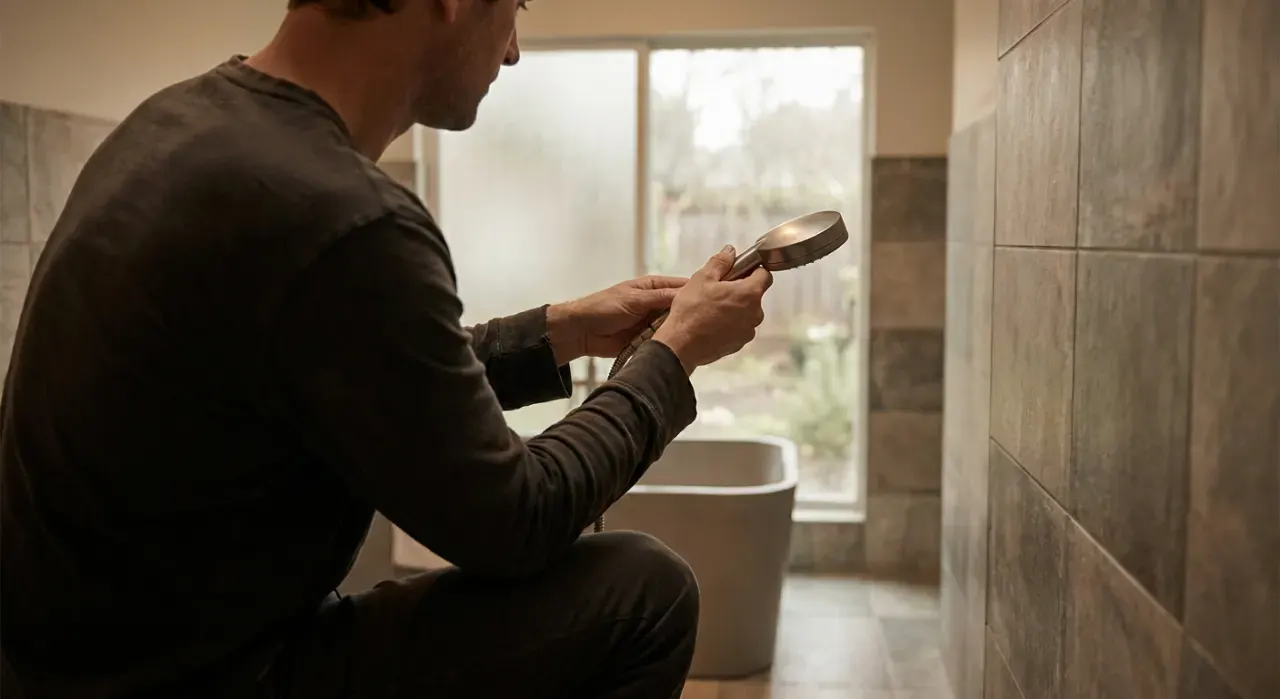
Better results, because you can also clean the inside. Worth the extra ten minutes on a head that has never been off, on a handheld, or on anything spraying sideways.
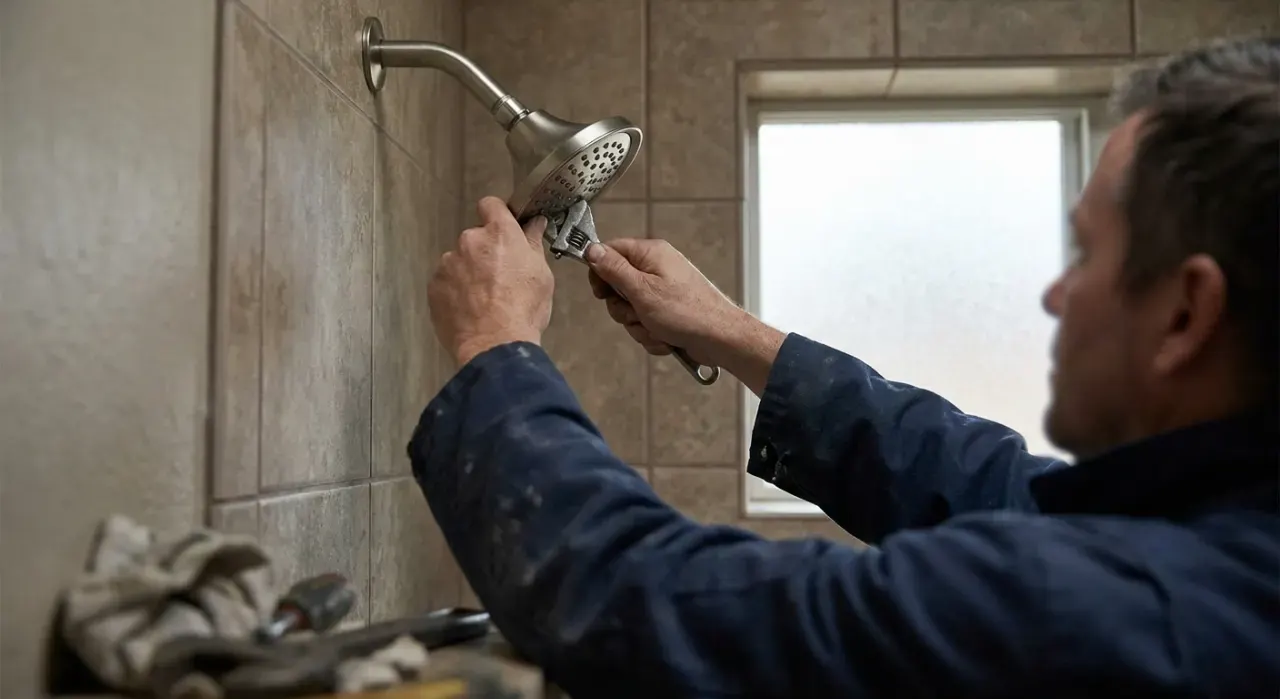
- Wrap the connection nut in a rag before the wrench touches it. Bare jaws on a chrome nut leave permanent marks.
- Turn counterclockwise from the shower arm. Most heads are hand-tight plus a quarter turn. If it will not move, a few drops of penetrating oil on the threads and ten minutes of patience beats more force — over-torquing can snap the shower arm inside the wall, which is a real repair rather than a chore.
- Pull the inlet screen. Inside the female thread is a small mesh filter, sometimes with a plastic flow restrictor behind it. This is where grit, pipe scale and PTFE tape fragments collect, and it blocks flow more often than the nozzles do. Ease it out with needle-nose pliers or a bent paperclip, rinse it under a hard stream, and check it against the light.
- Soak the whole head face-down in a bowl of undiluted vinegar for two to four hours. Weigh it down if it floats.
- Scrub inside and out — the toothbrush reaches into the inlet threads, which the bag method never touches.
- Rinse under a strong tap, running water backward through the head to push debris out the front.
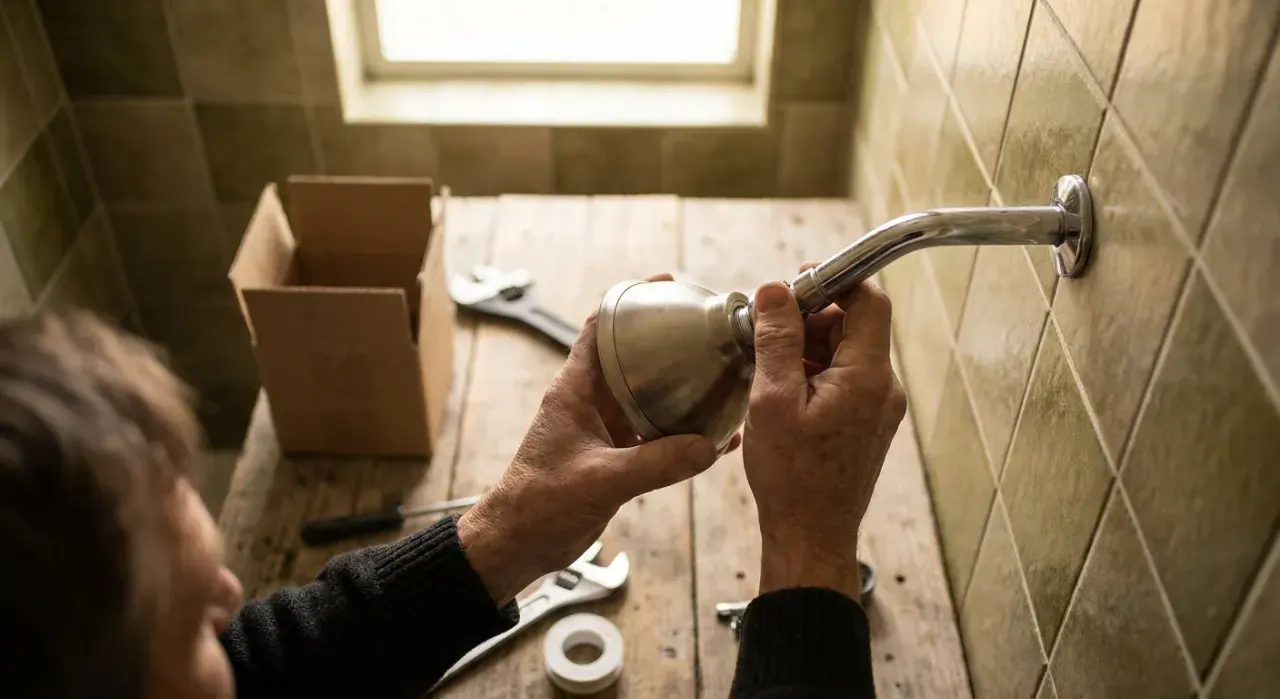
- Reinstall with fresh PTFE tape — two to three wraps clockwise around the male threads on the arm, in the direction the head screws on so it does not unwind. Hand-tight, then about a quarter turn with the wrapped wrench. Do not gorilla it; the seal comes from the tape, not the torque.
- Run the shower and check the joint for weeping. A slow drip means another wrap of tape, not another quarter turn.
If Your Head Has Rubber Nozzle Tips
Most heads made in the last fifteen years use soft silicone nozzle tips for exactly this reason. Run a thumb firmly across the face plate under running water and the scale cracks straight off — thirty seconds, no vinegar, no bag. Do this monthly and you may never need a full soak. It is also the single strongest argument for choosing a head with rubber tips if you live with hard water; the options are ranked in best shower head for hard water.
What Not to Use
| Product | Verdict | Why |
|---|---|---|
| White vinegar | Use it | Dissolves carbonate scale, rinses clean, costs nothing |
| Citric acid solution | Fine alternative | Works the same way, less smell, needs mixing |
| Baking soda paste | Exterior only | Mildly abrasive; will not dissolve scale inside channels |
| Chlorine bleach | Avoid | Does nothing to mineral scale and corrodes metal fittings |
| Bleach plus vinegar | Never | Releases chlorine gas — dangerous in an enclosed bathroom |
| CLR or similar | Works, but check first | Effective; several head manufacturers void warranty over it |
| Steel wool or scouring pads | Never | Scratches chrome permanently and gives scale more to grip |
The bleach-and-vinegar combination deserves the emphasis. Mixing them produces chlorine gas, and a shower stall is a small, poorly ventilated space. Use one or the other, never both, and run the exhaust fan while you work.
How Often, and Why It Matters Beyond Flow
Every six months on municipal water; every three on hard water or a private well. The obvious payoff is spray quality — a scaled head wastes pressure through misdirected jets and dribbles at the edges. The less obvious one is hygiene. The Centers for Disease Control and Prevention identifies shower heads among the building-water devices where Legionella can grow in biofilm and be inhaled in aerosolized droplets, and its guidance for building water systems treats fixtures with low or intermittent use as elevated risk. Descaling disrupts the film those organisms live in. If a bathroom has sat unused for weeks — a guest bath, a vacation home — flush it hot for several minutes with the door shut and the fan running before anyone showers.
Cleaning does not stop scale returning, because a shower filter does not remove hardness and neither does anything else short of a softener. What it does is reset the fixture. If you want to slow the return, dry the face plate after showering and consider what the water itself is carrying — the honest account of what filtration changes is in do shower head filters work, and the field is ranked in best shower head filter.
When to Stop Cleaning and Replace
Replace rather than persist when the face plate is pitted or corroded through, when nozzles have torn away during descaling, when the ball joint no longer holds an angle, or when a full eight-hour soak makes no difference to the spray. At that point the internal channels are scaled beyond what an external soak can reach. Heads start around twenty dollars and the swap is a ten-minute job — the ranked field is in best shower head, with high-pressure options and rain heads covered separately. We do not test products ourselves; our rankings come from the aggregated owner-review record, as set out in how we rank.
Related: descaling with vinegar in detail, cleaning without removing the head, and the full bathroom hub.