 Garden

Affiliate Disclosure
Some links on this page are affiliate links. As an Amazon Associate, we earn from qualifying purchases — at no extra cost to you. We do not buy, test, or physically handle the products we cover; our rankings come from aggregated owner reviews, ratings and expert consensus. Commissions never change our verdicts. How we rank · full disclosure.
Hard water underperforms in laundry because dissolved calcium and magnesium react with detergent before it can lift soil, so a portion of every dose is wasted neutralizing minerals. The fixes, in order of how much they help: switch to a powder detergent containing builders, add washing soda or a dedicated water softening booster to each load, raise the wash temperature where the fabric allows, and increase the detergent dose by about half. For fabric already stiff and gray from mineral buildup, a monthly vinegar rinse plus an oxygen bleach soak recovers most of it.
What hard water does to a load of laundry
Hardness is dissolved calcium and magnesium picked up from limestone and chalk in the ground. Detergent surfactants are attracted to those ions, and once bound to them they are chemically spent — they can no longer grab grease and soil off fabric. In genuinely hard water a meaningful share of every dose is consumed this way before any cleaning happens.
The wasted surfactant does not simply disappear either. It forms an insoluble curd, the same soap scum you see in a hard-water shower, and that curd deposits into fabric fibers. Repeated over months it produces the four symptoms people actually notice: towels that go stiff and stop absorbing, whites turning gray, colors going flat, and a smell that survives the wash because trapped residue holds body oils. Add mineral scale on the heating element and drum, and the machine itself loses efficiency.
The US Geological Survey classifies water by hardness in grains per gallon (gpg), and much of the Midwest, Southwest and Florida sits in the hard or very hard bands.
| Grains per gallon | mg/L (ppm) | Classification | Laundry impact |
|---|---|---|---|
| 0–3.5 | 0–60 | Soft | None; standard dosing works |
| 3.5–7 | 61–120 | Moderately hard | Slight; noticeable on whites over time |
| 7–10.5 | 121–180 | Hard | Real; dose up and switch to powder |
| Over 10.5 | Over 180 | Very hard | Severe; boosters or a softener needed |

The fixes, in order of effectiveness
1. Switch to powder detergent. This is the highest-impact change and it costs nothing extra. Powders can carry builders — typically sodium carbonate and sodium citrate — that liquids cannot hold in stable solution. Builders bind the calcium and magnesium first, freeing the surfactant to clean. It is the single most consistent theme in owner reviews from hard-water regions, and it is why the best laundry detergent for hard water picks skew heavily toward powders.

Best for households on water above about 7 grains per gallon, where liquid detergent visibly underperforms
- Powder formulas can carry builders that liquids cannot hold in solution
- Cost per load is among the lowest of any mainstream detergent
- Dose can be increased for hard water without a residue penalty
- Owners in known hard-water regions consistently rate powder above liquid
Why buy it: calcium and magnesium tie up surfactant before it reaches the fabric — builders in a powder formula grab those minerals first so the detergent can do its job.

Best for the gray, dingy cast that hard water builds into white cotton over months
- Oxygen-based rather than chlorine, so it does not yellow cotton over time
- Works as a long soak, which is what mineral-dulled fabric needs
- Safe on colors, unlike chlorine bleach
- Owners repeatedly describe recovering towels they had written off
Why buy it: chlorine bleach reacts with iron in hard water and can leave yellow marks — an oxygen bleach avoids that reaction entirely.
2. Add a water softening booster. Washing soda (sodium carbonate) at roughly half a cup per load, or a commercial laundry booster, pulls minerals out of solution before the detergent meets them. Borax is milder and adds deodorizing. Add the booster to the drum with the load rather than to the detergent dispenser.
3. Use warmer water where the fabric allows. Detergent works harder at higher temperatures, which partially offsets the loss to minerals. Warm rather than hot for most things — see what temperature to wash towels at. Cold-water detergents are formulated to compensate but still struggle in very hard water.
4. Increase the dose, modestly. About one and a half times the normal amount is the sensible ceiling. Past that, the residue problem outweighs the cleaning gain.
5. Do not overload. Hard water needs more water volume per item to rinse properly. A drum packed past three-quarters full guarantees residue no matter what you put in it.
Recovering fabric that is already stiff and gray
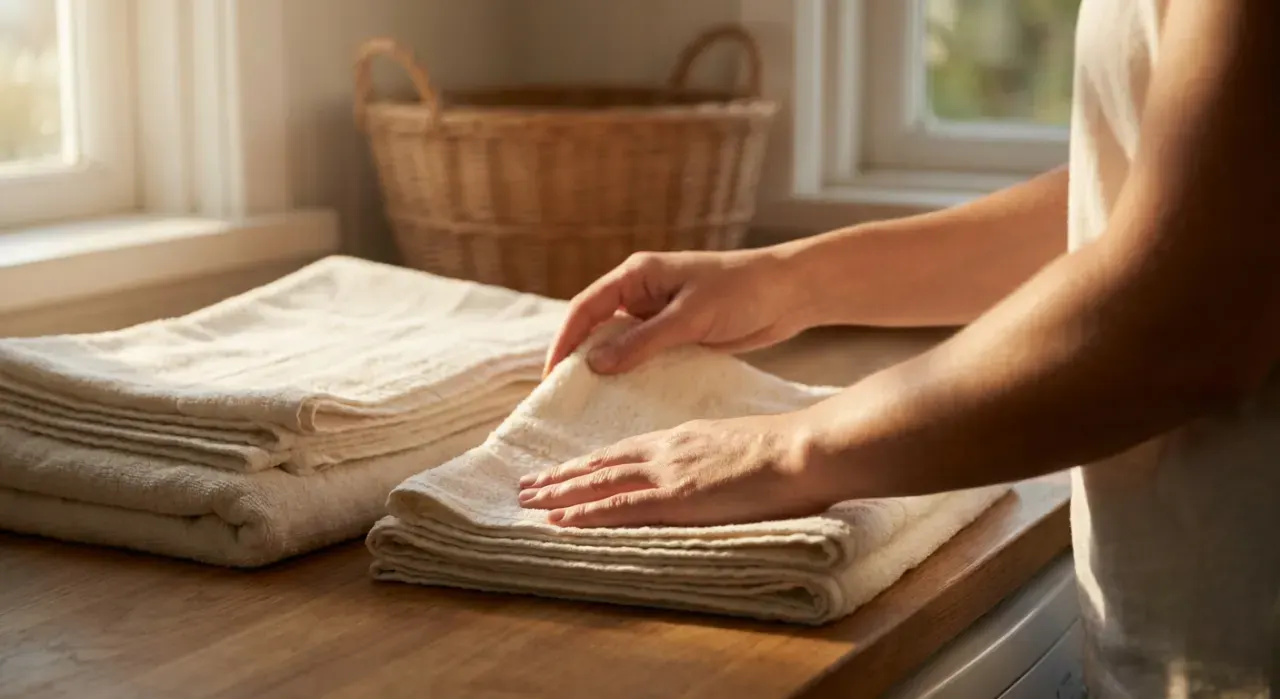
Buildup is cumulative, so switching detergents fixes the future without fixing what is already in the fibers. Two treatments do.
- The vinegar rinse. Run the affected items on a normal cycle with no detergent, adding one cup of distilled white vinegar to the fabric softener dispenser or at the start of the rinse. The acid dissolves mineral and soap deposits. Towels usually regain most of their absorbency in one pass. Repeat monthly if hardness is high, not every load.
- The oxygen bleach soak. Dissolve an oxygen-based whitener in hot water, submerge white and colorfast items fully, and leave four to eight hours or overnight before washing normally. This is what lifts the gray cast that mineral buildup produces. Avoid it on wool, silk and anything with elastane.
Never combine the two in one step, and never mix vinegar with chlorine bleach in any circumstances. Chlorine bleach in general is a poor choice in hard water because it reacts with dissolved iron and can leave yellow staining — oxygen bleach avoids that entirely.
If clothes still smell after all this, the machine is the more likely culprit than the water. Scale and biofilm in a front-loader gasket re-contaminate every load — see why clothes still smell after washing.
Protecting the washing machine itself
Scale builds on the heating element, the drum and the inlet valves, and it costs efficiency long before it causes a failure. Three habits keep it in check.
- Run a monthly maintenance wash on the hottest cycle with a machine cleaner or a cup of vinegar and nothing else in the drum. The full routine is in how to clean a washing machine.
- Wipe and dry the door gasket after each wash and leave the door ajar between loads — see cleaning the gasket.
- Descale the dispenser drawer. It is where powder and minerals cement together, and where the smell usually starts.
The same water is doing the same thing to the dishwasher and the faucets, which is why white film on glasses and hard water stains show up in the same households.

Matching the symptom to the fix
| Symptom | Most likely cause | First thing to try |
|---|---|---|
| Towels stiff and no longer absorbent | Soap curd and mineral deposits in the fibers | Vinegar rinse, no detergent, then stop using softener |
| Whites gone gray or yellow | Cumulative mineral and residue buildup | Overnight oxygen bleach soak |
| Colors looking flat and dusty | A film of curd over the fabric surface | Vinegar rinse; switch to powder |
| Clothes smell before they are dirty | Residue trapping body oils, or machine biofilm | Machine maintenance wash first, then reduce dose |
| White powder residue on dark clothing | Undissolved powder detergent in cold water | Dissolve powder in warm water before adding |
| Scale on the drum or heating element | Direct mineral deposition | Monthly hot maintenance cycle |
The residue-on-darks problem is worth calling out, because it is the one that pushes people back to liquid detergent at exactly the wrong moment. Powder needs water warm enough and time enough to dissolve; in a cold, short cycle it does not. Dissolving the dose in a cup of hot water and pouring it into the drum solves it completely and keeps the hard-water advantage.
When a water softener is worth it
A whole-house ion-exchange softener genuinely solves the problem rather than managing it, and it pays back across the plumbing, the water heater, the dishwasher and the fixtures, not just the laundry. Detergent use typically drops substantially, fabric lasts longer, and the scale stops accumulating everywhere at once.
The barriers are cost and circumstance: four figures installed, ongoing salt, periodic servicing, and in some municipalities restrictions on discharging brine from regeneration. As a rule of thumb, if you own the home and hardness is above about 10 grains per gallon, it is usually the rational purchase. Below that, or if you rent, the powder-plus-booster approach above closes most of the gap for a few dollars a month.
We never buy, test or physically handle the products we rank. Every recommendation is drawn from aggregated owner reviews, star ratings, review volume and published expert consensus — see how we rank.
More from this hub: Cleaning & Laundry · Best detergent for hard water · Laundry stain removal guide · How to clean a washing machine · How we rank