 Garden

Affiliate Disclosure
Some links on this page are affiliate links. As an Amazon Associate, we earn from qualifying purchases — at no extra cost to you. We do not buy, test, or physically handle the products we cover; our rankings come from aggregated owner reviews, ratings and expert consensus. Commissions never change our verdicts. How we rank · full disclosure.
The short answer: add organic matter, repeatedly, over years. Two to three inches of compost spread on the surface annually, a permanent mulch layer, deep-rooted plants, and no working the soil when it is wet. Do not add sand — in any practical quantity it makes clay denser, not looser. Gypsum helps only sodic clay, which is a specific western problem, not heavy clay in general.
This is a slow answer and it is the true one. Clay is a texture, set by the size of its mineral particles, and texture cannot be changed by anything you can afford to buy. What you can change is structure — how those particles clump into crumbs — and structure is built by organic matter and roots.
We never buy or physically handle the products we rank; recommendations come from aggregated owner reviews and expert consensus, described in how we rank. The wider system is at the composting and soil hub.
What Clay Actually Is
Soil is classified by particle size. Sand runs from about 0.05 to 2 mm, silt from 0.002 to 0.05 mm, and clay is anything under 0.002 mm — small enough that a teaspoon of clay soil can hold an enormous internal surface area. Those plate-shaped particles stack tightly, which is why clay drains slowly, compacts hard, stays cold late into spring and sets like brick when it dries.
The same properties are also why clay is fertile. That surface area carries electrical charge, giving clay a high cation exchange capacity — the soil’s ability to hold onto calcium, magnesium, potassium and ammonium rather than letting rain wash them through. Clay soils typically hold several times the nutrients and far more plant-available water than sandy soils. The trouble with clay is physical, not chemical.
Confirm it before you treat it. The ribbon test takes a minute: moisten a walnut-sized lump, roll it into a cylinder, then squeeze it upward between thumb and forefinger into a ribbon. Under an inch before it breaks is loam. One to two inches is clay loam. Over two inches, and if the soil feels slick rather than gritty, you have clay. For a quantified answer, the jar test — soil shaken with water in a straight-sided jar and left to settle into sand, silt and clay layers over 48 hours — gives you rough percentages.
Why Sand Makes It Worse
The reasoning behind adding sand is intuitive: clay is fine and dense, sand is coarse and open, so mixing should give something in between. Soil physics does not work that way.
For a mixture to behave like sandy soil, the sand grains must touch each other and form the structural skeleton, with everything else occupying the spaces between. That requires sand to be the dominant fraction by a wide margin — in practice well over half the total volume. Amending the top 8 inches of a clay bed to that level means importing a genuinely enormous quantity of sand, several cubic yards for even a small bed.
Add less than that and you get the opposite of what you wanted. The sand grains float in a clay matrix, and the fine clay particles pack into every gap between them. The result is denser and harder than the clay you started with, and gardeners who have done it describe the outcome in the same terms every time. It is also effectively permanent — you cannot remove it.
The exception is professional soil construction, where engineered rootzone mixes for sports fields are built to precise specifications from tested materials, usually with a much coarser sand than builders’ sand and under laboratory control. That is not a garden project.
The Truth About Gypsum
Gypsum is calcium sulfate, and it is widely sold as a clay-breaking amendment. It genuinely works on one specific problem and does essentially nothing for the rest.
Sodic soils are soils where sodium has displaced calcium on the clay exchange sites. Sodium causes clay particles to repel each other and disperse rather than aggregate, which destroys structure completely — sodic clay seals, ponds and crusts badly. Calcium from gypsum displaces the sodium, the clay flocculates back into crumbs, and drainage improves markedly. This is a real and dramatic effect, and it is common in parts of the arid and irrigated West and in some coastal areas.
On ordinary clay in a humid region, the exchange sites are already dominated by calcium and there is no sodium to displace. Gypsum then behaves purely as a source of calcium and sulfur nutrients, which may be useful in themselves, but it does not restructure the soil. Marketing that promises otherwise is trading on the sodic-soil result.
The way to know which you have is a soil test reporting exchangeable sodium percentage or a sodium adsorption ratio. Above roughly 15 percent exchangeable sodium, gypsum is the right tool. Below that, spend the money on compost. Reading those numbers is covered in how to read a soil test, and home and lab options are compared in best soil test kit.
What Actually Works
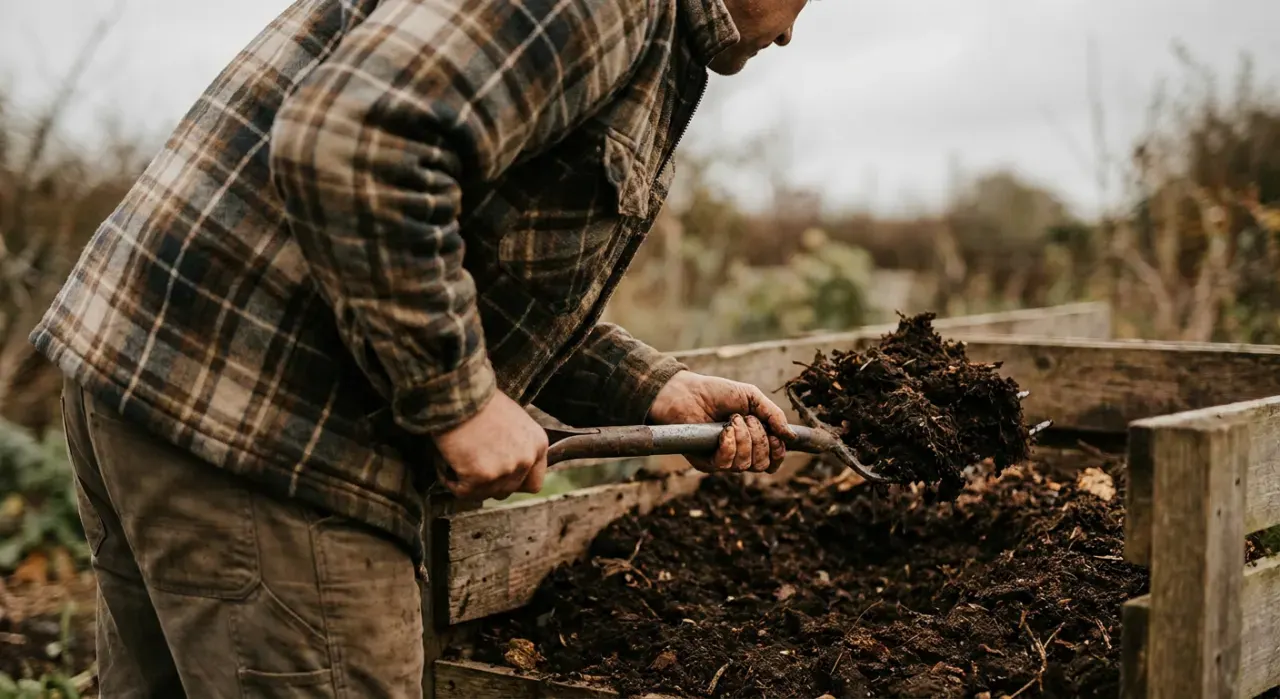
Organic matter, on the surface, every year. Two to three inches of finished compost spread over a bed and either left for worms to incorporate or lightly forked into the top few inches. Organic matter feeds the bacteria and fungi that produce the glues and threads binding clay particles into crumbs, and crumb structure is what creates the pore space clay lacks. This is the whole method. Everything else on this list supports it.
You will need a lot of it, which is the strongest practical argument for making your own — see how to make compost, and the systems compared in tumbler vs compost bin if you are choosing equipment.
Permanent mulch. Two to three inches of shredded leaves, bark, straw or wood chips over every bare surface. Mulch stops the surface crusting and cracking, keeps the soil moist so it stays workable, moderates temperature, and breaks down into the organic matter you were going to add anyway. On clay this is not decoration — bare clay swings between saturated and brick within days.
Roots. Deep-rooted plants open channels no tool can reach and leave organic matter at depth when they die. Daikon radish is the classic cover crop for compacted clay, driving a thick taproot down 12 inches or more and leaving a hole behind. Alfalfa, crimson clover, cereal rye and winter wheat all work. In ornamental beds, deep-rooted perennials and grasses do the same job over a longer horizon.
Stop compacting it. Never walk on or dig clay when it is wet — a squeezed handful should crumble under thumb pressure rather than form a slick ball. Working wet clay smears the particles into a dense mass that takes years to recover. Lay out permanent paths and beds so you never step on growing ground, and keep vehicles and equipment off it entirely.
Stop tilling. Rotary tilling gives a few weeks of fluffiness by pulverizing exactly the aggregates you are trying to build, and repeated passes create a compacted pan at the depth the tines reach. If you need to relieve deep compaction, use a broadfork: it lifts and fractures the profile without inverting or pulverizing anything.
Raised beds as a shortcut. If you want to grow vegetables this season rather than in three years, build raised beds 10 to 12 inches deep and fill them with a good mix. You garden in decent soil immediately, and the clay beneath improves anyway under permanent cover and root activity. The raised beds and planters hub covers construction and fill ratios.
Core aeration for clay lawns. Lawns on clay compact steadily and cannot be dug. Annual core aeration followed by a quarter-inch compost topdressing is the equivalent treatment, and it works — the method is in dethatching vs aerating.
A Realistic Timeline
| Stage | What you do | What changes |
|---|---|---|
| Year 1 | Test the soil, spread 2 to 3 in of compost, mulch everything, stop tilling and stop walking on beds | Surface crusting eases, water soaks in rather than ponding, earthworms appear |
| Year 2 | Another 2 in of compost, sow a cover crop over winter, broadfork if badly compacted | The top few inches crumble instead of clodding; spring workable weeks earlier |
| Year 3 | Compost and mulch again; plant deep-rooted perennials | Visible crumb structure, roots penetrating well below the amended layer |
| Years 4 to 5 | Maintain: an inch or two of compost each year, permanent mulch | Soil that digs easily, drains after storms and holds moisture through dry spells |
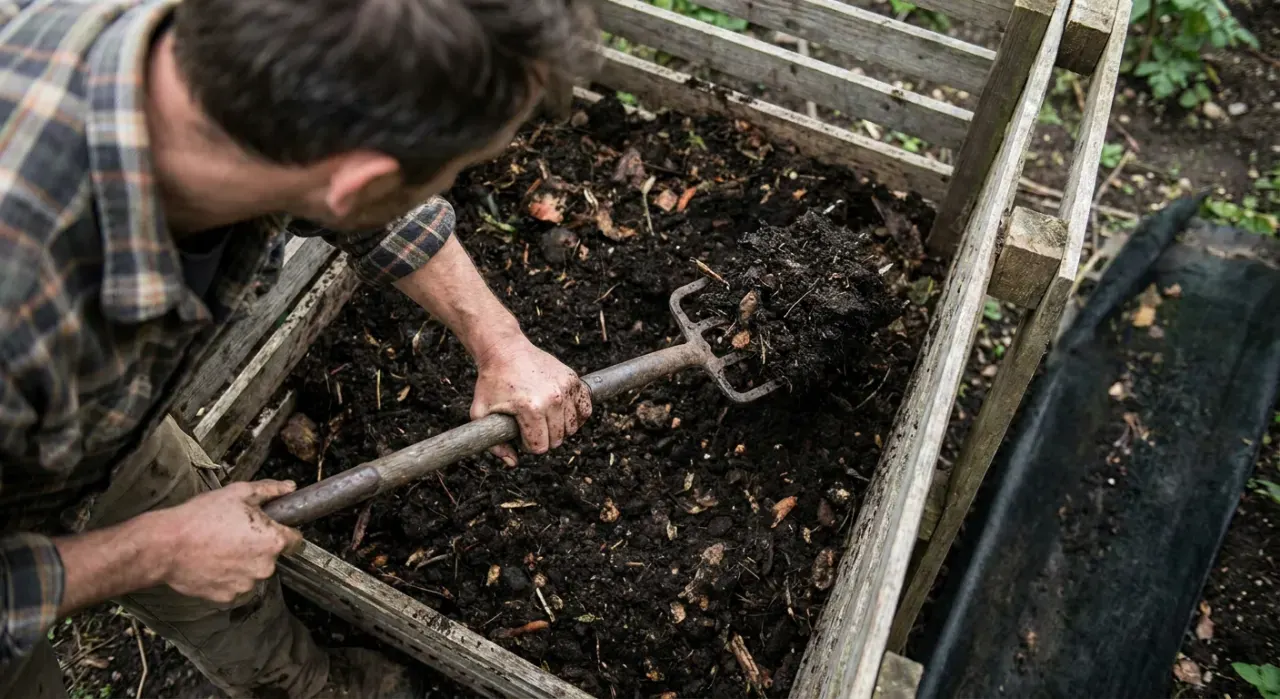
The change is gradual and then suddenly obvious — most gardeners report the turning point somewhere in the second or third season, when a spade goes in without a boot on it for the first time.
Working With Clay in the Meantime
Clay is not a sentence. It grows a great many plants extremely well, and some genuinely prefer it: most ornamental and shade trees, hostas, daylilies, asters, coneflowers, rudbeckia, switchgrass, viburnum, dogwood and willow. What struggles is anything demanding sharp drainage — lavender, Mediterranean herbs, most bulbs, and the majority of alpines. Plant those on a mound, in a raised bed or in containers rather than fighting the site.
Adjust your timing too. Clay warms slowly, so direct sowing two weeks later than the packet suggests usually gives better germination than sowing on schedule into cold, wet ground. And water it deeply but slowly: clay accepts water at a fraction of an inch per hour, so a fast application mostly runs off. Cycle-and-soak — water, wait, water again — puts moisture where the roots are, and once clay is wet it stays wet far longer than any other soil, which is the compensation for everything else.