 Garden

Affiliate Disclosure
Some links on this page are affiliate links. As an Amazon Associate, we earn from qualifying purchases — at no extra cost to you. We do not buy, test, or physically handle the products we cover; our rankings come from aggregated owner reviews, ratings and expert consensus. Commissions never change our verdicts. How we rank · full disclosure.
The short version: the best iron filter for most wells is the iSpring WGB21BM, a two-stage Big Blue system with a dedicated iron and manganese cartridge that covers the iron levels most households actually have. If your water is both orange and smells of rotten eggs, skip straight to an air-injection oxidizing filter such as the Iron Eater. If you only stain slowly, the Waterdrop WHF21-FG is the cheap way in.
But do not buy anything yet. There are four different kinds of iron problem and they need four different machines, and buying the wrong one is how people end up with a filter that clogs every three weeks or a softener with a ruined resin bed.
Which Kind of Iron Do You Have?
Run a glass of cold water and look at it immediately, then look again after it has stood for half an hour. What you see identifies the form, and the form dictates the treatment.
| What you see | What it is | What treats it |
|---|---|---|
| Clear from the tap, turns orange and drops sediment as it stands | Ferrous — dissolved "clear-water" iron | Softener below ~3 ppm; oxidizing backwash filter above that |
| Orange or rusty the moment it leaves the faucet | Ferric — already oxidized "red-water" iron particles | Sediment filtration, 5 to 20 micron depending on particle size |
| Reddish slime in the toilet tank, filters that foul fast, oily sheen | Iron bacteria | Shock chlorination of the well, sometimes repeatedly; filters alone will not fix it |
| Yellow or tea-colored water, especially from a shallow well | Organic-bound iron (tannin complexed) | Chlorination followed by carbon; resists ordinary iron filters |
Penn State Extension's guide to iron and manganese in private water systems is the clearest free reference on this distinction, and it makes the important point that treatment depends on both the form and the concentration. Their companion piece on iron and sulfur bacteria covers the bacterial case, which is the one people most often try to solve with the wrong equipment.
How Much Iron Is Too Much?
EPA lists iron and manganese under secondary drinking water standards — non-enforceable guidelines covering taste, color, odor and staining rather than health effects. The figures are 0.3 mg/L for iron and 0.05 mg/L for manganese, and Penn State Extension recommends the same thresholds for private wells. Manganese matters more than people expect: it is a tenth of the iron limit and produces black rather than orange staining, and it is far harder to remove.
| Iron level | What you notice | Right machine |
|---|---|---|
| Below 0.3 ppm | Nothing. This is the secondary standard | None needed |
| 0.3–1 ppm | Faint staining in toilets and tubs over weeks | Cartridge iron filter, or an existing softener |
| 1–3 ppm | Obvious orange staining, metallic taste, laundry damage | Two-stage cartridge system or iron-capable softener |
| 3–10 ppm | Rapid staining; cartridge filters clog in weeks | Oxidizing backwash filter (air injection or greensand) |
| Above 10 ppm | Severe; often with manganese and sulfide | Chemical oxidation plus filtration; get a professional water analysis |
Get the number before you shop. A home strip kit gives you a rough iron reading in minutes and a mail-in lab panel gives you iron, manganese, hardness, pH, sulfate and bacteria together — best water test kit covers both, and you can locate a state-certified laboratory through EPA's certified lab directory.
Top Picks at a Glance
Our #1 Pick: iSpring WGB21BM
Most iron-bearing wells in the United States are not dramatic. They sit somewhere between 0.5 and 3 ppm of dissolved ferrous iron, they stain a toilet bowl over a few weeks, and they do not warrant a $1,500 backwashing system. The WGB21BM is built exactly for that band: a sediment stage to catch the grit, then a dedicated iron and manganese reducing cartridge, in two universal 10 x 4.5 inch Big Blue housings on the incoming main.
The reason it ranks first is the housings. Big Blue is the commodity standard in whole-house filtration, so the media inside is a choice rather than a commitment — swap the iron cartridge for carbon, or for a finer sediment element, or for a different manufacturer's iron media entirely, without touching the plumbing. Owners consistently report the staining stopping within days of installation at moderate iron levels, and the honest counterpoint is equally consistent: at high iron, cartridge life collapses.
Its limitations are the limitations of all cartridge filtration. There is no backwash, so everything the media captures stays there until you change it, and on iron-heavy water that is a short interval and a real running cost. It does nothing for iron bacteria. And 1-inch ports notwithstanding, two Big Blue housings in series do cost you some pressure — if your well pump is marginal already, factor that in and read what PSI home water pressure should be first.
Check price on Amazon → (paid link)
The Ranked Field

Best for moderate clear-water iron on a typical family well
- Two 10 x 4.5 inch Big Blue stages: sediment plus an iron and manganese reducing cartridge
- Rated by the maker for iron up to around 3 ppm and manganese around 1 ppm
- 1-inch inlet and outlet, around 15 gpm service flow
- Cartridge housings are the universal Big Blue size, so media choices stay open
Why buy it: the honest sweet spot for most wells — it handles the iron range the majority of households actually have, on standard housings that let you change media later without replacing the system.
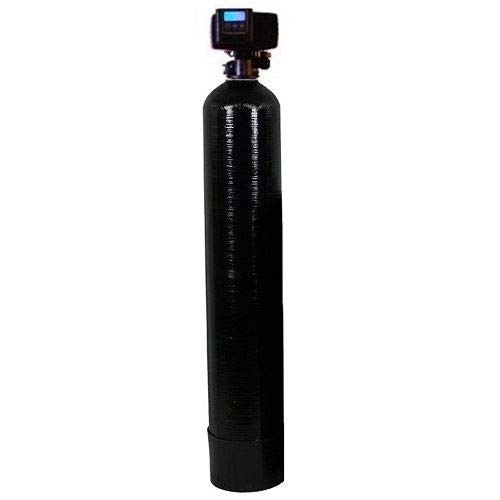
Best for wells where the water is orange AND smells of rotten eggs
- Air injection oxidizing filter — draws and holds an air pocket in the top of the tank
- Oxidizes dissolved iron, manganese and hydrogen sulfide, then filters the solids out
- Backwashes automatically on a programmed schedule; no chemicals to buy
- Handles iron levels well beyond what a cartridge filter can absorb
Why buy it: cartridge filters clog in weeks on genuinely high iron. An oxidizing backwash filter is the class of machine that keeps working, and it takes the sulfide smell out at the same time.

Best for light iron staining without spending four figures
- Two-stage system with sediment and iron-manganese reducing media
- Compact housings that fit where a Big Blue pair will not
- Includes mounting bracket, wrench and pressure relief buttons
- Cartridges are widely cross-compatible with GE and Culligan sizes
Why buy it: the cheapest sensible entry point into whole-house iron treatment, and enough for the very common case of a well that stains slowly rather than dramatically.

Best for iron plus taste and odor problems in one cabinet
- Three 10 x 4.5 inch stages: sediment, carbon block, iron and manganese media
- Adds chlorine, taste and odor treatment to the iron stages
- Around 100,000 gallon service life across the set
- 1-inch ports for full-house flow
Why buy it: iron rarely arrives alone; adding a carbon block stage deals with the taste and odor that iron-bearing water usually brings with it, in the same run of pipe.

Best for wells that produce grit as well as iron
- Full 20-inch housings — double the media of a standard 10-inch system
- Sediment stage ahead of a granular carbon and KDF stage
- Longer cartridge intervals thanks to the larger media volume
- Sized for whole-house flow without a pressure penalty
Why buy it: a 20-inch housing holds twice the media of the 10-inch standard, which on a gritty well is the difference between changing cartridges quarterly and changing them monthly.

Best for adding iron reduction to a Big Blue housing you already own
- Radial flow design gives a large surface area and low pressure drop
- Drops into any standard 20-inch Big Blue housing
- Targets dissolved ferrous iron specifically
- Pentair build quality on a commodity cartridge size
Why buy it: if you already have a Big Blue housing on the main, an iron cartridge costs a fraction of a new system and is a genuinely worthwhile first experiment.
Quick Comparison
| Product | Best for | Rating | Price | Buy |
|---|---|---|---|---|
| iSpring WGB21BM 2-Stage Whole House Water Filtration System with Iron and Manganese Reducing Filter | Best Overall | — | Check (paid link) | |
| Air Injection Iron Eater Filter, 1.0 Cubic Foot Media, Removes Iron, Manganese and Hydrogen Sulfide | Best for High Iron and Sulfur | — | Check (paid link) | |
| Waterdrop WHF21-FG 2-Stage Whole House Water Filter System, 5 Micron, Reduces Iron and Manganese | Best Value | — | Check (paid link) | |
| iSpring WGB32BM 3-Stage Whole House Water Filter System for Iron, Manganese, Chlorine, Sediment and Odor | Best Three-Stage | — | Check (paid link) | |
| iFilters MWH-D20-WELL Dual-Stage 4.5 x 20 inch Whole House Well Water Filter System with Sediment and KDF Media | Best for Sediment-Heavy Wells | — | Check (paid link) | |
| Pentair Pentek RFFE20-BB Big Blue Radial Flow Iron Reduction Replacement Cartridge, 20 Inch | Best Cartridge Upgrade | — | Check (paid link) |
Cartridge Filter or Backwashing Filter?
This is the real decision in the category, and it is decided by your iron number rather than by your budget.
| Cartridge system | Oxidizing backwash filter | |
|---|---|---|
| Iron range | Up to about 3 ppm | Roughly 3 to 15 ppm depending on media |
| Upfront cost | $150–$450 | $600–$1,500 |
| Running cost | Cartridges, 2–4 times a year | Almost none — it regenerates itself |
| Handles hydrogen sulfide | No | Yes, that is a standard capability |
| Needs a drain line | No | Yes — backwash water has to go somewhere |
| Installation | Two housings on the main | Tank, control valve, drain and usually a power outlet |
The trap is buying a cartridge system for 6 ppm water because it is cheaper. It will work beautifully for two weeks, then clog, and you will spend more on cartridges in a year than the backwashing filter would have cost. If your test comes back above about 3 ppm, or if the water also smells of sulfur, buy the oxidizing filter — why does my water smell like rotten eggs explains why those two problems arrive together so often.

How We Rank
We never buy or install these systems. For iron filters the ranking priorities are: honest capacity against a stated iron level, because the single biggest failure in this category is a machine sold beyond its range; media and housing standardization, since a system on universal Big Blue housings can be re-mediated instead of replaced; whether the design handles manganese and hydrogen sulfide, which usually arrive with the iron; and aggregated owner reports on cartridge life, pressure drop and staining outcomes, which is where these systems actually succeed or fail. Ratings come from verified Amazon listing data and refresh automatically. Prices were checked at the time of writing. Full method: how we rank.
The Systems, Reviewed
1. iSpring WGB21BM — Best Overall
Covered above. Owners praise: staining stopping quickly at moderate iron, clear installation instructions, and the flexibility of universal housings. Owners gripe about: short cartridge life on genuinely high iron, a noticeable pressure drop on marginal well pumps, and housings that need a proper wrench and real force to open. Check price (paid link).
2. Air Injection Iron Eater — Best for High Iron and Sulfur
A different class of machine. It maintains a pocket of compressed air in the top of the tank; water passing through it oxidizes dissolved iron, manganese and hydrogen sulfide into particles, and the media bed below catches them. On a schedule the valve backwashes the bed to drain and draws a fresh air charge. Nothing gets consumed, so there is no cartridge bill and no chemical to buy.
Owners praise: handling iron levels that destroy cartridge filters, removing the sulfur smell at the same time, and running for years without consumables. Owners gripe about: the price, an installation that needs a drain line and floor space, backwash cycles that use water, and programming that rewards reading the manual properly. Check price (paid link).
3. Waterdrop WHF21-FG — Best Value
Two compact stages, sediment then iron and manganese media, at roughly half the price of the Big Blue systems. For a well that stains slowly — the 0.3 to 1 ppm band that a great many households sit in — this is enough, and it fits in tight utility spaces where a pair of Big Blue housings will not.
Owners praise: the price, a genuinely easy installation with the bracket and wrench supplied, and visible improvement on light staining. Owners gripe about: smaller cartridges that need changing more often, and a hard ceiling on how much iron it can cope with. Check price (paid link).
4. iSpring WGB32BM — Best Three-Stage
The WGB21BM with a carbon block stage added. Iron-bearing well water frequently carries a metallic taste and an earthy odor that the iron cartridge alone does not address, and carbon is the answer to both. If you are treating an entire house and want one run of equipment rather than two projects, this is the sensible configuration.
Owners praise: the taste improvement over a two-stage setup, long service life across the cartridge set, and full-flow 1-inch ports. Owners gripe about: three housings taking real wall space, the cost of a full cartridge set, and the same cartridge-clogging ceiling at high iron. Check price (paid link).
5. iFilters MWH-D20-WELL — Best for Sediment-Heavy Wells
Twenty-inch housings instead of ten. That doubles the media volume and roughly doubles the interval between changes, which matters enormously on a well that produces sand and grit alongside iron. The KDF and granular carbon second stage adds taste and odor treatment.
Owners praise: long intervals between cartridge changes, low pressure drop for the filtration it provides, and suitability for genuinely dirty well water. Owners gripe about: the height the 20-inch housings need for cartridge removal — measure your clearance before buying — and heavier, more awkward cartridges. Check price (paid link).
6. Pentair Pentek RFFE20-BB — Best Cartridge Upgrade
Not a system, a cartridge. If there is already a 20-inch Big Blue housing on your main — and there is in a great many rural homes — dropping in a radial-flow iron reduction element costs a fraction of a new system and tells you within a week whether cartridge filtration is going to solve your problem at all.
Owners praise: the low pressure drop of the radial flow design, Pentair build quality, and how cheap the experiment is. Owners gripe about: service life at higher iron levels, and that it does nothing for manganese or bacteria. Check price (paid link).
What Owners Actually Complain About
Cartridges clogging far faster than advertised. Overwhelmingly the top complaint, and almost always the result of fitting a cartridge system to water above its iron rating. Test first; the rating on the box assumes a level you may not have.
Pressure loss. Every filter on the main costs pressure, and two or three housings in series on a well with a marginal pump can drop showers to a dribble. Fit a gauge before and after so you can see when cartridges are done rather than guessing.
Softener resin destroyed by iron. A recurring and expensive mistake. A standard softener tolerates roughly 3 ppm of clear-water iron; ferric iron fouls the bed instead of passing through. If you have both hardness and iron, treat the iron first or buy a combination unit — our water softener roundup covers the fine-mesh combination systems built for exactly this.
Filters that do nothing against iron bacteria. The slimy reddish deposits are a living colony, not suspended particles. Shock chlorination of the well is the treatment, and it sometimes has to be repeated. A filter downstream of an untreated bacterial colony just gives it more surface area to grow on.
Housings that will not open. Iron water fuses the O-ring seal over months. Lubricate the O-ring with food-grade silicone grease at every change, and keep the strap wrench where you can find it.
The Verdict
Test your water, identify the form of iron, then buy. For the common case of moderate clear-water iron the iSpring WGB21BM is the right machine on universal housings you can re-media later. Above roughly 3 ppm, or where the water also smells of sulfur, step up to the Air Injection Iron Eater and stop buying cartridges. The Waterdrop WHF21-FG is the value entry, the WGB32BM adds taste treatment, the iFilters 20-inch suits gritty wells, and the Pentek RFFE20-BB is a cheap way to test the idea in a housing you already own. Check price on Amazon → (paid link)
More from this hub: DIY plumbing · best well water filter system · why does my water smell like rotten eggs · best sediment filter · best water softener · how we rank.