 Garden


Affiliate Disclosure
Some links on this page are affiliate links. As an Amazon Associate, we earn from qualifying purchases — at no extra cost to you. We do not buy, test, or physically handle the products we cover; our rankings come from aggregated owner reviews, ratings and expert consensus. Commissions never change our verdicts. How we rank · full disclosure.
The short version: the best well water filter system for the most common problem — orange staining, metallic taste, iron and manganese — is the iSpring WGB32BM. If your well is hard as well as iron-bearing, which most are, the Iron Pro 2 treats both in a single tank. If it smells of rotten eggs, the Home Master HMF3SDGFEC names hydrogen sulfide as a design target. And if the well has ever failed a coliform test, none of those help — you need a UV purifier as an additional stage, because no cartridge filter on this page is rated for bacteria.
Do not buy anything until you have a lab test. This is not a category where you can shop by symptom and get lucky. A municipal customer gets an annual report telling them exactly what is in the water; a well owner gets nothing, and the burden of finding out is entirely theirs. The EPA's private well guidance recommends annual testing at minimum for coliform bacteria, nitrates, total dissolved solids and pH.
The Treatment Train: Order Matters More Than Brand
Well water treatment is a sequence, not a product. Installing the right units in the wrong order wastes money and destroys cartridges, and this is the single most common expensive mistake in the category.
| Position | Stage | Why it goes there |
|---|---|---|
| 1 | Spin-down sediment pre-filter | Sand and grit destroy everything downstream; a flushable screen is cheap insurance |
| 2 | Iron / manganese / sulfur treatment | Iron fouls softener resin permanently if it gets past this point |
| 3 | Water softener (if hard) | Needs clean, iron-free water to protect the resin bed |
| 4 | Fine sediment and carbon | Polishing stage for taste, odor and remaining particulates |
| 5 | UV purifier | Must be last in the whole-house line — UV cannot penetrate turbid water |
| 6 | Point-of-use RO at the kitchen sink | For nitrates, arsenic and dissolved solids that whole-house filters miss |
Two rules to internalize. First, UV is always last, because a lamp cannot disinfect water it cannot shine through — turbidity has to be removed first. Second, iron before softener, never after, because dissolved iron oxidizes inside the resin bed and coats it in a rust film that regeneration will not remove.
What to Test For, and What Each Result Means
| Test result | What you see or smell | What treats it |
|---|---|---|
| Iron above 0.3 ppm | Orange staining in toilets, tubs and laundry | Iron filter media or fine mesh softener resin |
| Manganese above 0.05 ppm | Black or brown staining, bitter taste | Same media beds as iron |
| Hydrogen sulfide | Rotten egg smell | Oxidizing media, air injection or catalytic carbon |
| Hardness above 7 gpg | Scale, spotting, soap that will not lather | A softener — see best water softener |
| Coliform bacteria present | Nothing visible at all | UV purifier, plus shock chlorination of the well |
| Nitrates above 10 mg/L | Nothing visible; a health concern for infants | Reverse osmosis at the kitchen sink |
| Arsenic above 10 ppb | Nothing visible | Reverse osmosis or a dedicated adsorption media |
| Turbidity, sand, grit | Cloudy water, grit in aerators | Spin-down pre-filter, then fine sediment cartridges |
Note that the two most serious results — coliform bacteria and elevated nitrates — are completely invisible. Water that looks and tastes perfect can carry both. That is the whole argument for annual testing.
Top Picks at a Glance
Our #1 Pick: iSpring WGB32BM
Most wells do not have exotic problems. They have iron, they have manganese, and they have enough sediment to wreck a cartridge in a month. The WGB32BM is built for precisely that combination: a 5-micron sediment stage, a coconut-shell carbon block, and a dedicated iron and manganese reducing media bed, all in 20 x 4.5-inch housings with 1-inch ports.
The port size matters more than buyers expect. Undersized filters are the most common source of the complaint that a whole-house filter "killed the water pressure" — a 3/4-inch filter head on a house that needs 10 to 12 gallons per minute is a restriction, and it will be blamed on the cartridge. One-inch porting with 4.5-inch-diameter cartridges keeps the pressure drop small. Owners consistently report staining disappearing from toilets and laundry within days, which is the visible result people buy this for.
Its honest limitations: it does not soften water, it does not disinfect, and it is rated for iron up to about 3 ppm. Wells with iron above that, or with heavy hydrogen sulfide, need an oxidizing system or air injection ahead of it. And it will not touch nitrates or arsenic, both of which are point-of-use reverse osmosis problems.
Check price on Amazon → (paid link)

The Ranked Field

Best for the classic well water complaint — orange staining and a metallic taste
- Three 20 x 4.5-inch stages: 5-micron sediment, carbon block, iron and manganese media
- Reduces iron from about 3.0 ppm and manganese from about 1.0 ppm to near zero
- 1-inch inlet and outlet so the filter is not the bottleneck in the house
- Rated for roughly 100,000 gallons or twelve months
Why buy it: iron and manganese are the two things that make well water look and taste like well water, and this is the off-the-shelf system built specifically for them rather than adapted from a city-water unit.

Best for wells that are hard AND iron-stained, which is most of them
- Fine mesh resin removes hardness and dissolved ferrous iron in a single tank
- Handles iron to roughly 6–8 ppm and manganese to about 6 ppm
- 64,000 grain capacity for very hard supplies
- Fleck 5600SXT digital metered valve — the most serviceable control head in the country
Why buy it: well water almost never arrives with only one problem, and this treats hardness and iron in one machine instead of two tanks and twice the plumbing.
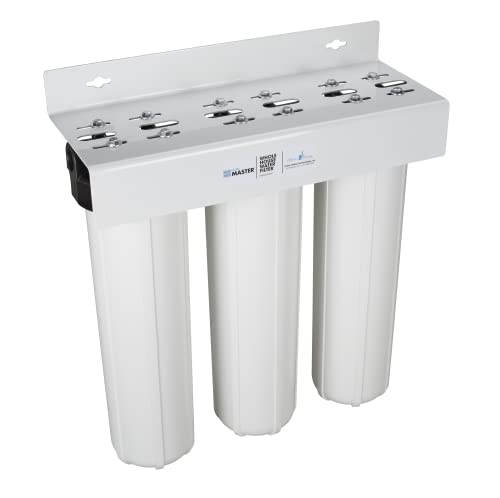
Best for non-chlorinated wells with a rotten-egg smell
- Multi-gradient sediment stage, then iron and manganese media, then radial-flow carbon
- Rated for iron, manganese and hydrogen sulfide up to about 3 ppm combined
- Oversized housings and 1-inch ports for up to 15 GPM
- Designed for well water rather than adapted from a municipal system
Why buy it: hydrogen sulfide is the smell people describe as rotten eggs, and this is one of the few packaged systems that names it as a design target.

Best for any well that has ever tested positive for coliform
- 304 stainless UV chamber, 40W germicidal lamp rated for 12 GPM
- Inactivates bacteria, viruses and cysts without chemicals or taste change
- Lamp replaced annually; quartz sleeve cleaned every 6–12 months
- 3/4-inch MNPT inlet and outlet
Why buy it: no cartridge filter on this page is rated for bacteria. If your well has ever failed a coliform test, UV is the stage that addresses it, and it belongs after the sediment filter, not before.

Best for wells with lead, mercury or arsenic concerns in the test results
- Three stages: sediment, KDF heavy-metal media, activated carbon
- Pressure gauges on each stage so you can see a clogged filter before flow drops
- Easy-release housings and 1-inch connections
- Free-standing stainless frame
Why buy it: the pressure gauges are the underrated feature — they turn filter changes from guesswork into a reading, which on a well with variable sediment is genuinely useful.

Best for protecting everything downstream from sand and grit
- Reusable 50-micron stainless mesh screen — flush it, do not replace it
- Clear housing so you can see the accumulated grit
- Flush valve with a garden hose barb for draining outside
- 1-inch MNPT and 3/4-inch FNPT threads, lead-free brass
Why buy it: sand and grit are what destroy expensive cartridges early. A $60 flushable screen at the front of the train can double the life of everything behind it.
Quick Comparison
| Product | Best for | Rating | Price | Buy |
|---|---|---|---|---|
| iSpring WGB32BM 3-Stage Whole House Water Filter System for Iron and Manganese, 1-Inch Ports | Best Overall | — | Check (paid link) | |
| AFWFilters Iron Pro 2 Combination Water Softener and Iron Filter, Fleck 5600SXT, 64,000 Grain | Best for Hard Iron-Bearing Water | — | Check (paid link) | |
| Home Master HMF3SDGFEC 3-Stage Whole House Filter for Iron, Manganese and Sediment | Best for Sulfur and Heavy Sediment | — | Check (paid link) | |
| HQUA-OWS-12 Whole House Ultraviolet Water Purifier, 12 GPM, 40W, with Spare UV Lamp | Best for Bacteria | — | Check (paid link) | |
| Express Water Heavy Metal Whole House Water Filter, 3-Stage with Sediment, KDF and Carbon and Pressure Gauges | Best for Heavy Metals | — | Check (paid link) | |
| iSpring WSP-50 Reusable Spin Down Sediment Water Filter, 50 Micron, Lead-Free Brass | Best Pre-Filter | — | Check (paid link) |
How We Rank
We never buy or install these systems. For well water treatment the ranking priorities are: whether the system was designed for well water or adapted from a municipal unit, which shows up in the media selection; flow rate and port sizing, since an undersized filter becomes a house-wide pressure complaint; honest contaminant limits — a system rated to 3 ppm iron that is sold as an answer to 10 ppm iron is a failure waiting to happen; and aggregated owner reports on media life, staining outcomes and pressure loss. Ratings come from verified Amazon listing data and refresh automatically. Prices were checked at the time of writing. Full method: how we rank.
The Systems, Reviewed
1. iSpring WGB32BM — Best Overall
Covered above. Owners praise: staining disappearing quickly, minimal pressure loss thanks to the 1-inch ports, and readily available replacement cartridges. Owners gripe about: cartridge life falling far short of the 12-month rating on heavily loaded wells, the weight of three full 20-inch housings when changing filters, and the wall space three big blues require. Check price (paid link).
2. Iron Pro 2 — Best for Hard Iron-Bearing Water
Fine mesh cation resin holds dissolved ferrous iron as well as calcium and magnesium, so one tank handles hardness and iron together. At 64,000 grains it has the capacity for genuinely hard well supplies, and it uses the Fleck 5600SXT valve — the most widely serviced residential control head in the United States, which is the specification that determines whether a machine is repairable in year fifteen.
Owners praise: orange staining and scale both disappearing from one installation, the serviceable Fleck valve, and metered regeneration that saves salt. Owners gripe about: more frequent regeneration on high-iron water, and resin fouling if iron exceeds what fine mesh can carry — above roughly 6 to 8 ppm you need a dedicated iron filter ahead of it, not a bigger softener. Check price (paid link).
3. Home Master HMF3SDGFEC — Best for Sulfur and Heavy Sediment
A multi-gradient sediment stage that catches particles across a range of sizes rather than one, then an iron and manganese media bed, then a radial-flow carbon stage. It names hydrogen sulfide as a design target up to about 3 ppm combined with iron and manganese, which very few packaged systems do.
Owners praise: the rotten-egg smell disappearing, oversized housings that keep flow up, and the multi-gradient sediment stage lasting longer than a plain 5-micron cartridge. Owners gripe about: the price, and cartridges that are proprietary enough to be more expensive than generic 20-inch big blues. Check price (paid link).
4. HQUA-OWS-12 UV Purifier — Best for Bacteria
A 40-watt germicidal lamp inside a 304 stainless chamber, rated for 12 gallons per minute. Water passing the lamp receives a UV dose that inactivates bacteria, viruses and cysts without adding anything to the water or changing its taste. It is the only stage on this page that addresses microbiological contamination, and it is not optional if your well has ever failed a coliform test.
Owners praise: chemical-free disinfection with no taste change, straightforward installation, and the spare lamp included. Owners gripe about: the annual lamp replacement being easy to forget — a UV lamp keeps glowing long after its germicidal output has decayed, so it fails silently — and the quartz sleeve needing cleaning on hard or iron-bearing water. Fit it last in the line, and never rely on it to disinfect cloudy water. Check price (paid link).
5. Express Water Heavy Metal System — Best for Heavy Metals
Sediment, then KDF media aimed at heavy metals, then activated carbon, on a free-standing stainless frame with a pressure gauge on every stage. Those gauges are the feature to notice: a rising pressure differential across a stage tells you a cartridge is loading up before anyone in the house complains about the shower.
Owners praise: the gauges, easy-release housings that come apart without a wrench fight, and 1-inch connections. Owners gripe about: the footprint of the frame, and cartridge costs across three stages adding up on a dirty well. Check price (paid link).
6. iSpring WSP-50 — Best Pre-Filter
A 50-micron stainless mesh screen in a clear housing with a flush valve. It does not replace anything else on this page; it protects everything else on this page. You can see the grit accumulating, and when there is enough of it you open the valve and flush it to a hose rather than buying a cartridge.
Owners praise: the reusable screen, the visible housing, and a dramatic extension in downstream cartridge life on sandy wells. Owners gripe about: the clear housing discoloring over time, and the need to remember to flush it — set a monthly reminder. Check price (paid link).
What Owners Actually Complain About
Pressure loss. The dominant complaint, and usually a sizing error rather than a defect. A whole-house filter has to pass the peak flow the house demands — typically 8 to 12 GPM for a family home. Undersized ports and small cartridges create a restriction that shows up as a weak shower when the washing machine runs. Check your pressure with a gauge before and after installation; what psi should home water pressure be explains the readings.
Cartridge life nothing like the rating. Manufacturer gallon ratings assume reasonably clean feed water. A well carrying sand will exhaust a 5-micron sediment cartridge in weeks. This is exactly what a spin-down pre-filter is for, and it is the cheapest upgrade in the category.
Iron fouling a softener. Painful and often permanent. Dissolved iron reaching a resin bed oxidizes inside it and coats the beads; regeneration does not remove it, and resin cleaners only partly help. Treat iron before the softener, always.
UV lamps left in past their life. A germicidal lamp keeps producing visible light for years after its UV-C output has decayed below an effective dose. Owners see it glowing and assume it works. Replace it annually regardless.
Treating symptoms instead of testing. The expensive one. People buy an iron filter for a smell that turns out to be the water heater anode rod, or a softener for staining that was manganese. A $150 lab test is the cheapest part of the entire project.
How to Choose
Test first, then design the train, then buy the units in order. Size every stage for your peak household flow rather than your average — the pressure complaint is a peak-flow problem. Budget for the consumables as well as the boxes, because on a loaded well the cartridges are the real annual cost.
Remember what whole-house treatment cannot do. It does not remove nitrates or arsenic; those need reverse osmosis at the kitchen tap — see best reverse osmosis system. It does not soften water; that needs a softener. And it does not substitute for maintaining the well itself: a cracked casing or a failing sanitary seal will keep reintroducing contamination no matter what you install indoors.
Finally, note that hard well water is what shortens water heater life fastest, since scale insulates the heating surface. How often should you flush a water heater matters more on a well than anywhere else, and our repair or replace calculator helps when the tank starts to go.
The Verdict
The iSpring WGB32BM is the well water filter system for the most common problem — iron, manganese, staining and taste. The Iron Pro 2 is the right answer when the well is hard as well as iron-bearing. The Home Master HMF3SDGFEC targets sulfur and heavy sediment, the Express Water system handles heavy metals with gauges that tell you when to change cartridges, and the HQUA-OWS-12 is the only stage here that addresses bacteria. Whatever else you buy, put the iSpring WSP-50 in front of it. Check price on Amazon → (paid link)
More from this hub: DIY plumbing · best whole house water filter · best water softener · how to test water hardness · water softener vs water filter · how we rank.