 Garden

Affiliate Disclosure
Some links on this page are affiliate links. As an Amazon Associate, we earn from qualifying purchases — at no extra cost to you. We do not buy, test, or physically handle the products we cover; our rankings come from aggregated owner reviews, ratings and expert consensus. Commissions never change our verdicts. How we rank · full disclosure.
Most failed plunging is a tool problem, not a technique problem. The plunger under nearly every American sink is a flanged toilet plunger, and a flanged toilet plunger cannot seal a flat sink drain — the folded-out flange holds the rim off the surface, no seal forms, no pressure builds, and the owner concludes that plunging does not work on sinks. It works fine. It needs a flat cup.
So the honest answer to "which plunger should I buy" is two of them: a Korky Beehive Max for the toilet and a flat-bottomed sink plunger for everything else. Together they cost less than thirty dollars and cover every household clog that a plunger can fix at all.
The four shapes, and what each one is actually for
| Type | Looks like | Use on | Never use on |
|---|---|---|---|
| Flange | Cup with a soft sleeve that folds out | Toilets — the flange seats in the trap throat | Flat sink or tub drains |
| Beehive | Tapered, ribbed, narrows to a tip | Toilets, including elongated and low-flow bowls | Flat drains |
| Cup | Plain half-sphere with a flat rim | Sinks, tubs, shower pans, floor drains | Toilets — it cannot reach the trap |
| Bellows / accordion | Ribbed concertina body | Stubborn sink and tub clogs | Old or fragile traps — the pressure is high |
The beehive shape deserves a note, because it is the reason the top pick is the top pick. Toilet bowls changed when the U.S. moved to 1.6 and then 1.28 gallon flushes: throats got narrower and geometry got more varied. A traditional flange, designed around 1970s bowls, skids out of a modern low-flow throat instead of seating. A tapered beehive wedges into whatever diameter it meets, which is why it seals round, elongated and compact bowls with the same head.
Top Picks at a Glance
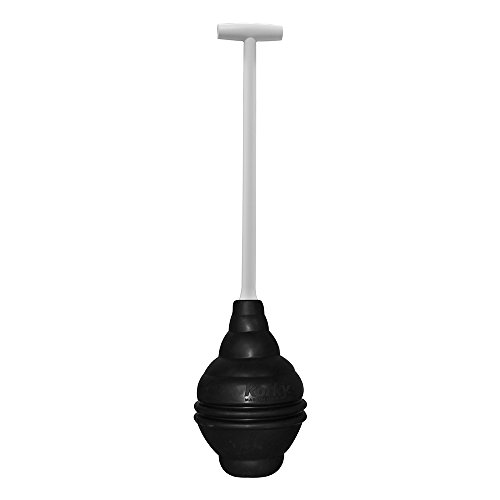
Our #1 Pick: Korky 99-4A Beehive Max
The Beehive Max does one thing better than everything else in the category: it seals. Owners consistently report it working on bowls where a conventional flanged plunger had simply skated around the throat, and that is the whole ballgame — a plunger that seals transfers your effort into the water column, and a plunger that does not is a stick with rubber on the end.
The head is a single piece of rubber with no metal insert, so nothing rusts into the handle and nothing separates after a few years in a damp bathroom. The T-handle matters more than it looks: with a straight shaft your hand slides down as the head compresses, and you lose both force and control at exactly the moment you need them.
The limitation is straightforward and worth repeating: this is a toilet tool. Do not take it to the kitchen sink, both for the obvious hygiene reason and because it will not seal there anyway.
Check price on Amazon → (paid link)
The Ranked Field
Best for the one plunger to keep beside the toilet in any house
- Beehive-shaped rubber head that seals round, elongated and low-flow bowls
- T-handle gives a straight push without your hand slipping down the shaft
- One-piece rubber head with no metal to rust into the handle
- Made in the USA and widely stocked, so replacements are easy
Why buy it: the beehive taper is the reason it works where flanged plungers fail — it seals modern low-flow and elongated bowls that a straight flange skids off.

Best for flat-bottomed drains — the job a toilet plunger genuinely cannot do
- Flat-bottom cup that seals against a flat sink, tub or shower pan
- Compact handle that fits under a vanity or in a caddy
- Natural rubber cup that stays flexible in cold bathrooms
- The most-owned dedicated sink plunger on the American market
Why buy it: a flanged toilet plunger cannot seal a flat surface, and this is the single most common reason people conclude that plunging a sink does not work.

Best for the best combination of price and seal quality
- All-angle head seals whether you push straight down or from the side
- Aluminum handle rather than wood — it will not rot or splinter
- Deep bellows-style flange for a large volume displacement per stroke
- Hangs on a hook or stands in a caddy
Why buy it: the all-angle head is the practical feature: real bathrooms rarely let you stand directly over the bowl, and a plunger that seals off-axis works in the space you actually have.

Best for a visible bathroom where the plunger has nowhere to hide
- Magnetic collar holds the head clear of the caddy floor so it drip-dries
- Narrow flange designed for modern low-flow and compact bowls
- Stainless steel handle and a caddy that does not tip
- Caddy conceals the head entirely
Why buy it: the magnetic drip-free collar solves the real problem with plungers, which is not clearing the clog but where the wet thing lives afterward.

Best for stubborn sink and tub clogs that a plain cup will not shift
- Accordion bellows body that generates far higher pressure than a cup
- Flat sealing rim for sinks, tubs and shower pans
- Rigid plastic construction with no wooden handle to rot
- Short body suited to working inside a sink basin
Why buy it: a bellows moves more water at higher pressure than any rubber cup, which is what a compacted kitchen-sink clog needs — with the caveat that the same force is hard on old traps.

Best for a plunger you will not mind seeing every day
- Canister with a lid that opens as the plunger is lifted out
- Non-slip handle that stays comfortable with wet hands
- Ventilated canister base so the head dries rather than sitting in water
- Deep rubber head suited to standard round and elongated bowls
Why buy it: the self-opening canister is the detail owners mention most — you lift the plunger and the lid moves out of the way, which sounds trivial until the moment you need it.
Quick Comparison
| Product | Best for | Rating | Price | Buy |
|---|---|---|---|---|
| Korky 99-4A BEEHIVE Max Universal Toilet Plunger with T-Handle | Best Overall | — | Check (paid link) | |
| Luigi’s Sink Plunger for Kitchen, Bathroom, Bathtub and Shower Drains | Best for Sinks, Tubs and Showers | — | Check (paid link) | |
| NEIKO 60166A Toilet Plunger with Patented All-Angle Design and Aluminum Handle | Best Value | — | Check (paid link) | |
| simplehuman Toilet Plunger with Holder Set, Magnetic Drip-Free Cover, Narrow Flange | Best with a Holder | — | Check (paid link) | |
| Master Plunger MPS4 Sink and Drain Plunger for Kitchen Sinks, Bathroom Sinks, Showers and Tubs | Best Bellows | — | Check (paid link) | |
| OXO Good Grips Toilet Plunger and Canister | Best Everyday Design | — | Check (paid link) |
How to actually use one
Plunging is hydraulics, and hydraulics needs an incompressible fluid and a closed system. Get those two things right and a $15 tool clears most household clogs.
- Cover the head with water. Air compresses; water does not. A plunger working in air transmits almost no force to the clog. In a toilet with a low water level, add water from a bucket. In a sink, run an inch or two in.
- Close every other opening. In a sink, plug the overflow hole with a wet rag and block the second basin of a double sink. In a bathtub, tape over the overflow plate. In a shower there is usually no overflow, which is why showers plunge well. Skip this and your pressure escapes rather than reaching the clog.
- Seat the head and get a full seal. A smear of petroleum jelly on the rim helps on a textured shower pan or a worn sink bottom.
- First stroke slow. Push down gently to expel trapped air without launching the contents of the bowl at you.
- Then pump hard, 10 to 20 strokes, keeping the seal on both the push and the pull. The pull matters as much as the push — the suction stroke breaks the clog up from the other side.
- Break the seal sharply on the last upstroke, then watch. If the level drops, run hot water for two minutes to carry the debris away.
If two or three rounds of that do nothing, stop plunging and change tools. Repeated failed plunging on a toilet risks pushing an object further into the trap; on a sink it just tires you out. The next step is an auger — a closet auger for a toilet, a 25-foot hand auger for a sink or tub. See best drain snake and how to use a drain snake.
How We Rank
We never buy or test these tools. For plungers the criteria are: sealing range, which for toilets means how many bowl geometries the head handles, and for sinks means whether the rim actually sits flat; displacement per stroke, since a deeper head or a bellows moves more water; handle and grip, because control matters when the head is compressing; durability of the rubber, which is where cheap plungers fail as the fold cracks; and storage and drying, the practical detail that decides whether the thing is tolerable to live with. Star ratings and review counts come from verified Amazon listing data and refresh automatically. Prices were checked at the time of writing. Full method: how we rank.
The Field, Reviewed
1. Korky 99-4A Beehive Max — Best Overall
Covered above. Owners praise: sealing on bowls where nothing else worked, the solid one-piece rubber head, and the T-handle grip. Owners gripe about: no caddy in the box, and a head large enough that it needs somewhere sensible to stand. Check price (paid link).
2. Luigi Sink Plunger — Best for Sinks, Tubs and Showers
The other half of the pair. A flat-bottomed cup with a short handle, made to seal against a flat surface, which is the one thing your toilet plunger cannot do. It is also small enough to live under the sink rather than in a corner, which is why it gets used instead of forgotten.
Owners praise: a genuine seal on flat drains, a size that stores in a vanity, and rubber that stays supple. Owners gripe about: the modest displacement compared with a bellows on a badly compacted kitchen clog, and a handle some find short for a deep sink. Check price (paid link).
3. NEIKO 60166A — Best Value
A deep-bellows toilet plunger with an aluminum handle and an all-angle head, at a price that undercuts most of the field. The all-angle claim is more useful than it sounds: in a small bathroom you frequently cannot stand square over the bowl, and a head that keeps its seal at 30 degrees off vertical works in the space you actually have.
Owners praise: strong suction for the money, an aluminum handle that will not rot like wood, and the off-axis sealing. Owners gripe about: the handle being slippery when wet compared with a molded grip, and a head that is bulky in a compact powder room. Check price (paid link).
4. simplehuman Plunger and Holder — Best with a Holder
The expensive one, and the reason people pay for it is the caddy rather than the plunger. A magnetic collar holds the head suspended above the base so it drip-dries in air instead of standing in a pool of its own drainage, which is the actual source of the smell that makes people hide plungers in the garage.
Owners praise: the drip-free magnetic collar, a caddy that hides the head completely and does not tip, and a narrow flange suited to modern bowls. Owners gripe about: the price, which is several times the field, and a narrower head that some owners find less effective on older wide-throated bowls. Check price (paid link).
5. Master Plunger MPS4 — Best Bellows
When a plain cup will not move a compacted kitchen-sink clog, a bellows will. The accordion body displaces far more water at far higher pressure than a rubber hemisphere, and on grease-and-food blockages that difference is decisive.
Owners praise: real power on kitchen clogs, a flat rim that seals well, and rigid construction with no wood to rot. Owners gripe about: splashing, which is inherent to the pressure it generates, and a genuine caution about using it on old or brittle traps — the same force that clears the clog can push a marginal slip joint apart. Check price (paid link).
6. OXO Good Grips Toilet Plunger — Best Everyday Design
A well-executed conventional toilet plunger with a canister whose lid lifts out of the way as you draw the plunger out, and a ventilated base so the head dries. The grip is the usual OXO story: comfortable with wet hands, which is not a trivial property in this application.
Owners praise: the self-opening canister, the comfortable handle, and a caddy that looks acceptable in a visible bathroom. Owners gripe about: a head aimed at conventional bowls rather than the narrowest low-flow throats, and a canister that needs occasional rinsing out. Check price (paid link).
What owners actually complain about
Wrong tool, wrong fixture. The dominant complaint across the whole category is a flanged toilet plunger failing on a sink. It was never going to work. Buy the flat cup.
No seal because the water is too low. People plunge a nearly empty bowl and conclude the plunger is weak. Add water until the head is submerged.
Rubber that hardens. Cheap plungers crack at the fold within a couple of years, especially in a cold bathroom or a garage. A cracked fold cannot hold a seal. This is the main reason to spend fifteen dollars rather than five.
Storage. Nearly every negative review that is not about sealing is about where the wet plunger lives. Ventilated or magnetic-collar caddies exist for this and are worth the extra few dollars.
Splashing. Almost always the first stroke. Push the first one down slowly to expel the air, then work.
A short safety note
The verdict
Buy the Korky 99-4A Beehive Max for the toilet and a flat-bottomed Luigi sink plunger for the sinks, tubs and showers. That pair is under thirty dollars and covers essentially every plunger-solvable clog in a house. Add the Master Plunger MPS4 bellows if your kitchen sink is a repeat offender, and pay up for the simplehuman set if the plunger has to live somewhere guests will see it. Check price on Amazon → (paid link)
More from this hub: DIY plumbing · best toilet plunger · toilet plunger vs sink plunger · how to use a plunger correctly · how to unclog a shower drain · how we rank.