 Garden
Affiliate Disclosure
Some links on this page are affiliate links. As an Amazon Associate, we earn from qualifying purchases — at no extra cost to you. We do not buy, test, or physically handle the products we cover; our rankings come from aggregated owner reviews, ratings and expert consensus. Commissions never change our verdicts. How we rank · full disclosure.
The short version: a toilet needs a flange plunger — the type with a soft rubber sleeve that pushes down into the drain throat — not the flat cup most people have under the sink. Our pick is the Korky 99-4A Beehive Max, whose tapered head seals both old wide drains and the narrow throats of modern low-flow bowls, which is the single thing that decides whether plunging works. If you want one you can leave on display, the simplehuman set adds a magnetic drip-free caddy. Everything else in this category is a detail.
Most households own the wrong plunger, and it is usually a flat black cup that has never sealed against a toilet drain in its life. This roundup sits inside the DIY plumbing hub. If you are unsure which type you own, toilet plunger vs sink plunger settles it in a minute, and how to unclog a toilet with a plunger fast covers the technique. If your problem is a sink or a tub rather than a toilet, skip to what to use on flat drains below.
Why the Flange Is the Whole Product
A toilet drain is not a flat hole in a flat surface. It is a curved throat that turns immediately into the trap — the sealed U that the residential code requires on every fixture, holding a water seal of 2 to 4 inches to keep sewer gas out, and there is no rim for a plain rubber dome to seal against. The flange — the tapered sleeve that folds out of the center of the cup — drops into that throat and seals it from the inside. Without it you are compressing air in the bowl, which is why so many people conclude their clog is unfixable when in fact they have the wrong tool in their hands.
| Head type | Seals against | Best on | Weak point |
|---|---|---|---|
| Flange (toilet) | The drain throat, from inside | Any toilet | Bulky for a flat sink drain unless the flange folds in |
| Beehive / tapered | Both wide and narrow throats | Mixed-age homes, low-flow bowls | Slightly more rubber to store and dry |
| Bellows / accordion | The throat, with a rigid body | Hard, compacted clogs | Harder to seal, splashes readily |
| Cup (sink) | A flat basin surface | Sinks and tubs | Cannot seal a toilet at all |
The second thing that matters is the bowl generation. Federal standards have driven toilets from 3.5 gallons per flush down to 1.6 and then 1.28 gallons, and the drain throats got narrower along the way to preserve flush velocity. A flange sized for a 1980s bowl can sit proud of a modern throat and lose its seal at the worst moment. A tapered beehive head sidesteps the problem by finding its seal at whatever diameter the bowl presents — which is why it dominates this category.
Top Picks at a Glance
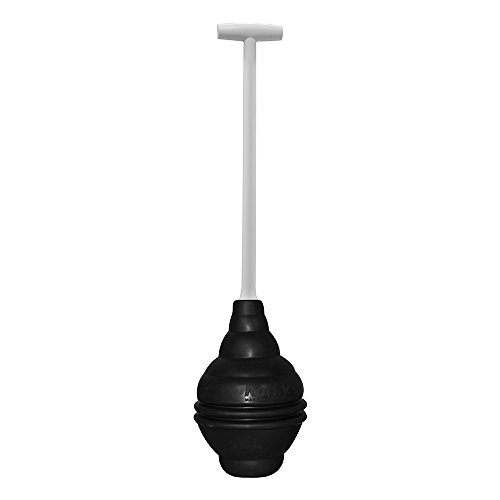
Our #1 Pick: Korky 99-4A Beehive Max
The Beehive Max earns the top spot for an unglamorous reason: it seals on everything. The head tapers from a wide base to a narrow tip, so it wedges into a narrow modern throat and still spans a wide older one, and owners consistently report that it grips where a conventional flange plunger skated off. Because the seal holds, every stroke you make actually moves water rather than venting air past the rim, and clogs that felt immovable with a cheap plunger give way in a handful of pumps.
The rest of the design is sensible rather than clever. The rubber is soft enough to conform but thick enough not to invert under a hard push, which is the failure that makes bargain plungers useless after a season. The T-handle encourages a straight vertical stroke — the direction that actually generates hydraulic pressure — rather than the angled shove a straight stick invites. It is made in the USA and it costs about the same as a takeout coffee and a sandwich.
The honest limitations: it ships bare, so you need somewhere sanitary to stand it — the 95-4A is the same head with a caddy for a few dollars more. And the beehive head is physically larger than a slim flange, which is a real consideration in a cramped half-bath where storage space is measured in inches.
Check price on Amazon → (paid link)
The Ranked Field
Best for sealing every modern bowl shape without thinking about it
- Tapered beehive head seals old and new toilet drains alike
- Soft rubber flange that will not fold under pressure
- T-handle gives a straight downward push
- Made in the USA
Why buy it: the tapered beehive shape is the one design that seals both the wide old drains and the narrow throats of modern low-flow bowls, so you are never fighting the plunger before you can even start working the clog.

Best for a plunger you are not embarrassed to leave beside the toilet
- Magnetic collar closes the caddy and traps drips
- Narrow flange head suited to modern bowls
- Stainless handle, ventilated caddy that dries out
- Compact footprint beside a pedestal or in a half-bath
Why buy it: the reason plungers get thrown away is that they sit in a puddle of their own drip water and go moldy. The magnetic drip-free caddy closes over the head and lets it dry, which is why owners keep this one visible in a guest bathroom.

Best for bowls where a standard flange keeps slipping off the drain
- All-angle head seals even when you cannot get square over the drain
- Aluminum handle resists flex on a hard push
- Large displacement head moves a lot of water per stroke
- Rubber compound stays flexible in cold bathrooms
Why buy it: in a tight half-bath you often cannot stand square over the bowl, and a conventional flange skates off the drain at an angle. This head is shaped to keep its seal off-axis, which is the whole battle.

Best for the top-rated head plus somewhere to put it, cheaply
- Same beehive head as the 99-4A
- Includes a matching drip tray and stand
- Fits old and new toilet drains
- Costs a few dollars more than the bare plunger
Why buy it: the identical head to our top pick with a caddy thrown in for a few dollars — the sensible buy if you do not already have somewhere sanitary to stand a wet plunger.

Best for a hard, compacted blockage that a cup plunger will not shift
- Accordion bellows delivers a much sharper pressure pulse
- Rigid plastic body transmits force without flexing
- Narrow snout drops into the trap throat
- Very inexpensive
Why buy it: a bellows plunger hits far harder than a rubber cup because the stiff accordion body does not absorb the stroke — it is the tool for a compacted clog, at the cost of being clumsier to seal and prone to splashing.

Best for one plunger for the toilet and the bathroom sink
- Flange folds up inside the cup to plunge flat drains
- Heavy rubber head, comfortable grip
- Covers toilet, sink and tub with one tool
- Cheaper than buying two plungers
Why buy it: the fold-out flap turns a toilet flange into a flat cup plunger for sinks and tubs, so a small bathroom only needs one tool — a genuine convenience, though a dedicated plunger of each type still seals better.
Quick Comparison
| Product | Best for | Rating | Price | Buy |
|---|---|---|---|---|
| Korky 99-4A BEEHIVE Max Universal Toilet Plunger with T-Handle | Best Overall | — | Check (paid link) | |
| simplehuman Toilet Plunger with Holder Set, Magnetic Drip-Free Cover, Narrow Flange | Best for Storage and Hygiene | — | Check (paid link) | |
| NEIKO 60166A Toilet Plunger with Patented All-Angle Design and Aluminum Handle | Best Seal on Awkward Bowls | — | Check (paid link) | |
| Korky 95-4A BEEHIVE Max Universal Toilet Plunger and Holder | Best Value Set | — | Check (paid link) | |
| Waxman PlumbCraft Bellows Accordion Toilet Plunger, 5.5-inch Diameter | Best for Stubborn Clogs | — | Check (paid link) | |
| SOFINNI Heavy Duty Toilet Plunger with Fold-Out Flap for Sinks and Drains | Best Dual Purpose | — | Check (paid link) |
Specifications Side by Side
| Plunger | Head type | Handle | Caddy | Also works on sinks |
|---|---|---|---|---|
| Korky 99-4A | Tapered beehive | Plastic T-handle | No | No |
| simplehuman | Narrow flange | Stainless | Yes, magnetic | No |
| NEIKO 60166A | All-angle flange | Aluminum | No | No |
| Korky 95-4A | Tapered beehive | Plastic T-handle | Yes, tray and stand | No |
| PlumbCraft bellows | Accordion bellows | Molded plastic | No | Poorly |
| SOFINNI | Fold-away flange | Plastic grip | No | Yes |
How We Rank
We never buy or use these plungers. For toilet plungers the ranking priorities are: seal reliability across bowl generations, taken from owner reports on both pre-1994 and modern 1.28-gallon toilets, because a plunger that cannot seal cannot work; head rigidity under load, since a cup that inverts on a hard push wastes the stroke; storage and hygiene, which is what actually determines how long the tool survives; and value. Aggregated owner ratings are weighted toward reviews written after repeated use rather than first impressions. Prices were checked at the time of writing. Full method: how we rank.
The Plungers, Reviewed
1. Korky 99-4A Beehive Max — Best Overall
Covered above. Owners praise: a seal that holds on old and new bowls alike, rubber that does not invert, and a price that makes replacing it painless. Owners gripe about: no caddy in the box and a bulkier head than slim flange designs. Check price (paid link).
2. simplehuman Toilet Plunger with Holder — Best for Storage and Hygiene
The one to buy if the plunger has to live in view. A magnetic collar draws the caddy closed around the head so drips stay inside, and the caddy is ventilated so the rubber dries instead of stewing. The head is a narrow flange sized for modern bowls, and the stainless handle does not corrode where it meets the wet head.
Owners praise: the drip-free magnetic caddy, a small footprint beside a pedestal sink, and build quality that justifies the price. Owners gripe about: costing several times what a plunger needs to cost, and a narrow head that has less reach into a wide older drain than a beehive. Check price (paid link).
3. NEIKO 60166A All-Angle — Best Seal on Awkward Bowls
Designed around the problem of not being able to stand square over the bowl. Instead of a smooth taper, the cup steps down through four graduated diameters, so it wedges into whatever size the drain opening happens to be and keeps contact when it meets the drain off-axis — which matters in a narrow half-bath where you are working from the side. Owners with unusual or very modern bowls tend to prefer this one over the beehive. The aluminum handle also resists the flex that makes long plastic handles feel spongy on a hard push, and unlike wood it will not swell, split or rot in a damp bathroom.
Owners praise: the off-angle seal, a stiff handle, and a large head that displaces plenty of water per stroke. Owners gripe about: a heavier tool than most, and an aluminum handle that will corrode at the joint if it is stored permanently wet. Check price (paid link).
4. Korky 95-4A Beehive Max and Holder — Best Value Set
Our top pick's head with a matching tray and stand. If you do not already have a hygienic place to keep a wet plunger, this is the version to buy — the caddy costs a few dollars and prevents the slow mold problem that ends most plungers' lives — the EPA's line on mold is that moisture control is the whole game.
Owners praise: the same excellent seal, and a caddy that catches drips instead of spreading them across the floor. Owners gripe about: a caddy that is functional rather than attractive, and a stand that can tip if it is knocked. Check price (paid link).
5. PlumbCraft Bellows Accordion — Best for Stubborn Clogs
A different mechanism for a different problem. The rigid accordion body does not absorb the stroke the way a rubber cup does, so the pressure pulse arriving at the clog is far sharper. When a soft plunger has failed on a compacted blockage, this frequently succeeds.
Owners praise: serious hitting power on hard clogs, and a very low price. Owners gripe about: being much harder to seal than a soft head, and splashing back if the seal breaks mid-stroke — wear something you do not mind. Check price (paid link).
6. SOFINNI Dual Purpose — Best Dual Purpose
A flange plunger whose sleeve folds up inside the cup, converting it to a flat sink plunger. In a small bathroom that has one storage spot, one tool that covers the toilet, the sink and the tub is a genuine advantage.
Owners praise: the versatility, a heavy rubber head, and a comfortable grip. Owners gripe about: the folded flange leaving a slight ridge that hurts the seal on a flat basin, and the compromise being worse at both jobs than a dedicated plunger of each type. Check price (paid link).

What Owners Actually Complain About
The head folding inside out. Cheap thin rubber inverts on a hard downward push, which dumps all the force and usually sprays the floor. It is the most common complaint about bargain plungers, and it is why head thickness matters more than any marketing feature.
No seal on a low-flow bowl. Owners of newer 1.28-gallon toilets frequently report that the plunger they have had for fifteen years suddenly will not grip. The drain throat is narrower than it used to be. A tapered head fixes this; a flat-flange plunger of the old pattern often will not.
Storing it wet. A plunger left standing in a closed cup grows mold and eventually the rubber stiffens and stops conforming. Owners describe this as the plunger "wearing out" — it did not wear out, it rotted. A ventilated caddy or a drip tray solves it.
Splash-back. Almost always caused by starting with a violent stroke instead of pressing down gently first to expel the air under the cup. Seat it slowly, then pump.
The flange tearing at the root. This is a construction issue rather than misuse: heads molded in one piece almost never do it, while two-part heads with a flange bonded into the cup eventually part company, usually inside the bowl. It is the reason to prefer a one-piece rubber head even when the two-part version is a dollar cheaper.
Handles snapping or unscrewing. Wooden handles in humid bathrooms are the main offender — they absorb water, swell, loosen at the threaded joint and eventually break mid-stroke, which is as unpleasant as it sounds. Aluminum and molded plastic do not.
Holders that are worse than no holder. Caddies that tip, do not drain, or trap standing water are one of the most consistently criticized parts of this category, and a bad caddy actively shortens a plunger's life by keeping the rubber wet.
Expecting it to clear solid objects. Plunging works by hydraulic pressure on soft blockages. A toy, a toothbrush, a flushable wipe, or compacted cat litter will not break up under pressure — that is an auger job, and continuing to plunge only risks overflowing the bowl.
What About Sinks, Tubs and Showers?
Those drains sit in a flat surface, so they need a flat cup rim rather than a flange — the beehive head that seals a toilet so well will not seal a basin at all. If you only want to own one plunger, buy a fold-out dual-purpose model like the SOFINNI above, whose sleeve tucks up inside the cup to leave a flat rim, and accept that it is good rather than excellent at both jobs. If you have the storage space, a dedicated plunger of each type seals better and is more hygienic than carrying one tool between the toilet and the kitchen sink.
It is also worth knowing where a plunger sits in the sequence, because it is step two of about six. Hot water and a plunger come first, then pulling the trap or the stopper, then a barbed hair wand, then a drum auger, and for a toilet specifically a closet auger that reaches through the internal trapway. That whole ladder is laid out for a blocked sink in how to clear a clogged kitchen sink, the mechanical tools are ranked in best drain snakes, and if you are assembling a kit from scratch, start with best plumbing tools.
How to Choose a Plunger
Buy a flange plunger, and prefer a tapered or beehive head if your home has more than one generation of toilet in it. Check the rubber thickness — a head you can fold in half with one hand will invert under load. Decide whether you want a caddy in the box; you should, unless you have a utility closet where a drip tray already lives.
Handle length is worth a thought too. A short handle brings your hands uncomfortably close to the bowl; a long one gives leverage but is harder to store. Wood handles look better and rot at the head end. Beyond that, spend the extra few dollars on a name you recognize, because a plunger that fails is a plunger that fails at the worst possible moment, and the whole tool costs less than a plumber's first fifteen minutes.
The Verdict
The Korky 99-4A Beehive Max is the toilet plunger to own: it seals on any bowl in any house, the rubber holds its shape under a hard push, and it costs almost nothing. Add the Korky 95-4A instead if you need the caddy, choose the simplehuman set if it has to look presentable, reach for the NEIKO 60166A in a cramped bathroom where you cannot get square over the drain, and keep a PlumbCraft bellows in the garage for the compacted clog that laughs at rubber. Check price on Amazon → (paid link)
More from this hub: DIY plumbing · how to use a plunger correctly · toilet plunger vs sink plunger · best drain snake · how to snake a clogged drain · how we rank.