 Garden

Affiliate Disclosure
Some links on this page are affiliate links. As an Amazon Associate, we earn from qualifying purchases — at no extra cost to you. We do not buy, test, or physically handle the products we cover; our rankings come from aggregated owner reviews, ratings and expert consensus. Commissions never change our verdicts. How we rank · full disclosure.
A water filter removes what it is certified to remove, and nothing else. That single sentence answers most of this question. Certification to NSF/ANSI 42 means the filter has been independently tested for chlorine, taste and odor. Certification to NSF/ANSI 53 means it has been tested for health-related contaminants — lead, cysts, VOCs and now PFOA and PFOS — and those claims are granted individually, not as a block. NSF/ANSI 58 covers reverse osmosis performance. A carton listing twenty contaminants tells you what the marketing department wanted to say; the certification listing tells you what was tested.
What Each NSF/ANSI Standard Actually Covers
These standards are narrow and specific, which is what makes them useful. Learn the four numbers and the aisle stops being confusing.
| Standard | Covers | Typical products | What it does not tell you |
|---|---|---|---|
| NSF/ANSI 42 | Aesthetic effects: chlorine, taste, odor, particulate | Pitchers, faucet mounts, refrigerator filters, basic under-sink cartridges | Anything about health contaminants. A 42-only filter is a taste product |
| NSF/ANSI 53 | Health effects: lead, cysts, VOCs, PFOA and PFOS | Better faucet mounts, carbon block under-sink systems | Which claims. Certification is per-contaminant — check the listing |
| NSF/ANSI 58 | Reverse osmosis system performance, including TDS reduction | Under-sink and countertop RO systems | Nothing about the carbon pre-filters, which are certified separately |
| NSF/ANSI 401 | Emerging contaminants: pharmaceuticals and unregulated chemicals | Premium faucet mounts and under-sink cartridges | It is an addition to 53, never a substitute for it |
| NSF P473 | Former standalone PFOA/PFOS protocol | Retired | NSF has moved PFOA and PFOS reduction claims into NSF/ANSI 53 and 58, so a current PFAS claim belongs under those |
NSF states plainly that certification to a standard does not mean a filter reduces every possible contaminant, and that you have to verify the specific claim you care about. The two-minute habit that follows from that: look your exact model number up in NSF's certified drinking water treatment unit database and read the claims listed beside it. If the model is not there, it is not certified, whatever the box implies.

Lead: Certified to 53, and Filtration Is Mitigation
Lead is the contaminant where the certification distinction matters most, because the risk is real and the marketing is loosest. Look for NSF/ANSI 53 with a lead reduction claim specifically. EPA's guidance is direct: using a filter can reduce lead in drinking water, and if you use one, make sure it is certified to remove lead.
Understand what a filter is doing here, though. Lead does not arrive in your water from the treatment plant. EPA states that lead enters drinking water when plumbing materials containing lead corrode — most often lead service lines, lead pipes and lead-bearing faucets and fixtures, particularly in homes built before 1986. Your utility is not sending you lead; your own supply line and fittings are contributing it on the way to the tap.
Which makes filtration a mitigation, not a solution. It works, it is cheap, and it should be running while you deal with the source — identifying whether your service line is lead, asking your utility for the inventory record covering your address, and planning replacement. EPA's lead in drinking water page and its lead service line replacement pages are the right starting points.
Three practical rules that no filter substitutes for. Use cold water only for drinking, cooking and formula, because hot water dissolves lead more readily and boiling concentrates it. Replace lead cartridges on schedule — a saturated lead-reduction cartridge is not a neutral object. And do not rely on a whole-house filter for lead, because it sits upstream of your interior plumbing and cannot treat what is picked up after it. Lead is a point-of-use problem.
Before deciding anything, get a number. A certified laboratory result is the only lead measurement worth acting on, and how to test for lead in water covers the first-draw sampling protocol that makes the result valid.
Chlorine: Yes, Easily — Chloramine, Less So
This is the one thing every carbon filter genuinely does well. Free chlorine is readily adsorbed by activated carbon, which is why a $25 pitcher and a $400 reverse osmosis system produce a similar improvement in how the water tastes. NSF/ANSI 42 is the standard that covers it, and a huge share of the market carries it.
The complication is chloramine. Many US utilities have moved from free chlorine to chloramine — chlorine combined with ammonia — because it persists longer in the distribution system. Chloramine is considerably more stubborn for carbon to remove. It needs catalytic carbon and a much longer contact time, which in practice means a large cartridge and a slow flow rate rather than a small filter on the end of the faucet.
Find out which one you have before you buy: your utility's annual Consumer Confidence Report states the disinfectant used, and EPA explains how to find yours at epa.gov/ccr. If it says chloramine, look for a catalytic carbon block sized for the job, or step up to reverse osmosis. A faucet-mount filter will help with taste but is not the right tool.
PFAS: Reverse Osmosis and Certified Carbon Blocks, Not Pitchers
PFAS — per- and polyfluoroalkyl substances, the so-called forever chemicals — is where the gap between marketing and certification is currently widest, so precision matters.
What reduces PFOA and PFOS: reverse osmosis systems, and activated carbon blocks that carry a certified PFOA/PFOS reduction claim. NSF ran a standalone protocol for this, NSF P473, and has since retired it and folded PFOA and PFOS reduction into NSF/ANSI 53 (for filtration) and NSF/ANSI 58 (for reverse osmosis). So a current, credible PFAS claim appears under 53 or 58, and a product still advertising P473 is quoting a protocol that has been superseded.
What generally does not: a basic filter pitcher. Some pitchers now carry PFOA/PFOS claims and those are meaningful when certified, but the default assumption for an ordinary carbon pitcher should be no.
Two honest caveats. First, PFAS is a family of thousands of compounds; a certification covering PFOA and PFOS does not cover the whole class. Second, the regulatory picture is moving. EPA finalized national drinking water standards for PFAS in 2024 setting maximum contaminant levels of 4.0 parts per trillion for PFOA and 4.0 ppt for PFOS, with maximum contaminant level goals of zero, and has since proposed changes to compliance timing and to some of the other regulated compounds. EPA's PFAS drinking water page is the source to check for the current position rather than any filter manufacturer's summary of it.
If PFAS is your actual concern, test before you spend. PFAS analysis is a specialist laboratory job, not a strip — find a state-certified laboratory through EPA's directory, and check whether your utility already reports PFAS results.
Filters That Carry the Certification
We do not buy or install these systems; the picks below reflect aggregated owner reports and published certification data, chosen to represent the three routes that genuinely carry health-effects certification.
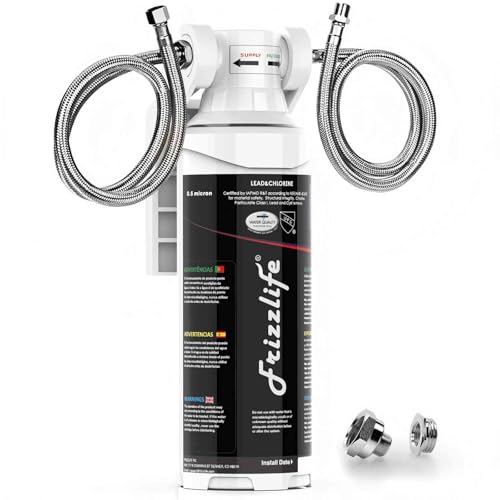
Best for a filter carrying the health-effects standard, not just the taste one
- Certified to NSF/ANSI 53 (health effects) as well as 42 (aesthetic effects)
- Connects directly to the existing cold line — no separate faucet or drilling
- Twist-off cartridge change without shutting the water off at the main
- High flow rate compared with faucet-mount filters
Why buy it: a 53 certification is the line between a filter that improves taste and one independently tested against health-related contaminants, and this one is on the right side of it.

Best for renters who cannot touch the plumbing under the sink
- Certified to NSF/ANSI 42 and 53
- Stainless steel housing instead of the plastic collar that usually fails
- Threads onto a standard faucet aerator in minutes, no tools
- Diverter for filtered or unfiltered flow
Why buy it: the cheapest route to a genuinely 53-certified filter, and it comes off the faucet and goes with you when the lease ends.

Best for dissolved contaminants that activated carbon cannot touch
- Reverse osmosis membrane rated under NSF/ANSI 58 for RO system performance
- Carbon block stages ahead of and after the membrane
- Removes dissolved solids that carbon filtration passes straight through
- Runs on line pressure with no electricity
Why buy it: reverse osmosis addresses the widest range of contaminants of any home technology, which is why it is the answer when the problem is dissolved rather than aesthetic.
For the full field in each format, see best faucet water filter, best under sink water filter and best reverse osmosis system.
What Water Filters Do Not Remove
| Contaminant or problem | Carbon filter | Reverse osmosis | What actually handles it |
|---|---|---|---|
| Chlorine, taste, odor | Yes | Yes | Any NSF/ANSI 42 carbon filter |
| Chloramine | Only catalytic carbon, slowly | Yes | Catalytic carbon block or RO |
| Lead | Only if certified to 53 for lead | Yes | Certified filter now; pipe replacement permanently |
| PFOA and PFOS | Only if certified under 53 | Yes, under 58 | Certified carbon block or RO |
| Nitrate | No | Yes | RO, ion exchange or distillation |
| Arsenic | No | Yes (form dependent) | RO or specialized adsorptive media |
| Hardness (scale) | No | At the tap only | A water softener — see softener vs filter |
| Bacteria and viruses | No, unless absolute sub-micron | Yes, but not a disinfection guarantee | UV disinfection, or boiling under an advisory |
| Iron staining on a well | Limited | At the tap only | A whole-house iron filter |
None of the above is a claim about health outcomes. It is a description of what a certification covers and what a treatment technology is capable of. If your concern is a specific contaminant, the sequence is always the same: test it, read the certification, then buy.
The Short Version
Do water filters remove lead? Only the ones certified to NSF/ANSI 53 with a lead claim — and filtration is the interim measure while the lead-bearing plumbing gets replaced. Chlorine? Yes, essentially any carbon filter, which is what NSF/ANSI 42 covers; chloramine needs catalytic carbon or reverse osmosis. PFAS? Reverse osmosis and certified carbon blocks reduce PFOA and PFOS; a basic pitcher generally does not, the old P473 protocol has been folded into 53 and 58, and no certification covers the entire PFAS family. In every case the move is identical: find the model in NSF's database, read the claims, and buy the certification rather than the carton.
More from this hub: DIY plumbing · how to test for lead in water · best faucet water filter · reverse osmosis vs carbon filter · how often to change a water filter · how we rank.