 Garden

Affiliate Disclosure
Some links on this page are affiliate links. As an Amazon Associate, we earn from qualifying purchases — at no extra cost to you. We do not buy, test, or physically handle the products we cover; our rankings come from aggregated owner reviews, ratings and expert consensus. Commissions never change our verdicts. How we rank · full disclosure.
The short answer: the best backyard hammock is the Vivere Double Cotton Hammock with Space Saving Steel Stand. It suits most yards because it answers both halves of the question in one box — a tightly woven cotton bed that breathes and drapes the way synthetic fabric never quite does, and a 450-pound-rated steel stand that assembles in minutes, so the hammock goes where you want it rather than where the trees are. If you prefer lying flat rather than nested, a quilted hammock with hardwood spreader bars like the Sunnydaze is the format to choose.
Below are the six the owner-review record supports, the difference between gathered-end and spreader-bar hammocks (which is the actual decision), and the hanging geometry that determines whether yours is comfortable or a struggle.
Gathered-End or Spreader Bar? This Is the Real Decision
Everything else is secondary to this, and almost nobody explains it before you buy.
| Gathered end (no bars) | Spreader bar | |
|---|---|---|
| How you lie | Diagonally, fabric wraps around you | Flat, across the bed like a bench |
| Stability | Very stable — hard to tip out | Tippy until you learn it |
| Feel | Cocooned, cradled | Open, more like a lounger |
| Best for | Napping, reading, all-day lounging | Sunbathing, sharing, getting in and out often |
| Sitting up in it | Awkward | Easy |
Spreader-bar hammocks are what most people picture, and they are genuinely less stable — the bars raise the center of gravity and they will roll if you climb in carelessly. Gathered-end hammocks look less appealing and are markedly more comfortable once you learn to lie diagonally rather than along the length, which flattens the bed considerably.
If you have never used a hammock much, buy a spreader-bar model — it behaves the way you expect. If you have, and you want to spend an afternoon in it, buy gathered-end.

Top Picks at a Glance
Our #1 Pick: Vivere Double Cotton Hammock with Steel Stand
Vivere's universal combo sells the way it does because it removes both obstacles at once. Most people who want a hammock do not have two trees 14 feet apart in the right patch of shade, and buying a hammock and a stand separately is fiddly, expensive, and frequently ends in a mismatch.
The bed is tightly woven 100% cotton, and material matters here more than any other spec. Cotton breathes, so on an 85°F afternoon you are not lying on a sheet of plastic. It also drapes — the weave gives and conforms around your body in a way that polyester, which is stiffer and slicker, does not. The trade is weather resistance, which is genuinely poor; cotton must come indoors.
The stand is heavy-duty steel with a 450-pound capacity, assembles without tools in a few minutes, and comes apart again for storage. The space-saving footprint is a real design feature rather than marketing — the frame is narrower than a typical arc stand, so it fits on a deck or a small patio where a 15-foot arc will not.
It comes with a carry bag, which sounds trivial and is the thing that makes the take-it-in routine actually happen.
Honest limitations: cotton mildews if stored damp or left out in rain, and that is by a wide margin the most common cause of a Vivere ending up in the bin. The stand is steel and will surface-rust at scratches over several seasons. And it is a gathered-end double hammock, so if you were expecting a flat lounger, buy a spreader-bar model instead.
Check price on Amazon → (paid link)
The Ranked Field

Best for most yards — hammock and stand together, no trees required
- Tightly woven 100% cotton bed
- Heavy-duty steel stand assembles in minutes
- 450 lb weight capacity
- Carry bag included, packs down for storage
Why buy it: cotton breathes and drapes around you in a way polyester never quite manages, and the stand means you are not hostage to where the trees are.
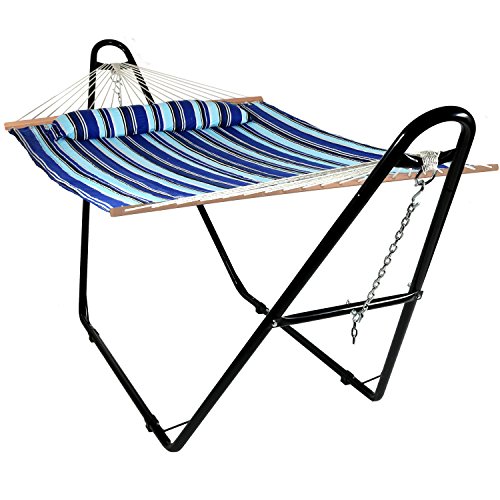
Best for a flatter, more bed-like lie with spreader bars
- Quilted polyester bed with polyester fiber fill
- Hardwood spreader bars keep the surface flat
- 440 lb capacity on 1.5 inch powder-coated steel
- Roughly 125 in wide overall
Why buy it: spreader bars plus quilting give you a flat surface you can lie across, which suits people who find a deep cocoon claustrophobic.

Best for hanging between two trees or existing posts
- 12 ft quilted double bed with a detachable pillow
- Hardwood spreader bars
- 450 lb capacity
- Chains and S-hooks pre-attached
Why buy it: if you already have two trees the right distance apart, skipping the stand saves $80 and a lot of steel.

Best for a complete setup without the premium price
- Quilted double bed with spreader bars
- 12 ft steel stand included
- 450 lb capacity
- Assembles without tools
Why buy it: the same quilted-and-spreader-bar formula as the premium sets, complete with a stand, for meaningfully less money.

Best for a hammock that is part of the garden design
- Curved laminated wood arc stand, 13 ft
- Quilted double hammock with spreader bars
- 400 lb capacity
- Finished for outdoor use
Why buy it: a curved wood arc is the only hammock stand that looks like furniture rather than scaffolding, and that matters on a visible lawn.

Best for trees, travel, and hanging somewhere different each week
- 210T 75D nylon taffeta, no spreader bars
- Packs into a stuff sack the size of a grapefruit
- Rated to 500 lb
- Straps sold separately or bundled
Why buy it: a gathered-end nylon hammock is more comfortable than most people expect, and it costs less than a good pillow.

Quick Comparison
| Product | Best for | Rating | Price | Buy |
|---|---|---|---|---|
| Vivere Double Cotton Hammock with Space Saving Steel Stand | Best Overall | — | Check (paid link) | |
| Sunnydaze Double Quilted Fabric Hammock with Universal Steel Stand | Best Quilted with Stand | — | Check (paid link) | |
| Lazy Daze Hammocks 12 FT Double Quilted Fabric Hammock with Spreader Bar | Best Without a Stand | — | Check (paid link) | |
| Lazy Daze Hammocks Quilted Fabric Hammock with 12 Feet Stand | Best Value with Stand | — | Check (paid link) | |
| Sunnydaze Quilted Double Fabric Hammock with 13-Foot Curved Arc Wood Stand | Best Wood Stand | — | Check (paid link) | |
| Bear Butt Double Parachute Camping Hammock | Best Packable | — | Check (paid link) |
How We Rank
We do not buy or hang hammocks. We read the owner-review record at volume, weighting reviews written after a full summer because comfort impressions form in minutes and durability problems take months. Four things carry the most weight. Fabric behavior over a season — mildew, fade, stretch and thread failure, which separate cotton, polyester and quilted beds sharply. Stand stability and capacity honesty, tracked through reviews describing flex, rocking or bending under load. Hardware quality, since S-hooks, chains and end rings are where failures concentrate. And assembly and storage friction, because a hammock that is a chore to put away is one that gets left out and ruined. Prices were checked at time of writing. Full method on how we rank.
The Hammocks, Reviewed
1. Vivere Double Cotton Hammock with Steel Stand — Best Overall
Covered above. What owners consistently praise: the comfort of cotton, quick tool-free assembly, the compact stand footprint, and that everything needed arrives together. Recurring complaints: cotton mildews if left out, which is the dominant failure story; the stand surface-rusts at scratches over a few seasons; a subset report the stand flexing noticeably with two adults despite the 450 lb rating; and the fabric stretches over the first few weeks, so it hangs lower than it did new. Check price (paid link).
2. Sunnydaze Double Quilted Fabric Hammock with Universal Steel Stand — Best Quilted with Stand
The other main format, done well. A quilted polyester bed with fiber fill over hardwood spreader bars, on a 1.5-inch tubular powder-coated steel stand rated to 440 pounds. The quilting gives padding that a woven cotton bed does not have, and it is reversible, so there are two colors in one hammock. Polyester also handles a rain shower far better than cotton, though it should still not live outdoors.
Recurring complaints: spreader-bar hammocks are tippy and several owners describe an undignified first attempt; the fill compresses over a season and the bed flattens; and at around 125 inches overall the stand takes real lawn space. Powder-coated steel chips and then rusts at the chip. Check price (paid link).
3. Lazy Daze 12 FT Double Quilted Hammock with Spreader Bar — Best Without a Stand
If you already have two suitable trees or posts, skipping the stand saves around $80 and a considerable amount of steel. A 12-foot quilted double bed with hardwood spreader bars, a detachable pillow, a 450-pound rating, and chains with S-hooks already attached so it is ready to hang.
Recurring complaints: the chains are short and most owners need to buy tree straps separately — do not use the chains directly against bark; the detachable pillow slides out of position; and the quilting is thinner than the Sunnydaze. Check your tree spacing before ordering: 12 feet of hammock plus chains needs roughly 14 to 16 feet between anchors. Check price (paid link).
4. Lazy Daze Quilted Hammock with 12 Feet Stand — Best Value with Stand
The same quilted, spreader-bar formula as the premium sets, complete with a 12-foot steel stand, for meaningfully less money. It assembles without tools and carries the same 450-pound rating. For a first hammock where you are not yet certain how much you will use it, this is the sensible spend.
Recurring complaints: the steel is lighter gauge than the Sunnydaze stand and flexes more; the powder coat is thinner and chips during assembly; and the 12-foot stand is a slightly tight fit for a 12-foot hammock, so the hang can be flatter than ideal. Check price (paid link).
5. Sunnydaze Quilted Hammock with 13-Foot Curved Arc Wood Stand — Best Wood Stand
The one you buy when the hammock is part of how the garden looks. A curved laminated wood arc is genuinely handsome in a way no steel frame manages, and on a lawn visible from the house that is the whole point. Quilted double bed with spreader bars, 400-pound capacity, finished for outdoor use.
Recurring complaints: at around $400 it is by far the most expensive here; wood needs re-oiling or sealing every year or two or it greys and eventually checks; assembly is more involved than the steel stands and benefits from two people; and it is heavy and awkward to move once built. Buy it as garden furniture, priced accordingly. Check price (paid link).
6. Bear Butt Double Parachute Camping Hammock — Best Packable
At around $40, a 210T 75D nylon taffeta gathered-end hammock that stuffs into a sack the size of a grapefruit and is rated to 500 pounds. It is designed for camping, and it is the reason a lot of people discover they prefer gathered-end hammocks — lying diagonally in one is more comfortable than most spreader-bar hammocks at four times the price.
Recurring complaints: straps are usually sold separately or in a bundle, so check what you are ordering; nylon is warm and slightly clammy on a hot day compared with cotton; and there is no stand option, so you need trees or posts. It also dries fast and shrugs off a rain shower, which cotton does not — and if it hangs from a wooden frame rather than trees, note that only the heartwood of species like cedar and redwood is naturally decay resistant, per the USDA Forest Products Laboratory; sapwood is not. Check price (paid link).

Hanging It Right — and Protecting the Trees
Comfort in a hammock is mostly geometry, and the geometry is simple once someone tells you.
- Check any stand or hammock against the CPSC recall database before you buy, which lists current US product recalls by category. Distance: 13 to 16 feet between anchors is ideal for a gathered-end hammock; 10 to 18 feet works with strap adjustment. Spreader-bar hammocks need roughly two feet more than their stated length.
- Anchor height: roughly 4 to 6 feet up each trunk, then adjust.
- Hanging angle: about 30 degrees from horizontal at each end. This is the important one. A hammock hung nearly flat multiplies the tension on the straps and anchors dramatically, and that is how hardware and trees fail. Sag is not sloppiness; it is load management.
- Sitting height: the lowest point should sit around 18 inches above the ground when occupied — chair height, so you can get in and out naturally.
- Expect stretch. Cotton and rope stretch noticeably in the first week. Hang higher than you think and re-adjust.
On tree protection: use webbing straps at least 0.75 to 1 inch wide, and 2 inches on young or thin-barked trees. Many state and national parks now specify a minimum strap width because thin cord and chain cut through bark and can girdle a trunk. Never run chain or cable directly against bark, never screw eye bolts into a tree you value, and pick trunks at least 8 to 12 inches in diameter that are alive, healthy and firmly rooted. A dead or leaning tree is not an anchor.
What Owners Actually Complain About
Mildew. The single most common way a hammock dies, and it is always cotton left out in rain or stored damp. Dry it fully before it goes in the bag.
Stands that flex. Weight ratings are static; real use is dynamic, and two adults getting in at once loads a stand far beyond a still 400 pounds. Heavier gauge steel or a wood arc flexes less.
Tipping out of spreader-bar hammocks. Universal and mostly technique. Sit in the center first, then swing your legs up — do not climb in from the end.
Rust at chips. Powder coat chips during assembly, and the chip rusts. Touch up scratches with exterior paint when you build it.
Fading. UV takes the color out of every fabric here within a couple of seasons if it lives outdoors. Another reason for the carry bag.
The Verdict
For comfort, capacity and not being tied to where the trees are, the Vivere Double Cotton Hammock with Steel Stand is what the owner-review record supports most strongly — just bring the cotton in when it rains. Prefer to lie flat? The Sunnydaze quilted set. Already have two trees? The Lazy Daze 12 FT, plus proper wide straps. Watching the budget? The Lazy Daze with stand. Want it to look like furniture? The curved wood arc Sunnydaze. Just want to try one for $40? The Bear Butt. Check price on Amazon → (paid link)
Next: the full garden decor hub · best porch swings · decorating a small yard · best garden arbors · how we rank.