 Garden
Affiliate Disclosure
Some links on this page are affiliate links. As an Amazon Associate, we earn from qualifying purchases — at no extra cost to you. We do not buy, test, or physically handle the products we cover; our rankings come from aggregated owner reviews, ratings and expert consensus. Commissions never change our verdicts. How we rank · full disclosure.
The short version: after weighing five popular garden arbors on owner star ratings, review volume, material, post and section sizes, assembly reports and how each behaves in wind once a mature climber is on it, our #1 pick is the Vita Heartwood cedar arbor. It has the rot resistance, the mass and — crucially — the lattice sides that give climbing plants something to grip. The rot resistance is real rather than marketing: the USDA Forest Products Laboratory lists the heartwood of cedars, redwood and bald cypress as naturally resistant to decay fungi.
An arbor is a structural purchase disguised as a decorative one. The two things that decide whether you are happy in five years are how well it is anchored and whether the plants can actually hold onto it, and neither appears in the product photography. For the broader question of where ornament belongs in a garden, see choosing garden statuary, and the whole picture is on the garden decor hub.
Top Picks at a Glance
Our #1 Pick: Vita Heartwood Cedar Arbor
Cedar is the traditional arbor material for good reasons that have nothing to do with looks. It contains natural oils that resist rot and insects without any treatment, it holds a screw well, and it is dimensionally stable enough that a kit assembled square in spring is still square after a wet fall. Left alone it weathers to a soft silver-gray; stained, it holds color longer than pine or spruce would.
Consensus Score ████████░░ 8.6 — owners consistently rate the material and the finished appearance above the assembly experience
The detail that earns it the top spot is the lattice side panels. A great many arbors are essentially two posts and a curved top, which looks correct in a catalogue and gives a clematis nothing to wrap around — the plant reaches the top of the post and stops. Lattice provides continuous grip from the ground up, so the structure fills in from the bottom rather than sprouting a tuft at the crown. The recurring caution in its reviews, as with every kit arbor, is assembly: allow a few hours, assemble loosely, square everything, then tighten.
Check price on Amazon → (paid link)
Best Garden Arbors 2026: The Ranked Field

Best for a garden entrance that will still be standing in fifteen years
- Sustainably sourced cedar with natural rot resistance
- Lattice side panels for vines to grip
- Roughly 55 in. wide by 88 in. tall opening
- Bolt-together assembly, no cutting required
Why buy it: cedar posts with lattice sides give climbers something to actually hold, which is the difference between an arbor and a bare frame.
Best for a fast, inexpensive arch over a path or a wedding aisle
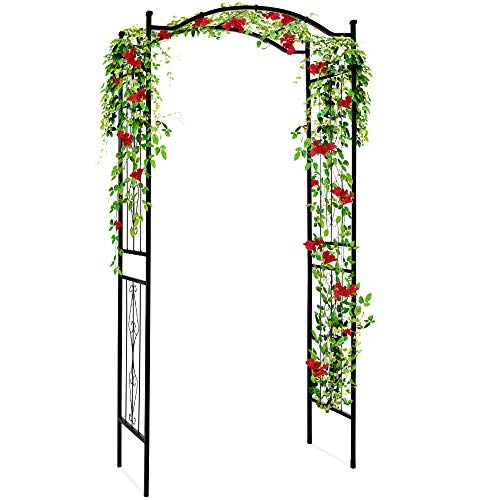
- Powder-coated tempered steel with scroll lattice
- About 44 in. wide by 92 in. tall
- Assembles in roughly 15 minutes
- Ground stakes included
Why buy it: it costs a quarter of a cedar arbor and gives climbing roses and clematis plenty of thin bar to wrap around.

Best for a modern garden where the arbor is a piece of architecture
- FSC-certified cedar in a charcoal finish
- Craftsman proportions, roughly 91 in. x 40 in. x 85 in.
- Heavier timber sections than typical kit arbors
- All-weather construction, natural insect resistance
Why buy it: the timber sections are thick enough that the structure reads as built rather than assembled.

Best for a low-maintenance arbor with somewhere to sit under it
- Vinyl construction, never needs staining or sealing
- Integrated bench seat
- Roughly 49 in. wide by 91 in. tall
- Long manufacturer warranty against warping and cracking
Why buy it: vinyl is the only material here you can genuinely ignore — no stain, no sealer, no splinters, no rot.

Best for heavy climbers such as wisteria or a mature climbing rose
- Solid western red cedar throughout
- Substantial post and beam sections
- Open lattice sides for training vines
- Unfinished — takes stain or weathers to silver
Why buy it: a mature wisteria will pull a light steel arch apart; this is the section size that carries the weight.
Quick Comparison
| Product | Best for | Rating | Price | Buy |
|---|---|---|---|---|
| Vita Heartwood Cedar Wood Arbor, 55 in. x 88 in. | Best Overall | — | Check (paid link) | |
| Best Choice Products 92 in. Steel Garden Arch Arbor Trellis | Best Value | — | Check (paid link) | |
| Vita Summerwood Craftsman Cedar Arbor, Charcoal | Best Premium Cedar | — | Check (paid link) | |
| New England Arbors Vienna Vinyl Arbor with Bench, 49 in. W | Best Vinyl | — | Check (paid link) | |
| All Things Cedar GA87 Garden Arbor | Best Solid-Timber Build | — | Check (paid link) |
How We Rank
We do not buy, test or physically handle these arbors. We rank them by aggregating owner star ratings and review counts across the category, weighting recent reviews above launch-window ones, cross-checking dimensions, material and section sizes against manufacturer specifications, and reading negative reviews closely for what goes wrong after the first winter rather than on assembly day.
Four things drive the order. Stability under load, because an arbor with a mature climber on it is a sail, and this is where light steel fails. Climbability — whether the structure gives plants something to grip, which decides how the arbor looks in year three. Material longevity, meaning rot, rust and UV behavior. And assembly quality, since misdrilled holes and vague instructions generate a very large share of the one-star reviews in this category. Prices were checked at time of writing and move seasonally. Full method: how we rank.
The Arbors, Reviewed
1. Vita Heartwood Cedar Arbor — Best Overall
Covered above. Consensus Score ████████░░ 8.6. Strengths: naturally rot-resistant cedar, lattice sides that plants can grip, sensible opening width for a path, and a finished look that suits both cottage and formal gardens. Recurring complaints: assembly time and hole alignment lead the negatives, with several owners reporting they had to re-drill. Timber sections are lighter than a custom-built arbor, so anchoring is not optional. A minority report knots and color variation in the cedar, which is a characteristic of the material rather than a defect.
2. Best Choice Products 92 in. Steel Arch — Best Value
The most-bought product in this category by a wide margin, and for a specific set of jobs it is the right answer. A powder-coated steel arch with decorative scroll lattice, about 44 inches wide and 92 inches tall, that goes together in a quarter of an hour. Thin bars are exactly what twining climbers want — clematis, honeysuckle and morning glory grip steel far more readily than they grip a four-inch cedar post.
Consensus Score ███████░░░ 7.7 — very high satisfaction on price and appearance, much lower on wind survival
Recurring complaints: wind, overwhelmingly. The supplied ground stakes are short, and reviews are full of arches folded over after a storm — owners who replaced the stakes with long rebar or set the legs in concrete report a completely different experience. The steel is light gauge and can bend during assembly, and the powder coat chips at the joints and then rusts. It is a good arch that needs a better foundation than it ships with.
3. Vita Summerwood Craftsman Cedar Arbor — Best Premium Cedar
The design-led option: Craftsman proportions, heavier timber sections and a charcoal finish that suits contemporary planting far better than orange-toned cedar. It is wider and more substantial than the Heartwood, which makes it a genuine garden feature rather than a doorway, and the FSC-certified cedar carries the same natural rot and insect resistance.
Consensus Score ████████░░ 8.2 — owners rate appearance and material highest; price is the common reservation
Recurring complaints: cost, first and foremost. Assembly is a longer job than the Heartwood and reviewers consistently recommend two people. The charcoal finish weathers unevenly if left untreated, and several owners re-stain within a couple of years to keep it consistent. Shipping damage on long timber sections shows up in a visible minority of reviews.
4. New England Arbors Vienna Vinyl Arbor — Best Vinyl
The maintenance-free option, with a bench built into it. Vinyl does not rot, does not need sealing or staining, does not splinter and does not feed insects, and the manufacturer warranty against warping and cracking runs for many years. With the integrated seat it functions as a destination in a garden rather than just a threshold.
Consensus Score ███████░░░ 7.8 — strong ratings for low maintenance, weaker for value and for plant support
Recurring complaints: vinyl gives climbing plants almost nothing to grip, so owners end up adding wire, netting or eye hooks — worth planning for at purchase. Reviewers describe the sections as lighter than expected for the price, and several note that the structure flexes noticeably in wind unless anchored. White vinyl also shows dirt and algae in shaded, damp positions and needs washing.
5. All Things Cedar GA87 Garden Arbor — Best Solid-Timber Build
The heaviest structure here, and the one to choose if the plan involves wisteria, a mature climbing rose — Clemson Extension warns that vigorous vines can collapse a weak support, and Missouri Extension says wisteria in particular needs space and large supports or anything else that becomes genuinely heavy. Solid western red cedar in substantial post and beam sections, with open lattice sides for training. It ships unfinished, so you can stain it to match a fence or leave it to silver.
Consensus Score ███████░░░ 7.9 — highest ratings from owners with heavy climbers, mixed on packaging and finish
Recurring complaints: raw cedar quality varies between shipments, and reviewers report knots, splits and rough faces that needed sanding. Assembly is heavy work and genuinely a two-person job. Because it ships unfinished, leaving it untreated in a wet climate accelerates surface checking. It is the strongest structure in this roundup and the least polished out of the box.
How to Choose a Garden Arbor
Start with what will grow on it, because that sets the structural requirement. Annual vines and clematis need almost nothing — a steel arch is ideal and the thin bars suit them. Climbing roses need timber you can tie into. Wisteria, trumpet vine and mature grape need solid post sections, and putting one on a light steel arch simply postpones a failure by a few years.
Then measure the opening you actually need. A path arbor wants to be at least 4 feet wide and 7 feet tall, because a fully clothed arbor loses about a foot of clearance on every surface — arbors that felt generous when bare become tunnels once the plant fills in. Check the stated dimensions are the opening rather than the outside width.
Finally, plan the anchoring before you buy, and budget for it. Concrete footings, long rebar stakes or metal post anchors are what keep an arbor upright, and the supplied hardware is usually the minimum rather than the recommendation. Anchoring is the single strongest predictor of whether an arbor is still standing after five winters.
What Owners Actually Complain About
Five complaints recur across every material here. Blowing over leads by a wide margin and is concentrated on light steel arches with short stakes — a foundation problem rather than a product problem, but it accounts for most of the angry reviews. Assembly frustration is second: misaligned pre-drilled holes, unclear diagrams and parts that need forcing.
Shipping damage is third, because these are long, awkward packages and timber sections arrive cracked more often than anyone would like. Rust and finish failure is fourth on coated steel, typically starting at joints and stake points within a couple of seasons. And plants failing to climb is fifth — an entirely avoidable disappointment that comes from pairing a twining plant with a structure that offers no thin members to twine around. Choosing material for the plant and anchoring properly removes almost all of these.
The Verdict
For most gardens, the Vita Heartwood cedar arbor is the one to buy — rot-resistant, properly climbable, and substantial enough to look permanent. On a budget, or growing light twining vines? The Best Choice Products steel arch is excellent value provided you upgrade the stakes. Want a design statement? The Vita Summerwood. Want to never maintain it, and to sit under it? The Vienna vinyl arbor. Planting wisteria? Only the All Things Cedar GA87 has the sections for it.
Check price on Amazon → (paid link)
Next: add a focal point with best outdoor fountain, bring birds in with best birdbath, or work out scale and placement in decorating a small yard.