 Garden

Affiliate Disclosure
Some links on this page are affiliate links. As an Amazon Associate, we earn from qualifying purchases — at no extra cost to you. We do not buy, test, or physically handle the products we cover; our rankings come from aggregated owner reviews, ratings and expert consensus. Commissions never change our verdicts. How we rank · full disclosure.
The short answer: dark sky friendly lighting means fully shielded fixtures that emit no light above horizontal, warm color at 3000K or lower (2700K is the sweet spot for yards), the lowest lumen output that does the job, and controls — a timer or a motion sensor — so nothing burns all night for no reason. Aim everything down, light only what needs lighting, and the yard looks better while the street stays quiet.
The Five Principles, in Plain Terms
Astronomy and conservation groups have converged on effectively the same short checklist, and it maps neatly onto ordinary residential decisions. Light should be useful — every fixture has a job it can be named. It should be targeted, hitting the thing it is meant to light and not the fence, the window or the sky. It should be at a low level, no brighter than the task needs. It should be controlled, on a timer, photocell or motion sensor rather than running blind. And it should be warm-colored, minimizing blue content.
What is striking about that list is how much it overlaps with lighting design that simply looks good. Every one of those five moves also makes a yard more atmospheric, more legible after dark, and less like a gas station forecourt. The dark-sky version of a landscape lighting plan is not a compromise; it is usually the better-looking plan.
Shielding: the One That Matters Most
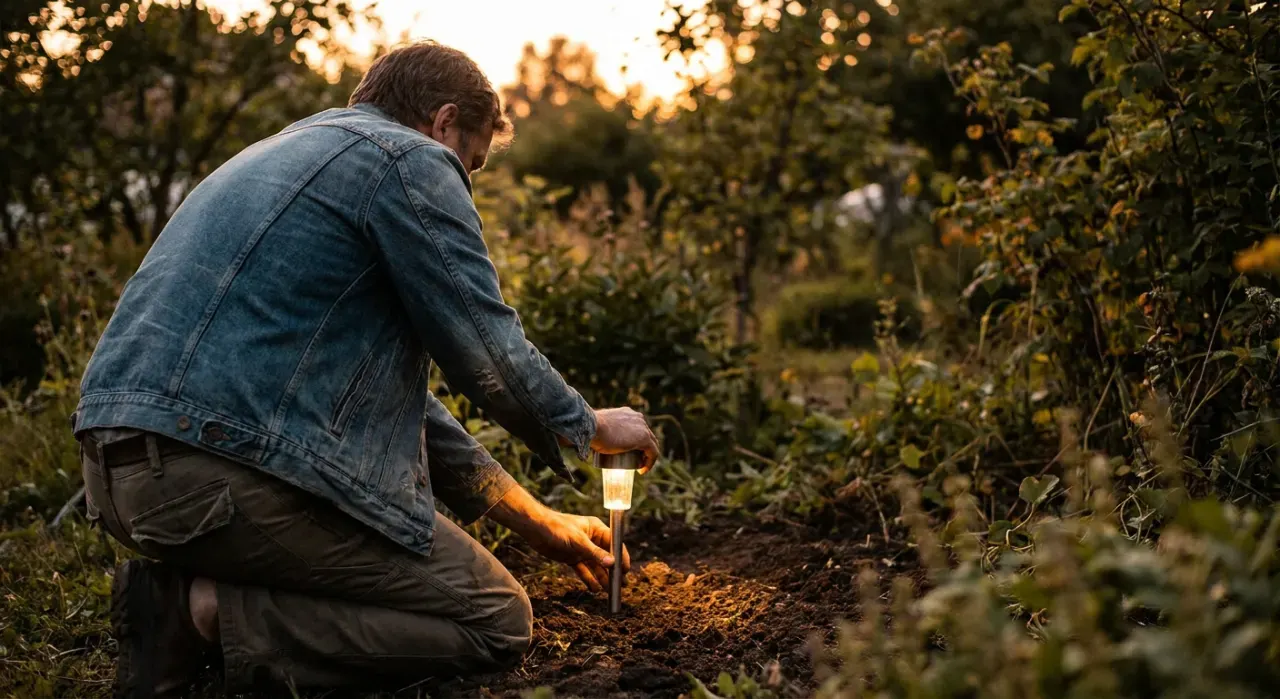
If you change one thing, change the shielding. A fully shielded fixture has an opaque top and sides so that no light leaves above the horizontal plane, and ideally you cannot see the light source itself from a normal standing position outside the beam. That single property eliminates direct skyglow contribution, kills glare, and stops light trespass over the fence in one step.
| Fixture style | Shielding | Dark sky verdict |
|---|---|---|
| Path light with a solid domed cap | Full cutoff, light down only | Good — the default choice |
| Path light with a clear glass globe | None; radiates all directions | Poor — glare at eye level |
| Wall lantern with clear panes | Partial at best | Poor unless you use a low-lumen amber lamp |
| Wall lantern with a solid top and frosted glass | Mostly downward | Acceptable at low output |
| Bullet spotlight with a snoot or hood | Beam controlled, spill reduced | Good if aimed at a target, not past it |
| Uplight aimed at a tree with no canopy above | Sky spill by definition | Poor — pick a dense canopy or downlight instead |
| Downlight mounted high in a tree or under an eave | Inherently downward | Best of all — the moonlighting effect |
| Unshielded flood on a bracket | None | Worst common offender in residential yards |
The awkward case is uplighting, which is the most popular technique in landscape lighting and the least dark-sky compliant by nature. It is not automatically disqualified. Aim a narrow beam into a dense evergreen or a broad deciduous canopy and most of the light is absorbed by foliage. Aim the same fixture at a bare winter trunk with open sky behind it and you are effectively running a searchlight. If you uplight, use tight beam angles, add a snoot to cut the halo, and reassess in January when the leaves are gone.
Color Temperature and Why Blue Is the Problem
Short wavelengths scatter far more in air than long ones — the Rayleigh scattering that makes the daytime sky blue also means blue-rich artificial light spreads out into a much larger glow dome over a neighborhood. A 5000K LED and a 2700K LED of identical lumen output do not produce identical skyglow; the cool one produces substantially more.
| Color temperature | Appearance outdoors | Dark sky rating |
|---|---|---|
| 1800–2200K (amber) | Candlelit, almost sodium-orange | Best — used near observatories and sea turtle nesting beaches |
| 2700K (warm white) | Flatters brick, wood, foliage and skin | Recommended default for residential yards |
| 3000K (soft white) | Slightly crisper, still pleasant | Acceptable ceiling in most guidance |
| 4000K (neutral) | Commercial, cold on foliage | Avoid outdoors at home |
| 5000K+ (daylight) | Parking lot; greens turn gray-blue | Avoid entirely |
There is a practical wrinkle for solar buyers: budget solar fixtures very often ship at 6000K because cool white LEDs are cheaper and read as brighter on a shelf, and listings frequently do not state the number at all. If a product page does not name a Kelvin value, assume cool white. The full brightness and color discussion is in lumens and color temperature, which also covers the lumen levels below.

How Little Light You Actually Need
Outdoor lighting is chronically overspecified because people shop by wattage habits formed indoors. Your eyes adapt to darkness; after 20 minutes outside, a very small amount of light is enough to move confidently. The numbers that follow are generous rather than minimal.
| Job | Sensible output | Notes |
|---|---|---|
| Path and walkway marking | 60–120 lumens per fixture | Marking the route, not floodlighting it |
| Steps and level changes | 50–100 lumens, recessed or shielded | Light the tread, hide the source |
| Entry door | 200–400 lumens total | Enough to find a keyhole and read a face |
| Uplighting a small tree | 100–200 lumens | Narrow beam, aimed into canopy |
| Uplighting a mature tree | 250–400 lumens | Two fixtures beat one bright one |
| Deck or patio ambience | 10–40 lumens per fixture | String lights and deck pucks; many small sources |
| Motion security at a side gate | 700–1200 lumens, shielded, 3 min timeout | Only when triggered — never dusk to dawn |
Note how far below a typical big-box floodlight those figures sit. A 5000-lumen dual-head security flood, unshielded and burning nightly, is the single largest light pollution source on most residential lots — and it is usually less effective at its stated job than three shielded 200-lumen fixtures spread along the same approach, because it creates glare and deep shadow instead of even visibility.
Controls: the Cheapest Improvement
A photocell turns lights on at dusk. That is only half a control strategy, because dusk-to-dawn means eight to fourteen hours of run time in a yard nobody enters after 11pm. Better options, roughly in order of usefulness:
Astronomic timer. Most low-voltage transformers include one. Set the lights to come on at dusk and off at 11pm or midnight. You keep the entire evening you actually use, and cut run hours roughly in half.
Motion sensing on security fixtures. A 3 to 5 minute timeout is plenty. Aim the sensor across the approach path rather than straight down it — sensors respond better to movement crossing the field of view than moving directly toward it.
Split zones. Put the atmosphere lighting on the early-evening timer and the safety lighting on a longer schedule, so the steps and the back door still light up at 1am while the uplit maple does not.
A manual override switch. Underrated. The evenings you want the whole yard lit are a handful a year, and a switch means the default can be conservative.
The Wildlife Argument, Briefly
Beyond astronomy, artificial light at night measurably affects the things living in your yard. Moths and other nocturnal insects are drawn to and disoriented by blue-rich sources, which pulls them out of pollination and feeding behavior and concentrates them where predators wait. Migratory birds navigate partly by natural sky cues and are disrupted by bright ground lighting, especially during spring and fall migration. Amphibians, fireflies and bats all shift behavior under lit conditions.
None of this requires giving up a lit yard. Warm color, downward aim, low output and shutting off after midnight address the bulk of it. If you have fireflies in early summer and want to keep them, the timer is the single most effective change — their courtship signaling is drowned out by ambient light, and a yard that goes dark at 10pm keeps the show.
What the Local Rules Usually Say
Outdoor lighting provisions turn up in municipal zoning codes, HOA covenants and county development standards, and they are more common than most homeowners realize. Typical residential provisions include a maximum fixture mounting height, a full-cutoff requirement for anything above a stated lumen threshold, a cap on light measured at the property line, and sometimes a curfew for non-security lighting. Communities near observatories, coastal turtle nesting areas and designated dark sky places have stricter versions.
Two practical implications. First, if you are planning a wired system, a quick search of your municipality plus "outdoor lighting ordinance" is worth ten minutes before you buy fixtures. Second, if a neighbor's floodlight is genuinely making a room unusable, there is often a written standard to reference, which changes the conversation from a matter of taste to a matter of compliance.
Choosing Fixtures That Comply
Reading across owner reviews in this category, the fixtures that satisfy dark-sky principles without any effort share a short list of traits: a solid opaque top, a frosted or louvered lens rather than a clear globe, a stated color temperature at or below 3000K, and either a low native output or a dimmable driver. Brass and copper path lights with a hooded cap are the archetype and the reason they dominate the premium end of the category.
On the wired side, the well-rated fixtures in our low-voltage landscape lighting picks are mostly hooded designs at 2700K to 3000K, which is not a coincidence — the same construction that keeps light out of the sky also keeps glare out of your eyes, and owners notice. On the solar side, the honest caveat is that many affordable fixtures are cool white and unshielded; the shortlist in best solar landscape lights notes color temperature where the manufacturer publishes it, because it is the specification most often left off a listing.
If you are retrofitting rather than buying new, three cheap fixes cover most sins: add a snoot or hex louver to existing spotlights, swap clear globes for frosted, and re-aim anything currently pointing above horizontal. None of that costs much, and the difference from the sidewalk is dramatic.
A Dark Sky Plan for an Average Yard
Walk the property after dark with the lights off and note where you genuinely could not see. That list is normally shorter than expected: the steps, the walk from the car, the back door, the side gate. Light those with shielded, warm fixtures at modest output on a timer. Then choose two or three focal points worth seeing — a specimen tree, a stone wall, the porch — and light those with narrow beams aimed into the object, not past it, on the early-evening schedule.
Leave the rest dark. That is not a sacrifice; contrast is what makes lighting read as designed rather than merely applied, which is the whole argument in landscape lighting design. A yard with six well-aimed fixtures and plenty of shadow looks considered. The same yard with twenty-two cool-white lamps looks like a lot from the street and like nothing at all from the patio.
We never buy, test or physically handle the products we rank. Recommendations come from aggregated owner reviews, star ratings, review volume and expert consensus — see how we rank.
More from this hub: Garden Lighting · Lumens and color temperature · Landscape lighting design · Outdoor lighting IP ratings · How we rank