 Garden

Affiliate Disclosure
Some links on this page are affiliate links. As an Amazon Associate, we earn from qualifying purchases — at no extra cost to you. We do not buy, test, or physically handle the products we cover; our rankings come from aggregated owner reviews, ratings and expert consensus. Commissions never change our verdicts. How we rank · full disclosure.
The short answer: outdoors you need far fewer lumens than indoors — 60 to 120 per path light, 100 to 400 for uplighting a tree, 200 to 400 total at an entry door, 10 to 40 for deck and string lighting. Choose 2700K for almost everything and never go above 3000K in a residential yard; at 4000K and up, foliage renders gray-blue and the property reads as commercial. Prefer CRI 90 or better if the specification is published.
Lumens, Not Watts
Watts measure electricity consumed; lumens measure light produced. Under incandescent and halogen the two tracked each other closely enough that "60-watt bulb" was a meaningful description of brightness. LEDs broke that link — outdoor LED fixtures run at roughly 80 to 110 lumens per watt against a halogen figure closer to 15 — so a 3-watt LED and a 20-watt halogen are broadly comparable at the fixture.
Two complications keep the conversion honest. First, manufacturers sometimes quote the raw LED chip output rather than what leaves the fixture after the reflector, lens and shielding have taken their cut, and the difference can be 30 percent or more. Second, a shielded fixture deliberately throws away the light that would have gone up, which is a good thing but means an unshielded fixture with the same number on the box will look brighter and worse. Treat lumen figures on budget listings as approximate and rank by what owners report rather than what the box claims.
Lumen Ranges by Fixture Type
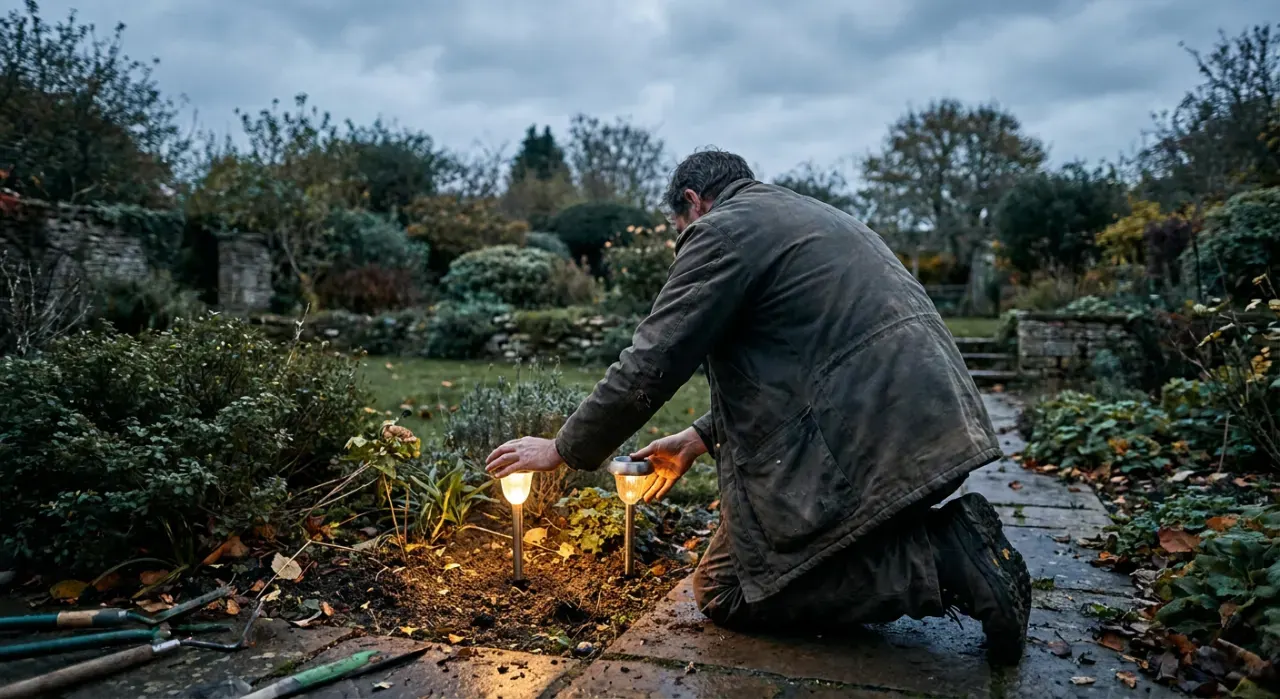
These are working ranges for residential yards, and they run well below what most people initially buy.
| Fixture / job | Sensible lumen range | Notes |
|---|---|---|
| Solar path stake | 5–20 lm | A route marker, not a task light. Set expectations accordingly. |
| Premium solar path light | 20–50 lm | Larger panel, larger cell; visibly better but still modest |
| Low-voltage path light | 60–120 lm | The workhorse. Above 200 lm is glaring at ankle height. |
| Step / hardscape light | 30–80 lm | Light the tread, hide the source entirely |
| Deck puck / rail light | 10–40 lm | Many small sources beat a few bright ones |
| String / bistro light per bulb | 15–60 lm | Warmth matters far more than output here |
| Uplight, small ornamental tree | 100–200 lm | Narrow beam, 12–24 in from trunk |
| Uplight, mature shade tree | 250–400 lm per fixture | Two or three fixtures beat one bright one |
| Wall wash | 150–300 lm | Wide beam, set back 2–4 ft |
| Wall graze (texture) | 200–400 lm | Close to the surface, aimed up the face |
| Tree downlight / moonlighting | 200–400 lm | Mounted 15–25 ft up through branches |
| Entry door, total | 200–400 lm | Enough to find a keyhole and read a face |
| Motion security flood | 700–1500 lm | Shielded, on motion only — never dusk to dawn |
| Garage / driveway apron | 1000–2000 lm | Aim down, cut off at the property line |
Set that against interior habit: a single kitchen ceiling fixture commonly produces 1,500 to 3,000 lumens. Bringing that instinct outside is why so many yards end up harsh. Outdoors you are working against a dark-adapted eye and a black background, and a 100-lumen pool of light on a walkway is genuinely, comfortably visible.
Color Temperature: What Kelvin Actually Describes
Correlated color temperature, given in kelvin, describes the appearance of the light — counterintuitively, low numbers look warm and orange while high numbers look cool and blue. It has nothing to do with the physical heat of the fixture or how bright it is.
| Kelvin | Name | Outdoors it looks like | Use it for |
|---|---|---|---|
| 1800–2200K | Amber / candle | Firelight, old sodium street lamp | Dark sky zones, coastal turtle areas, deliberate warmth |
| 2400–2700K | Warm white | Flatters brick, timber, foliage, skin | The residential default. Path, uplight, entry, string lights. |
| 3000K | Soft white | Slightly crisper, still pleasant | Modern facades, pale stone, contemporary hardscape |
| 3500K | Neutral | Starting to feel commercial | Rarely the right answer in a yard |
| 4000K | Cool white | Cold on foliage; greens lose depth | Only a deliberate moonlight downlight effect |
| 5000–6500K | Daylight | Parking lot; greens turn gray-blue | Task work lights and security floods, briefly |
Why higher Kelvin looks wrong outdoors specifically
Four reasons compound, and they are worth spelling out because "warm looks nicer" on its own sounds like preference rather than reasoning.
Foliage renders badly. Chlorophyll green sits in a part of the spectrum that cool-white LEDs, which use a blue chip with a thin phosphor coating, reproduce poorly. Under 5000K a mixed border loses the distinction between six different greens and reads as one flat gray-green mass — precisely the interest you planted it for.
It clashes with your house. Interior lighting is overwhelmingly 2700K, so warm light spills from every window. Cool fixtures outside put two color temperatures in the same view, and the eye reads the mismatch as wrong before anyone can name it.
It scatters and spills. Blue wavelengths scatter far more in air, so a cool source produces more visible haze around itself, more skyglow, and more perceived glare for the same delivered light on target.
It signals institution, not home. Cool white is the color of gas stations, loading docks and parking structures because it is cheap and it reads as bright on a spec sheet. Bringing it home brings the association with it.
The practical hazard for shoppers is that budget solar fixtures very often ship at 6000K, because cool white LEDs cost less and look punchier under store lighting, and many listings simply do not state a Kelvin figure. The absence of a number is itself a signal — assume cool white until proven otherwise. This is one of the specifications weighted in best solar landscape lights, because it is the one owners most often mention regretting after installation.
CRI: the Specification Nobody Reads
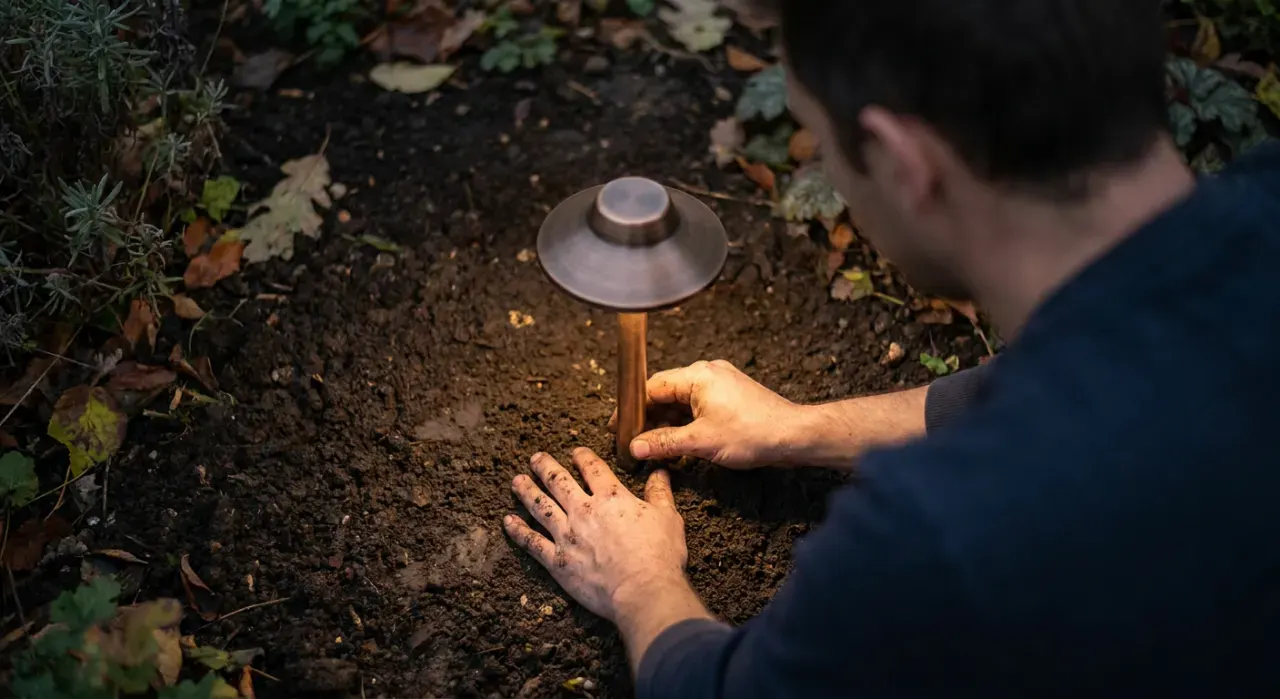
Color Rendering Index scores how faithfully a source reproduces colors against a reference, on a scale to 100. Two fixtures at identical 2700K and identical lumens can look completely different if one is CRI 70 and the other CRI 95.
| CRI | What you see |
|---|---|
| 70–79 | Typical budget outdoor LED. Reds go brown, greens flatten into one tone. |
| 80–89 | Acceptable. Most mid-range fixtures. Foliage reads reasonably. |
| 90+ | Flowers, brick, cedar and mixed foliage look the way they do in daylight. |
CRI matters most where color is the point: a planted border, a flowering shrub, a brick or stone facade, a cedar fence. It matters least on a path light aimed at gray concrete. If you are buying a small number of feature fixtures, this is where the money goes; if you are buying twelve path lights, CRI 80 is fine.
Beam Angle Changes Everything
Lumens describe total output; beam angle decides how concentrated it is. The same 300 lumens in a 15 degree spot lands as an intense shaft up a trunk, and in a 60 degree flood as a gentle wash over a wall. Buying by lumens alone leads to fixtures that are simultaneously too bright at the source and too dim on target.
| Beam angle | Character | Best for |
|---|---|---|
| 10–15° | Very narrow shaft | Tall columnar trees, flagpoles, chimney stacks |
| 24° | Tight spot | Trunk emphasis, single specimen, architectural columns |
| 35–40° | Medium | Ornamental trees, large shrubs, sign lighting |
| 60° | Flood | Wall wash, broad canopy, hedge |
| 120°+ | Very wide | Downlights, general area, deck pucks |
The general rule is to use the narrowest beam that covers the feature, because everything outside the target is spill — wasted light, glare and, if it clears the fence, an irritated neighbor. Detail on which technique wants which beam is in landscape lighting design.
Dimming, and Why It Is Worth Having
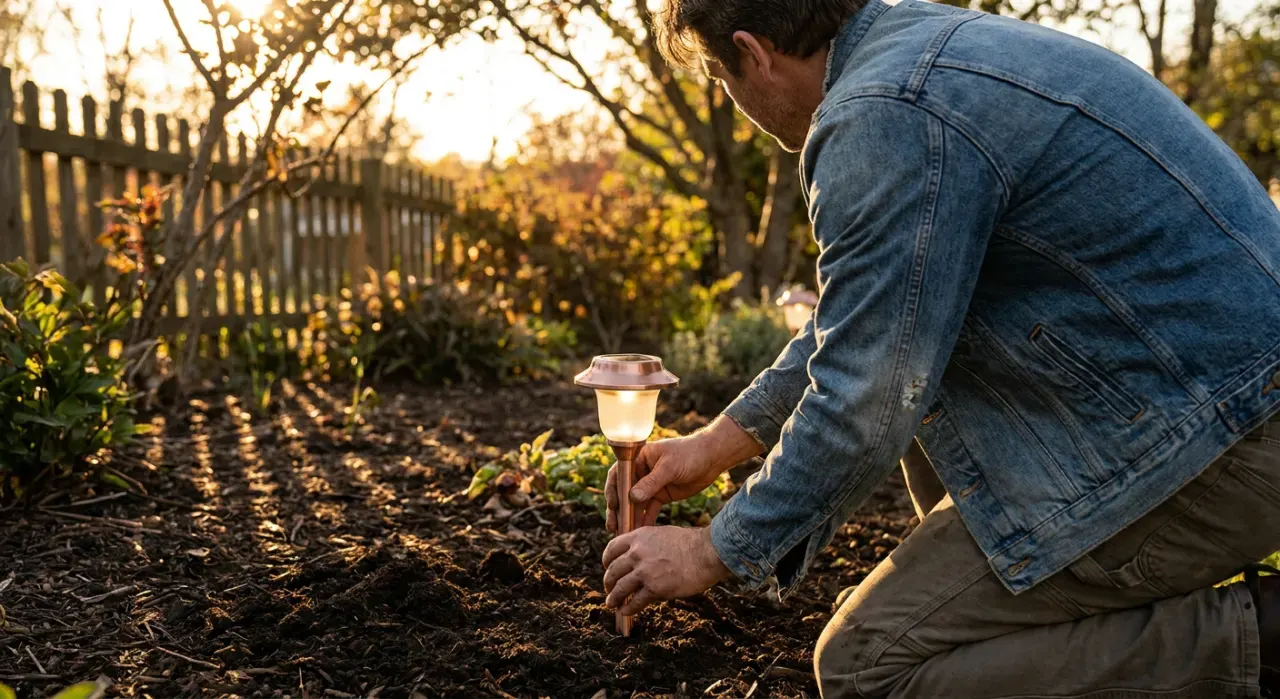
Most people specify too bright and then live with it. Low-voltage systems make this fixable in two ways: many transformers offer multiple voltage taps that pull the whole system down slightly, and better fixtures ship with in-line dimming or interchangeable lamps at different outputs. Being able to knock a system back 30 percent after living with it for a month is the cheapest quality upgrade available.
Solar fixtures rarely dim, but many now include a high/low mode where low output extends winter runtime substantially. In December, running at low all night usually looks better than running at high for four hours and then going dark at 9pm.
Reading a Listing Properly
A useful specification block for an outdoor fixture states lumens delivered, color temperature in kelvin, CRI, beam angle, and an IP rating. Very few budget listings state all five. In descending order of how much the omission matters:
- Color temperature missing — assume cool white. This is the one that ruins the look.
- IP rating missing — assume the seal is minimal. What each rating survives is covered in outdoor lighting IP ratings.
- Lumens quoted with no qualifier — likely chip output rather than delivered light.
- Beam angle missing — usually means a wide, uncontrolled beam.
- CRI missing — almost certainly in the 70s.
Across owner reviews in this category, the two complaints that recur most are "much dimmer than expected" on solar and "far too blue" on both solar and cheap wired fixtures. Those are the two specifications above worth checking hardest before buying. On the wired side, where color temperature and CRI are published far more consistently, the field ranked in best low-voltage landscape lights is filtered on exactly that — stated 2700K to 3000K output and a lumen figure that matches what owners describe. For uplighting on solar, where beam control is the harder problem, best solar spotlights weighs adjustability and beam concentration over headline brightness.
We never buy, test or physically handle the products we rank. Recommendations come from aggregated owner reviews, star ratings, review volume and expert consensus — see how we rank.
More from this hub: Garden Lighting · Landscape lighting design · Dark sky friendly lighting · Solar vs low-voltage · How we rank