 Garden

Affiliate Disclosure
Some links on this page are affiliate links. As an Amazon Associate, we earn from qualifying purchases — at no extra cost to you. We do not buy, test, or physically handle the products we cover; our rankings come from aggregated owner reviews, ratings and expert consensus. Commissions never change our verdicts. How we rank · full disclosure.
The short answer: the great majority of dead solar lights fail for one of five reasons — the rechargeable cell has reached end of life after two to three years, the panel has filmed or hazed over so charging collapses, the on/off switch or battery contacts have corroded, the dusk sensor is being confused by nearby light, or the winter sun angle simply is not delivering a usable charge. Four of those five are fixable in under ten minutes, and the first two account for most cases.
Diagnose It in Five Minutes
Work through this in order before buying anything. Each step rules out a whole class of problem.
- Check the switch. Many fixtures have an on/off switch under the cap and a separate pull tab on new units. It sounds trivial and it is a real proportion of "faulty" lights.
- Cover the panel with your hand for ten seconds. If the LED comes on, the circuit and the LED are fine and you have a charging or capacity problem, not a dead light. If nothing happens, it is the cell, the contacts or the board.
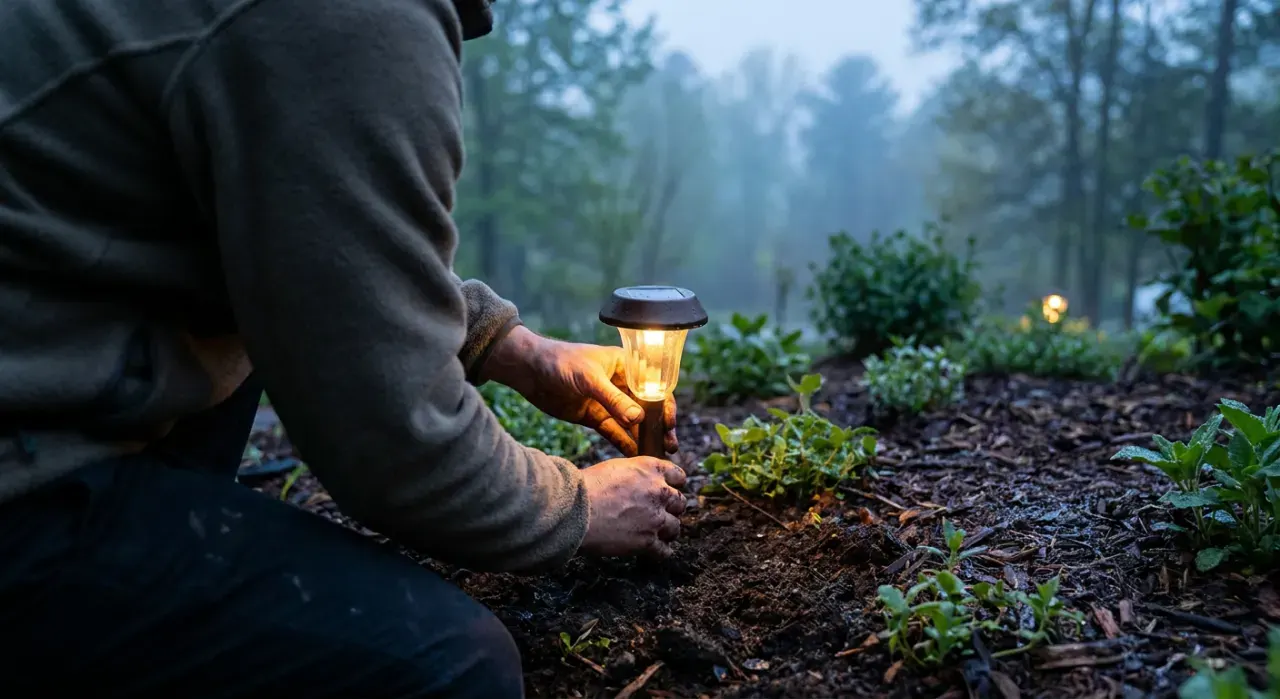
- Open the battery compartment. Look for white or green crusting on the contacts, and check the cell for swelling or leakage. Clean contacts with a pencil eraser or fine abrasive paper.
- Try a known-good cell. Swap in a fresh NiMH cell of the same size and roughly the same capacity. If it runs, you have your answer.
- Look at the panel in raking light. Tilt it against the sun. A haze, a milky film or a fine crazing pattern that is invisible head-on shows up clearly at an angle.
- Look for condensation inside the lens. Water ingress is the one failure that usually ends the fixture.
Symptom, Cause, Fix
| Symptom | Most likely cause | Fix | Worth it? |
|---|---|---|---|
| Runtime dropped from 8 hours to 1–2 | NiMH cell at end of life (2–3 years) | Replace the cell with the same chemistry and capacity | Yes — the best-value fix in the category |
| Dim from the first night, brand new | Pull tab still in place, or first charge incomplete | Remove tab; leave switched off in full sun for 2–3 days | Yes |
| Gradually dimmer over two seasons | Panel hazing from UV, pollen and hard-water film | Wash with warm soapy water and a soft cloth; a car plastic polish restores badly hazed panels | Yes |
| Works some nights, not others | Marginal charge — shade or overcast | Relocate to a spot with 6 hours of direct sun, or use a remote-panel model | Yes |
| Never comes on at all, panel covered test fails | Corroded battery contacts or switch | Clean contacts; work the switch back and forth; a drop of dielectric grease | Yes |
| Comes on then flickers off repeatedly | Cell too depleted to sustain the LED | Charge in a standalone charger, then replace if it fails again | Yes |
| Stays off even after dark | Dusk sensor confused by a nearby porch or street light | Move the fixture, or shield the sensor side from the artificial source | Yes |
| Comes on in daylight | Sensor failed short, or fixture is in deep permanent shade | Relocate; if it persists, the board has failed | Usually no |
| Misted or water-filled lens | Seal failure — gasket aged or lens bond let go | Dry out, clean and re-grease the gasket if serviceable | Sometimes — often terminal |
| Works in summer, useless from November | Winter sun angle and short days | Re-angle or relocate the panel; switch to a low-output mode; accept seasonal reduction | Manageable, not curable |
| Whole set died at once after a storm | Snow, frost or leaf litter on the panels | Wipe every panel; they should recover in 2–3 sunny days | Yes |
| Stake snapped, fixture leaning | Brittle plastic stake, or mower contact | Replace with a length of rebar or a metal stake; move out of the mowing line | Yes |
The Battery Is the Usual Answer
A path light cycles its cell every single night. A typical AA-format NiMH cell of 600 to 1000 mAh is good for something like 700 to 1000 cycles before capacity falls off materially, which lands squarely at two to three years of nightly use. That is not a defect; it is the designed life of a consumable, and it is why solar lighting has a running cost even though it has no electricity bill.
Three things to get right when replacing:
Match the chemistry. NiMH replaces NiMH. Never fit alkaline AAs — they are not rechargeable and a charging circuit pushed into them can leak or vent. Some better fixtures use lithium iron phosphate cells, often in an 14500 or 18650 format; replace those like for like as well, because the charging voltage differs.
Match capacity roughly. Going from 600 to 1000 mAh is fine and buys a little runtime. Going to 2500 mAh does not help, because the panel cannot deliver enough charge in a winter day to fill it, and a cell that never reaches full charge ages faster.
Replace the whole set at once if a fixture uses two cells in series. A fresh cell paired with a tired one gets dragged down and both fail sooner.
Cold matters here too. NiMH loses noticeable capacity below freezing, which is part of why winter runtime collapses beyond what shorter days alone would explain. Lithium chemistry handles cold considerably better, which is one of the specifications worth paying for in a climate with real winters.
Panel Filming — the Invisible Failure
The second most common cause, and the one people rarely suspect, is that the panel has stopped collecting properly. It happens through three mechanisms working together: ultraviolet light hazes the clear plastic cover over a couple of summers, pollen and dust bond into a film that rain does not remove, and hard water leaves mineral spotting where sprinklers hit. The panel still looks more or less clear from directly above, which is why it gets overlooked, but its output can fall by a third or more.
The fix is a wash with warm soapy water and a soft cloth twice a year, spring and fall. For panels that are genuinely hazed rather than dirty, a plastic polish or headlight restoration compound cuts back the oxidized surface layer and restores a surprising amount of clarity. Do not use an abrasive scrubber or a solvent, both of which will scratch or craze the surface and make things permanently worse.
The other half of the panel problem is shade that was not there when you installed the light. Shrubs grow, perennials fill out, a tree canopy closes over three seasons. Walk the yard at noon in June and again in October and check that each panel is actually in the sun — this catches more failures than any electrical diagnosis.
Switches, Contacts and Corrosion
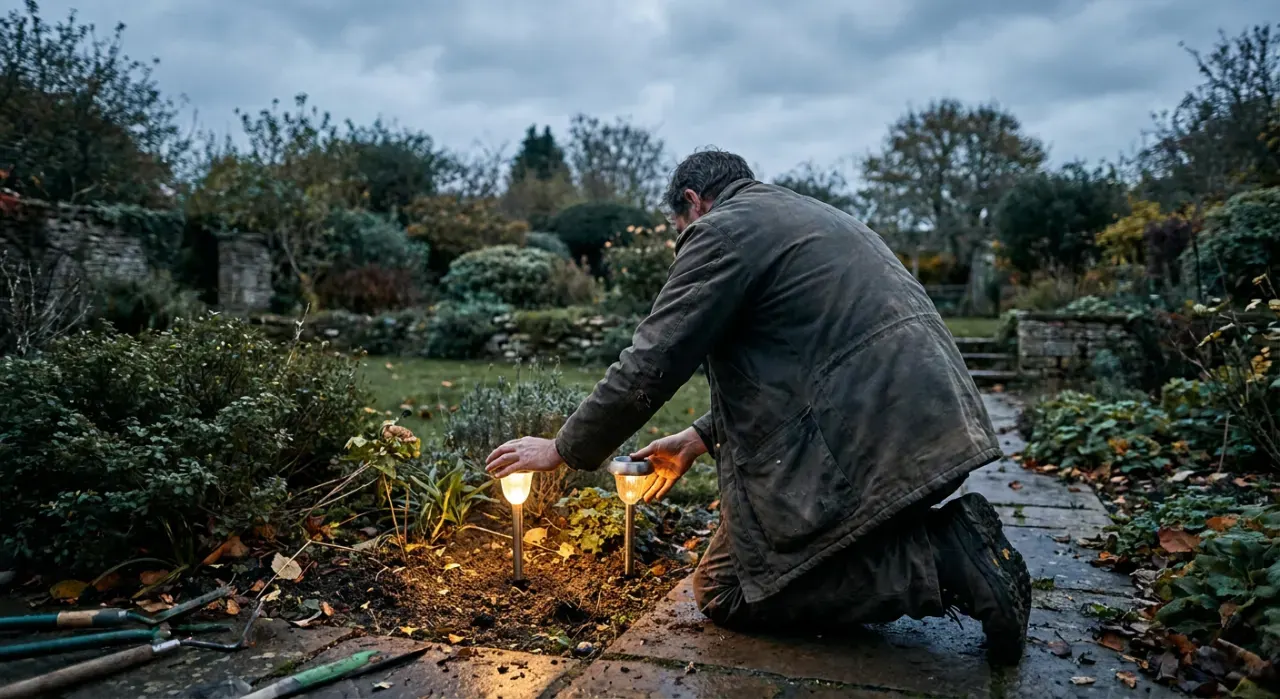
The on/off switch on a solar path light is usually a small slide or rocker mounted under the cap, and it is one of the least protected components on the fixture. Moisture reaches it, the contacts oxidize, and the light goes dark with a perfectly healthy battery inside.
Working the switch back and forth twenty times often restores contact on its own by scraping the oxide layer. If not, a spray of electrical contact cleaner, worked through the switch, usually does it. The same applies to the battery terminals — the springs and tabs corrode, especially in coastal air, and a pencil eraser or fine abrasive paper cleans them in seconds. A trace of dielectric grease on the terminals afterward slows the process considerably.
If corrosion has eaten through a terminal or spread onto the board, the fixture is done. That is the point at which the design decision made at purchase matters: a gasketed, screw-down compartment keeps this from happening for years, and a snap-fit cap does not.
The Dusk Sensor
Most solar fixtures do not have a separate light sensor — the solar panel itself doubles as the sensor, and the circuit switches the LED on when panel voltage falls below a threshold. That has a specific consequence: any artificial light falling on the panel can keep the fixture believing it is still daytime. A porch light, a street lamp, a neighbor's motion flood, or the glow from a window can all do it.
The diagnosis is easy. Cover the panel with your hand in daylight; if the light comes on, the sensor works and the problem is ambient light at night. The fix is either relocating the fixture, or shielding the panel from the offending source with a small baffle or by rotating the fixture so the panel faces away from it.
The opposite fault — coming on in broad daylight — is either deep permanent shade or a failed component on the board, and the latter is not economically repairable.
Winter Is Not a Fault
Between roughly November and February in the northern half of the US, four things stack up against a solar fixture at once: fewer daylight hours, a much lower sun angle, more overcast days, and colder cells with less usable capacity. Snow or frost on the panel stops charging entirely until it is cleared. Runtime that was eight to ten hours in July becomes three to five, at exactly the time of year when darkness starts at 5pm.
You can improve it rather than fix it. Angling the panel more steeply toward the low winter sun helps materially — some fixtures allow the panel to tilt, and remote-panel models let you aim it properly. Relocating for winter to a spot with unobstructed southern exposure helps. Clearing snow after every storm helps. Running a low-output mode, if the fixture has one, trades brightness for hours and usually looks better than going dark at 9pm.
What you cannot do is make a solar fixture behave like a wired one in January. If a location has to work every winter night — steps, an entry, the path from where you park — that location wants low-voltage wiring, and the comparison is laid out in solar vs low-voltage lighting.
Water Ingress: the One That Ends It
Condensation inside the lens, corrosion on the board, or visible water pooling in the housing is usually terminal on a budget fixture. Seals age — gaskets harden and shrink under UV, lens adhesive fails, and thermal cycling breathes moist air in and out through any imperfect joint. A fixture rated IP65 when new can behave much worse by year four, which is covered in detail in outdoor lighting IP ratings.
If the fixture opens, a rescue is worth one attempt: dry it out completely indoors over a day or two, clean the gasket seat, apply a thin film of silicone dielectric grease to the gasket, add a silica gel packet if there is room, and reassemble. If the lens is bonded and there is no way in, the fixture is disposable by design.
Preventing the Next Round of Failures
- Wash the panels twice a year — spring and fall. Fifteen minutes for a whole yard and it recovers real output.
- Replace cells on a schedule rather than waiting for failure. Every second or third spring, across the whole set.
- Check for new shade each summer as planting fills in.
- Bring fixtures in over winter if you do not need them. Store them switched off with a partial charge; it extends cell life considerably.
- Site them out of the mowing line and off the edge of the path so stakes do not get clipped.
- Clear snow promptly. A panel under an inch of snow charges at essentially zero.
Buying Solar That Survives
Reading across long-term owner reviews, the fixtures still working in year three share a consistent set of traits, and none of them are brightness. A glass lens rather than a clear plastic one that hazes. A metal or thick powder-coated body. A battery compartment with a gasket and a screw, so the cell is genuinely replaceable. An IP65 or better seal. A panel that is generously sized for the LED it feeds rather than minimally sized to hit a price. And a stated color temperature at or below 3000K, since the cool white default on cheap fixtures is the other thing owners regret.
Those are the criteria weighted in best solar landscape lights, which is deliberately biased toward fixtures with long-term reviews rather than new arrivals — a solar light that is impressive in week one tells you nothing, and a solar light people are still praising twenty months later tells you almost everything. For uplighting specifically, where a larger cell and a bigger panel are doing more work, best solar spotlights covers the models where owners report the beam still reaching the tree a year in.
We never buy, test or physically handle the products we rank. Recommendations come from aggregated owner reviews, star ratings, review volume and expert consensus — see how we rank.
More from this hub: Garden Lighting · Solar vs low-voltage · Outdoor lighting IP ratings · Lumens and color temperature · How we rank