 Garden

Affiliate Disclosure
Some links on this page are affiliate links. As an Amazon Associate, we earn from qualifying purchases — at no extra cost to you. We do not buy, test, or physically handle the products we cover; our rankings come from aggregated owner reviews, ratings and expert consensus. Commissions never change our verdicts. How we rank · full disclosure.
The one thing this page ranks on: what changes when the fan is out of reach. A high ceiling makes three demands and no others — it must hang on a downrod, it must be controllable without touching it, and it must move air down through roughly twice the volume of a normal room. Rank on those and the high-airflow, remote-controlled Honeywell Carnegie wins, while the low-profile fan that tops our general rankings is disqualified outright.
That disqualification is worth being blunt about. Our best ceiling fan roundup is won by a low-profile mount fan, which is the correct answer for an 8-foot ceiling and the worst possible one for a 14-foot vault — a hugger holds the blades in the hot layer at the very top of the room, and almost nothing reaches the floor. It is not on this page. Nor is a second otherwise-good fan whose only control is a pull chain, which is fine at 8 feet and useless at 16. The heating and cooling hub covers how a fan cuts both heating and cooling bills.
Top Picks at a Glance
Our #1 Pick: Honeywell Carnegie Industrial 52 Inch
Two things are true of a fan hanging in a two-story great room, and neither applies downstairs. The first is that it is fighting a much bigger problem. Air movement is what you feel, and a tall room holds twice or three times the air of a standard one — a breeze that is pleasant at 8 feet dissipates before it reaches the sofa when it starts at 16. The second is that once it is up there, you are not touching it again. Not the chain, not the light bulb, not the balancing kit, without hiring a ladder or a scaffold tower.
The Carnegie is ranked first because it answers both plainly. Five stamped-steel blades and a three-speed motor produce the strongest air movement in this group, which is the specification that decides whether the fan does anything at all in a big volume of space. And the handheld remote means the fan is adjustable from wherever you happen to be sitting, which is not a luxury when the alternative is a chain dangling out of reach or nothing at all.
The mounting hardware is the quiet reason to prefer it. Downrod, angled and flush kits all come in the box, so a sloped or vaulted ceiling does not send you back to the store mid-install — and on a high ceiling that install is a whole afternoon with a ladder, so getting it right first time has real value. Everything about the fan is mechanically simple: a straightforward AC motor, a caged light, nothing clever. On a fixture you cannot service without scaffolding, simple is a feature.
The honest limitations: the industrial cage look will not suit every room, and in a tall space the fan is visible from the stairs and the landing as well as the floor, so appearance matters more than it does downstairs — the Westinghouse and the Minka-Aire are there for that reason. The included downrod is short, so for anything over about 9 feet you are buying a longer one separately. It is louder on high than the DC-motor Minka-Aire. And the caged bulb is not dimmable in every configuration.
Check price on Amazon → (paid link)
The Ranked Field
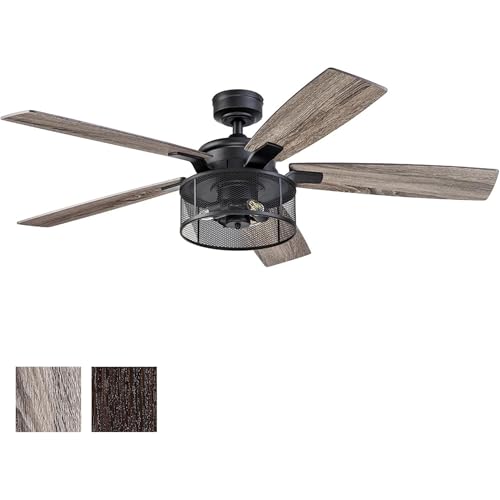
Best for moving enough air down through a tall volume, on a downrod, controlled from the sofa
- Five stamped-steel blades — the highest airflow here
- Downrod, angled and flush hardware all in the box
- Handheld remote with three speeds and reverse
- Straightforward motor with few things to fail out of reach
Why buy it: a fan 14 feet up has to push air through twice the volume of a normal room and you cannot reach it to touch anything, so raw airflow and a remote matter more than any styling decision.

Best for a vaulted great room where the fan runs all day and must not be heard
- DC motor — quieter and more efficient than AC at every speed
- Sculptural blades that suit an exposed mount
- Integrated dimmable LED with a handheld remote
- Mounts on a downrod as standard
Why buy it: sound rises and a tall room reflects it, so a motor hum that is inaudible at 8 feet becomes a presence at 16 — the DC motor is why this is the one to hang over a living space.

Best for a two-story ceiling where you will never touch the fan again
- WiFi app control plus Alexa and Google voice
- Whisper-quiet operation, designed around noise
- Automatic scheduling and speed control
- Downrod mount with a sealed, low-maintenance motor
Why buy it: app and voice control is not a gimmick at this height — it is the difference between adjusting the fan and getting a ladder out, and a sealed motor is the right bet on something you cannot service easily.

Best for the essentials for a tall room at the lowest price
- Tri-mount hardware including downrod and angled mount
- Remote control with dimmable LED
- 52-inch reversible five-blade span
- Quiet reversible motor for winter use
Why buy it: it has the two non-negotiables for a high ceiling — a downrod mount and a remote — for barely over a hundred dollars, which is the cheapest a tall room should go.

Best for a contemporary room where the fan is visible from everywhere
- Matte black finish with an opal frosted glass shade
- Remote control included
- 52-inch span with a reversible motor
- Downrod mount suited to sloped and tall ceilings
Why buy it: in a tall room the fan is at eye level from the stairs and the landing, so appearance genuinely matters — and this one keeps the remote and the downrod while looking like a light fitting.

Best for a beamed room, if you will add a wall control or a remote kit
- Reversible wood-finish blades for a beamed room
- Three mounting options including downrod
- Bright integrated LED
- Pull chain control — no remote included
Why buy it: the styling is right for a vaulted farmhouse ceiling and the control is wrong for any high ceiling, so budget for a remote kit or a wired wall control before you buy it.
Quick Comparison
| Product | Best for | Rating | Price | Buy |
|---|---|---|---|---|
| Honeywell Ceiling Fans Carnegie Industrial 52 Inch Ceiling Fan with Light and Remote Control | Best Overall for High Ceilings | — | Check (paid link) | |
| Minka-Aire F844-DK Light Wave 52 Inch Ceiling Fan with LED Light Kit | Quietest | — | Check (paid link) | |
| Big Ass Fans Haiku L 52 Inch Smart Ceiling Fan with LED Light and WiFi App Control | Best Control From the Floor | — | Check (paid link) | |
| Prominence Home Ashby Modern 52 Inch Ceiling Fan with Light and Remote Control | Best Value Downrod Fan | — | Check (paid link) | |
| Westinghouse 7205900 Alta Vista Modern LED Ceiling Fan with Light and Remote Control, 52 Inch | Best Modern Look | — | Check (paid link) | |
| Honeywell Ceiling Fans Ventnor 52 Inch Modern Farmhouse Indoor LED Ceiling Fan with Light and Pull Chain | Best Farmhouse (Chain Caveat) | — | Check (paid link) |

How We Rank for This Use Case
We do not buy, test or physically handle ceiling fans. For high ceilings we rank on four properties in this order, and two of them are pass-or-fail. Downrod mounting — a low-profile or hugger fan is excluded from this page entirely, whatever its general merits, because it holds the blades in the hot layer at the ceiling. Remote or app control, since a pull chain at 14 feet cannot be reached; a chain-only fan can still make the list but ranks last with the caveat stated. Airflow, judged on blade count, span and the strength of the breeze owners describe in large rooms. Noise and serviceability, because sound rises and because a fixture you cannot reach should have as little on it to fail as possible. Those sit on aggregated owner ratings weighted by review volume, plus the complaints that repeat — wobble on a long downrod, light failures and remote gremlins. Prices were current at the time of writing. Full method on how we rank.
The Six, Reviewed for a Tall Room
1. Honeywell Carnegie Industrial — Best Overall for High Ceilings
Covered above. What owners praise: a breeze you can genuinely feel in a big room, complete mounting hardware for downrod and angled installs, and a remote that works from across the space. What owners complain about: the industrial look, a short included downrod, and noise on the top speed. First because airflow and remote control are what a tall room actually needs.
2. Minka-Aire Light Wave — Quietest
The one to hang over a living space you spend evenings in. Its DC motor is quieter than any AC motor here at every speed and draws considerably less power, which matters when a high-ceiling fan tends to run continuously rather than in bursts. Noise is worth taking seriously up high for a reason people do not anticipate: sound rises, and a tall room with hard surfaces reflects it, so a hum that is inaudible at 8 feet becomes a background presence at 16. The sculptural blades also look deliberate on an exposed downrod rather than like a fan that ended up there. What owners complain about: the price, and a sealed integrated light that cannot be swapped if it fails — a real consideration at this height.
3. Big Ass Fans Haiku L — Best Control From the Floor
Third on a criterion the general fan market barely prices in: how you operate something you will never physically touch again. App control, voice control through Alexa or Google, and scheduling mean the fan is adjusted from the sofa, from bed, or automatically — and in a two-story space that is the difference between using the fan properly and leaving it on one speed for a year. It is exceptionally quiet and the motor is sealed and low-maintenance, which is the right bet on a fixture behind a ladder. It ranks third rather than first because it is expensive and its raw airflow is good rather than class-leading. What owners complain about: price, dependence on an app and a network, and less air movement than the price suggests.
4. Prominence Home Ashby — Best Value Downrod Fan
The floor of what a high ceiling should accept, and it clears it. Tri-mount hardware including a downrod and an angled mount, a remote, a dimmable LED and a 52-inch reversible five-blade span for around a hundred and ten dollars. Both non-negotiables are covered, which is more than can be said for plenty of fans at twice the price. What owners complain about: a lighter-duty motor than the Honeywell or Minka-Aire, and occasional wobble — which is worth taking seriously on a long downrod, since a small imbalance at the canopy becomes a visible wobble at the blade tip. Balance it carefully during the install, while the ladder is already up.
5. Westinghouse Alta Vista — Best Modern Look
Appearance is a more serious criterion in a tall room than a short one, because a fan on a 6-foot downrod is at eye level from the stairs, the landing and the mezzanine as well as being overhead from the floor. The Alta Vista is the one here that reads as a light fitting rather than a fan: matte black with an opal frosted glass shade, remote included, 52-inch reversible span, downrod mounted. What owners complain about: airflow that is good rather than strong, so in a genuinely large great room the Honeywell moves more air, and a glass shade that is a nuisance to clean at height.
6. Honeywell Ventnor — Best Farmhouse (Chain Caveat)
Included, ranked last, and the reason is a single specification. The styling is genuinely right for a beamed or barn-style vault — reversible wood-finish blades, a bright LED, three mounting options including a downrod. The control is a pull chain, and a pull chain on a 14-foot ceiling is not a compromise, it is a fan you cannot turn on. If you want this fan, budget for a wired wall control or a compatible remote receiver kit and factor the wiring into the install while the ladder is up. Bought that way it is a good fan for the room; bought as shipped it will frustrate you within a week. What owners complain about: a laminate rather than real wood finish, and more noise on high than the Hunter and Minka-Aire fans.
What Owners Actually Complain About
Two complaints dominate high-ceiling installs and both are decided before the fan is bought. It does not move any air is almost never a weak fan — it is a fan flush-mounted or left on its stock 4-inch downrod on a tall ceiling, leaving the blades stranded in the hot layer at the top of the room. The fix is a correctly sized downrod, not a bigger fan, and it is the single most common mistake in this category. Wobble is the other, and a long downrod amplifies it: a tiny imbalance at the canopy becomes a visible arc at the blade tip six feet below. It comes from an unbalanced blade set or a box that is not fan-rated — ENERGY STAR is specific that the box must be a UL-listed metal box marked for use with ceiling fans, since a fan can weigh 50 pounds, and a balancing kit plus a proper brace solves it — ideally on the day, because nobody wants to put the ladder up twice. Owners also note that changing a bulb or a remote battery at 14 feet is a genuine chore, which is an argument for a simple, reliable fan over a clever one. Installation on a tall or sloped ceiling is significantly harder than a standard one; see how to install a ceiling fan.
Sizing the Downrod and the Fan
Two measurements decide whether this works. Downrod length sets how far the blades drop, and the target is blades 8 to 9 feet off the floor. Subtract 9 from your ceiling height in feet: a 12-foot ceiling wants a 3-foot rod, a 16-foot ceiling a 7-foot rod, a 20-foot two-story space roughly 12 feet. Almost every fan ships with a rod for a standard ceiling, so plan on buying the right one, matched to the brand and pipe diameter. Look for the ENERGY STAR label while you are at it: certified fans are up to 44 percent more efficient than conventional models. Blade span follows floor area, not height: 42 to 52 inches for a typical room, 52 inches or more — or two fans — above 175 square feet. Because a tall room holds so much more air, err toward the larger span and the stronger motor. And on a vaulted ceiling, confirm the fan handles your slope angle or buy the adapter at the same time.
Get More From It in Winter
A high-ceiling fan earns more in winter than in summer, and most owners never use it that way. All the warm air your heating produces rises to the top of a vaulted room and sits there doing nothing for anyone. Run the fan clockwise on low and it draws cool air up the center and pushes that trapped warm air gently down the walls, evening out a room that is otherwise cold at the sofa and tropical at the mezzanine — and letting you drop the thermostat a couple of degrees. Reverse to counterclockwise in summer for a downward breeze. Our guides on which way a fan should spin in winter and how to reverse it walk through it — and note that on a high ceiling this is another argument for a remote, since the direction switch is on the motor housing.
The Verdict
Ranked on what actually changes when the fan is out of reach, the Honeywell Carnegie Industrial is our pick: the most airflow here, a remote, and downrod and angled hardware in the box. Take the Minka-Aire Light Wave if the fan hangs over a room you sit in every evening and quiet matters, or the Big Ass Fans Haiku L if you want to control a two-story fan from your phone rather than ever thinking about it again. The Prominence Ashby covers both essentials for a hundred and ten dollars. What we would not hang in a tall room is a low-profile fan or a chain-only one, however well they are reviewed elsewhere. Check price on Amazon → (paid link)