 Garden

Affiliate Disclosure
Some links on this page are affiliate links. As an Amazon Associate, we earn from qualifying purchases — at no extra cost to you. We do not buy, test, or physically handle the products we cover; our rankings come from aggregated owner reviews, ratings and expert consensus. Commissions never change our verdicts. How we rank · full disclosure.
The short answer: the best oil filled radiator heater for most rooms is the De’Longhi Dragon Digital TRD40615E. It runs the full 1,500 watts through a fin profile that exposes far more radiant surface than a plain column, adds a digital thermostat and a 24-hour programmable timer, and makes no noise at all because there is no fan. Prefer dials to a menu? The mechanical TRD40615T is the same body for less. Best value goes to the Dreo remote model; the most precise thermostat is Pelonis.
The framing that matters: every plug-in radiator here produces identical heat. A 120-volt outlet caps them all at about 1,500 watts, roughly 5,100 BTU per hour. What separates them is how much surface that heat is spread across, how precisely the thermostat holds a temperature, and how long the unit lasts. Buy on those three things and ignore any claim of superior efficiency — there is no such thing in resistance heating. For other formats see best space heater, or the heating and cooling hub.
Top Picks at a Glance

Our #1 Pick: De’Longhi Dragon Digital, TRD40615E
An oil filled radiator is a very simple machine: a resistance element heats sealed diathermic oil, the oil transfers heat to steel fins, and the fins warm the room by radiation and gentle convection. Because every unit gets the same 1,500 watts, the only real engineering lever is surface area — spread the same energy across more steel and the surface runs cooler, the convection current is gentler, and more of the room feels warm rather than just the air immediately above the heater.
Consensus Score ████████░░ 8.5 — owners consistently report it warming a room more evenly than column-style radiators of the same wattage
That is what the Dragon fin profile is for. De’Longhi claims up to 75 percent more radiant surface than a conventional column design, and while any manufacturer figure deserves scrutiny, the owner-review record is consistent with it: reviewers who have owned both describe the Dragon as producing a softer, more even warmth and reaching a comfortable room temperature faster.
The digital version adds the controls that make a radiator actually usable. A digital thermostat holds a set temperature instead of a vague dial position, and the 24-hour programmable timer means the bedroom can be warm at 6 a.m. without the heater running all night. There is an anti-freeze setting that kicks in near 41 °F, a thermal cutoff, and rubber-coated caster wheels that let you push it between rooms without marking a floor.
It is silent, which is the property people actually buy oil radiators for. No fan, no click beyond the thermostat relay, nothing to hear at 2 a.m. If your reason for shopping this category is that a ceramic heater kept you awake, this is the answer.
Check price on Amazon → (paid link)
Best Oil Filled Radiators 2026: The Ranked Field
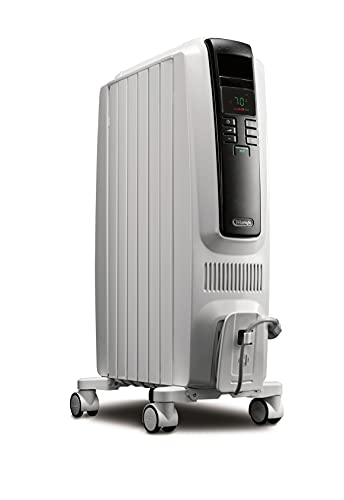
Best for a bedroom or living room you want warm all evening
- 1,500 W with a digital thermostat and 24-hour programmable timer
- Patented Dragon fin design for extra radiant surface area
- Permanently sealed oil, never needs refilling
- Thermal cutoff, anti-freeze setting and rubber-coated wheels
Why buy it: it is the most refined radiator on the page — silent, programmable, and the fin design genuinely puts out more heat per watt of surface than a plain column.
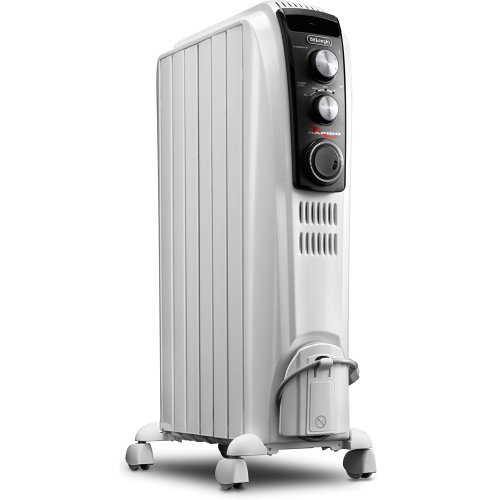
Best for anyone who wants a dial, not a menu
- 1,500 W with a mechanical thermostat dial
- 24-hour mechanical timer, three heat settings
- Up to 75% more radiant surface area than a plain column
- Front and rear handles, SmartSnap caster wheels
Why buy it: the same Dragon body as our top pick without the digital panel — and the panel is the part owners most often report failing.

Best for a bedroom where you want to change settings without getting up
- 1,500 W with 600/900/1500 W steps and an ECO mode
- Remote control, 24-hour timer, digital thermostat
- Overheat and tip-over protection
- Child lock and a quiet, fanless design
Why buy it: the only radiator here with a remote as standard, and the 600 W low setting is genuinely useful for holding a small room overnight.

Best for holding a set temperature to the degree
- 1,500 W with 600/900/1500 W heat settings
- Thermostat adjustable from 41 to 95 °F in 1 °F steps
- ECO mode, 24-hour timer, remote control
- Overheat and tip-over protection, fanless operation
Why buy it: single-degree thermostat steps are rare at this price and they make a real difference to how often the heater cycles.

Best for a spare room, office or workshop corner
- 1,500 W with 600/900/1500 W heat modes
- Adjustable mechanical thermostat
- Tip-over and overheat protection
- Universal caster wheels and a carry handle
Why buy it: the cheapest honest way to get silent, fanless radiant heat into a room that only needs it occasionally.

Best for an open-plan room or a large primary bedroom
- 1,500 W across 8 fins for more radiant surface
- Four modes with a digital thermostat and 24-hour timer
- Eight-point safety system including tip-over cutoff
- Remote control, fanless and near-silent
Why buy it: more fins means more surface area at the same wattage, which is the only lever that actually changes how a 1,500 W radiator feels.

Quick Comparison
| Product | Best for | Rating | Price | Buy |
|---|---|---|---|---|
| De’Longhi Dragon Digital Oil Filled Radiator Heater, 1500W, TRD40615E | Best Overall | — | Check (paid link) | |
| De’Longhi TRD40615T 1500-Watt Portable Radiant Radiator Heater with Mechanical Controls | Best Simple Controls | — | Check (paid link) | |
| DREO Oil Filled Radiator Heater with Remote Control, 1500W | Best Smart Features | — | Check (paid link) | |
| PELONIS Oil Filled Radiator with Thermostat and Remote, 1500W | Best for Precise Temperature | — | Check (paid link) | |
| COSTWAY Oil Filled Radiator Heater, 1500W Portable Space Heater | Best Budget | — | Check (paid link) | |
| DREO Radiator Heater with 8 Fins and Digital Thermostat, 1500W | Best for Large Rooms | — | Check (paid link) |
How We Rank
We do not buy or physically handle these heaters. Rankings come from aggregating star ratings and review volume across thousands of verified owner reviews, weighting recent reviews above launch-window ones, checking published wattage, fin count, thermostat range and safety certifications against manufacturer documentation, and reading negative reviews for the failures that appear after a full winter rather than in the first week.
Four factors set the order. Surface area and fin design, the only variable that changes how 1,500 watts feels in a room. Thermostat quality — how tightly the unit holds a set temperature and how fine the steps are. Build and longevity, judged from second- and third-winter reports and from leak complaints. And owner satisfaction weighted by review volume. Prices were checked at time of writing. Full method: how we rank.
The Radiators, Reviewed
1. De’Longhi Dragon Digital TRD40615E — Best Overall
Covered above. Consensus Score ████████░░ 8.5. Strengths: the largest effective radiant surface here, a genuine digital thermostat, a 24-hour programmable timer, an anti-freeze mode, silent operation and De’Longhi's long track record in the category. Recurring complaints: the digital control panel is the most reported failure — buttons that stop responding, or a display that goes blank while the heater still works. It is heavy, around 30 pounds, and the wheels are the weak point on carpet. Several owners mention a faint burning smell for the first few hours, which is normal manufacturing residue but alarming if you are not expecting it.
2. De’Longhi TRD40615T — Best Simple Controls
The same Dragon body and the same fin geometry, with mechanical controls: a thermostat dial, three heat settings and a physical 24-hour timer ring. It costs less, and it removes the exact component owners most often report failing on its digital sibling. For a room where you set it once and leave it, this is arguably the smarter buy.
Consensus Score ████████░░ 8.3 — very close to the digital model, with fewer control-related complaints
Recurring complaints: the dial has no numbers that correspond to actual temperatures, so setting it is guesswork until you learn the room. The mechanical timer ring is fiddly and several owners report the pins snapping. Same weight and same wheel complaints as the digital version.
3. DREO Oil Filled Radiator with Remote — Best Smart Features
Dreo has taken the same approach here that it took with tower fans: put the features people actually use on a mid-priced product and undercut the incumbent. You get 600, 900 and 1,500 watt steps, an ECO mode that modulates against room temperature, a digital thermostat, a 24-hour timer, a child lock, and — unusually in this category — a remote control as standard.
Consensus Score ████████░░ 8.2 — strong ratings on a large and fast-growing review base
Recurring complaints: the 600-watt low setting is not enough for a cold room, and owners who bought expecting it to hold a large space at that level are disappointed. The remote is small and easily lost, and there is no way to reach some settings without it on certain firmware. A minority report the ECO mode cycling more often than they would like, which produces a noticeable temperature swing.
4. PELONIS Oil Filled Radiator — Best for Precise Temperature
The specification that earns its place: a thermostat adjustable from 41 to 95 °F in single-degree increments. Most radiators in this class give you a dial or five-degree steps, and the difference shows up as how often the element cycles and how wide the temperature swing is in the room. Add three wattage steps, an ECO mode, a 24-hour timer and a remote, and the value case is strong.
Consensus Score ███████░░░ 7.9 — good ratings on a newer, smaller review base than the De’Longhi models
Recurring complaints: build feels lighter than the De’Longhi units and several owners describe panel gaps and flex. The display is bright enough to be a nuisance in a dark bedroom and cannot be dimmed on all versions. A handful report the unit resetting to default settings after a power interruption.
5. COSTWAY Oil Filled Radiator — Best Budget
The honest entry point. Three heat settings, a mechanical thermostat, tip-over and overheat protection, universal casters and a carry handle, for roughly half the price of the Dragon. For a spare bedroom, a home office you use two days a week, or a workshop corner, it does the same physics as everything above it.
Consensus Score ███████░░░ 7.6 — decent ratings with the variance typical of value-priced heaters
Recurring complaints: the thermostat is coarse and owners describe noticeable temperature swings. Casters are the weakest here, with several reports of wheels breaking off or refusing to swivel. Paint finish marks easily. And the review record contains more dead-on-arrival and early-failure reports than the premium units, which is the trade you are making.
6. DREO 8-Fin Radiator Heater — Best for Large Rooms
More fins is the only meaningful upgrade path in a category where the wattage is fixed. Eight fins spread the same 1,500 watts across more steel, which lowers surface temperature and widens the convection footprint — in practice, a larger room comes up more evenly. Four modes, a digital thermostat, a 24-hour timer, an eight-point safety system and a remote round it out.
Consensus Score ████████░░ 8.1 — well rated, with expectations the main variable in the negatives
Recurring complaints: it is physically large and owners are surprised by the footprint. Warm-up takes longer than a smaller radiator because there is more mass to bring up, which reviewers sometimes read as weakness. And the same remote-dependence and bright-display complaints as the smaller Dreo appear here.

How to Choose an Oil Filled Radiator
Stop comparing wattage. Every plug-in model is 1,500 watts, because that is what a 120-volt outlet allows. The real questions are surface area, thermostat quality and build.
Surface area is set by fin count and fin shape. More fins, or a profiled fin like De’Longhi's, spreads the same heat over more steel, which lowers surface temperature and gives a gentler, wider convection current. That is why two 1,500-watt radiators can feel meaningfully different in the same room.
Thermostat is what determines your electricity bill more than anything else, because it sets the duty cycle. A digital thermostat with fine steps cycles the element less and holds the room tighter than a dial. If you plan to run the heater for hours daily, this is where to spend.
Room size is a rough calculation: about 10 watts per square foot for a reasonably insulated room with 8-foot ceilings, so 1,500 watts is a genuine match for roughly 150 square feet as a primary source, and it will supplement a larger space. Anyone selling you a plug-in radiator as whole-home heat is misleading you.
Electrical safety is non-negotiable. A 1,500-watt heater draws about 12.5 amps, which is 80 percent of a 15-amp circuit — and because a space heater running more than three hours counts as a continuous load under the NEC, 80 percent of the breaker rating is the design ceiling. Plug it directly into a wall outlet, never an extension cord or a power strip, and never share the circuit with a second heater, a microwave or a window air conditioner.
What Owners Actually Complain About
Four themes recur across every brand here.
Slow warm-up is the most common, and it is physics rather than a fault. There is 20-odd pounds of oil and steel to bring up to temperature before the room starts to change, which takes 15 to 30 minutes. Buyers coming from a ceramic fan heater consistently describe the first evening as disappointing, then change their minds by week two once they understand the heater holds warmth after the element cuts out.
Control panel failure is the most common actual defect, and it is concentrated in the digital models across every brand. The heating element and the oil almost never fail; the buttons and displays do. This is the strongest argument for a mechanical model if you do not need programming.
Wheels and mobility come third. These units weigh 25 to 35 pounds and the supplied casters are consistently the flimsiest component. Owners report wheels snapping off, refusing to swivel, or simply sinking into carpet and refusing to roll.
And a first-use smell generates a surprising number of alarmed one-star reviews. New radiators burn off manufacturing oils and dust for the first few hours of operation. It is normal, it should clear within a day of use, and it is not a leak — but ventilate the room the first time you run it, and if the smell persists past a few hours or you see actual oil, stop and return the unit.
The Verdict
For a bedroom or living room you want quietly and evenly warm, buy the De’Longhi Dragon Digital TRD40615E — the fin design does real work and the programmable timer earns its keep every winter morning. If you would rather have dials than a display, take the TRD40615T; it is the same heater with the component that fails most often removed. The Dreo remote model is the best value, the Pelonis holds a temperature most precisely, the Costway is the sensible budget choice for a room used occasionally, and the Dreo 8-fin is the one to pick for a genuinely large space.
Check price on Amazon → (paid link)
Next: compare technologies in oil filled vs ceramic space heaters, see the wider field in best space heater, check the arithmetic in what it costs to run a space heater for 8 hours, or read are space heaters safe to leave on overnight.