 Garden

Affiliate Disclosure
Some links on this page are affiliate links. As an Amazon Associate, we earn from qualifying purchases — at no extra cost to you. We do not buy, test, or physically handle the products we cover; our rankings come from aggregated owner reviews, ratings and expert consensus. Commissions never change our verdicts. How we rank · full disclosure.
The short answer: yes. A smart thermostat is a thermostat first — the schedule, setpoints and relay control all run locally on the device, so when your internet drops the heat and AC keep working exactly as programmed, and the buttons or touchscreen still work at the wall. What stops is everything that depends on the cloud: the phone app, remote access, voice assistants, geofencing, weather-based adjustment, energy reports and firmware updates. Nothing needs to be reconfigured when the connection returns.
We do not physically handle the products we rank; picks come from aggregated owner reviews and expert consensus — see how we rank. Model shortlists are in best smart thermostat.
What keeps working when the internet goes down?
Everything that decides when your furnace runs. The thermostat stores its schedule in onboard memory, reads its own temperature and humidity sensors, and closes the same 24V relay contacts a mechanical thermostat would. Manufacturers are explicit about this — Google states that Nest thermostats continue to control heating and cooling on their schedule when offline, and Ecobee and Honeywell Home say the same. Wired room sensors and most short-range radio sensors also keep reporting, because they talk to the thermostat directly rather than through the internet.
| Function | Works offline? | Notes |
|---|---|---|
| Heating and cooling control | Yes | Runs entirely on the device |
| Stored schedule | Yes | Held in onboard memory through power loss |
| Touchscreen and manual setpoint | Yes | Full control at the wall |
| Paired room sensors | Usually | Direct radio link, not internet |
| Phone app and remote access | No | Routed through the manufacturer cloud |
| Alexa, Google Assistant, Siri | No | Voice commands go out to the cloud first |
| Geofencing and occupancy away mode | No | Falls back to the stored schedule |
| Outdoor weather compensation | No | Weather data is fetched online |
| Energy reports and alerts | No | Queued or lost for the outage period |

Is there any risk of the house getting cold?
Not from a Wi-Fi outage alone. The failure mode is deliberately conservative: lose the cloud and the thermostat reverts to the last schedule it holds rather than to off. The scenarios worth planning for are different — a long power cut that resets the internal clock, and a unit that runs on power stealing rather than a C wire, where a weak supply can cause reboots. If you leave a house empty in winter, keep a minimum setpoint programmed at the wall rather than relying on a remote check-in, and read how low can you set a thermostat before pipes freeze.
How do I stop it dropping offline in the first place?
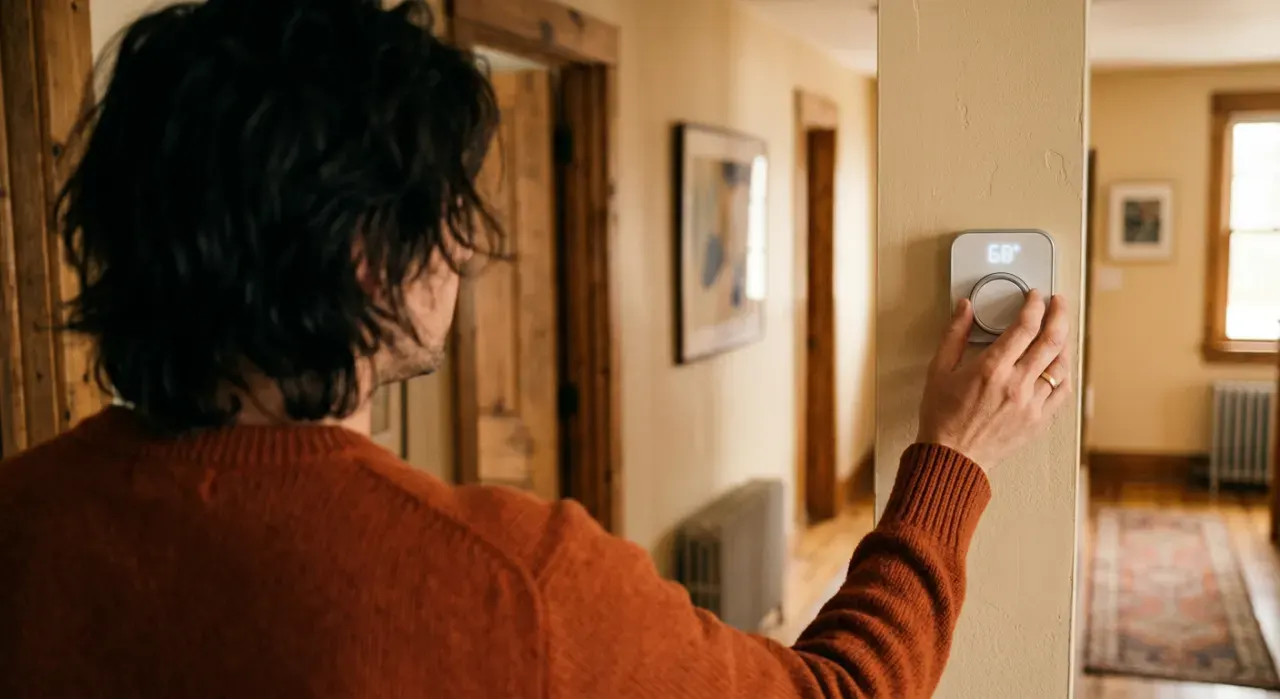
Most repeat disconnections trace to signal strength at the thermostat, not the thermostat itself. It sits low on an interior wall, often behind a corner, with a small internal antenna and no external one. Three fixes solve the overwhelming majority of complaints: put the unit on a 2.4 GHz network rather than a merged 5 GHz one, add a mesh node or access point within line of sight of the hallway it lives in, and give the thermostat a DHCP reservation so the router stops handing it a new address. Check for a firmware update once it is stable.
- Force 2.4 GHz — longer range through interior walls than 5 GHz.
- Reserve the IP in the router so the connection stops dropping on lease renewal.
- Confirm the C wire — power-stealing installs reboot more often. See can you install a smart thermostat yourself.
If reliable internet is simply not on offer where the house is, a 7-day programmable unit does the same core job for far less money — the trade-offs are laid out in smart thermostat vs programmable thermostat and the savings case in are smart thermostats worth it. More in the heating and cooling hub.