 Garden

Affiliate Disclosure
Some links on this page are affiliate links. As an Amazon Associate, we earn from qualifying purchases — at no extra cost to you. We do not buy, test, or physically handle the products we cover; our rankings come from aggregated owner reviews, ratings and expert consensus. Commissions never change our verdicts. How we rank · full disclosure.
To care for a Monstera deliciosa, give it bright indirect light, water when the top 2 inches of soil dry out, provide a moss pole to climb, and keep it warm and moderately humid — that combination is what produces the big, split leaves it is famous for. The monstera, or Swiss cheese plant, is a fast-growing tropical climber that turns from a modest tabletop plant into a room-filling statement in a few years. Most care questions come down to two things: enough light to drive those dramatic fenestrations, and restraint with the watering can.
This guide covers light, watering, the moss pole, why leaves split, feeding, and common problems. Our advice reflects the consensus of experienced growers and extension resources, not first-hand trials; see how we rank. One note up front: monsteras are toxic to pets — more below.
Light for a Monstera
Light is the single biggest factor in a happy, dramatic monstera. It wants bright, indirect light — a spot near an east or west window, or a few feet back from a bright south window out of the harsh direct beam. In the wild it grows under the forest canopy, receiving strong but filtered light, and that is what you are recreating.
Too little light is the usual reason a monstera grows slowly and produces small, solid leaves with no splits. Too much direct sun scorches the leaves with bleached or brown patches. If your plant leans hard toward the window, rotate it a quarter turn each week for even growth. In a dim room, a grow light fills the gap; see how much light do houseplants need and best grow lights for indoor plants.
Watering a Monstera
Monsteras like to dry out partway between waterings and rot if kept soggy. The rule: water when the top 2 inches of soil are dry, then water thoroughly and drain.
- Check first — push a finger 2 inches down; if it is still damp, wait.
- Water deeply until it runs from the drainage holes.
- Drain completely and empty the saucer.
That works out to roughly weekly in spring and summer and every 10 to 14 days in winter, always driven by the soil. Overwatering shows as yellowing leaves and, eventually, mushy stems and root rot; underwatering shows as drooping, crispy edges and curling. See how often to water houseplants and, for the closely related question, how often should you water a monstera.
Why the leaves split (fenestration)
The holes and splits that make a monstera iconic are called fenestrations, and they develop as the plant matures under good light. New plants and low-light plants make solid, heart-shaped juvenile leaves; as the plant ages and receives enough bright indirect light, each new leaf emerges more deeply cut. To encourage splitting:
- Maximize bright indirect light — the number one driver.
- Give it a support to climb, which signals the plant to produce mature, fenestrated foliage.
- Be patient and let it mature — you cannot force splits on a juvenile leaf, only on new growth.
- Keep it healthy and fed so it has the energy for big leaves.
The moss pole and support
Monsteras are climbers, and giving them something to climb makes a real difference. A moss pole, trellis or wooden stake gives the aerial roots something to grip, encourages an upright habit instead of a sprawl, and typically yields larger, more fenestrated leaves. Insert the pole when repotting so you do not damage roots, and gently tie the stems to it, guiding aerial roots toward the pole. Keeping a moss pole lightly damp lets the aerial roots attach and draw moisture. Without support a monstera still grows, but it tends to flop and produce smaller leaves.
Soil and potting
Use a rich but well-draining mix — a quality houseplant potting mix with added perlite, and often some orchid bark, which keeps the chunky, airy texture aroids like. Always use a pot with drainage holes. Monsteras grow fast and need repotting every one to two years, or when roots circle the pot or push out the bottom; move up one or two pot sizes in spring. The general method is in how to repot a houseplant, and mixes in best potting mix for houseplants.
Temperature, humidity and feeding
Monsteras are comfortable at normal room temperatures of about 65 to 85 F and dislike cold below roughly 55 F, so keep them away from cold drafts and vents. As tropical plants they enjoy moderate to high humidity; average home humidity is usually fine, but very dry winter air can brown the leaf edges, in which case a nearby humidifier or pebble tray helps.
Feed during the growing season, spring through summer, with a balanced houseplant fertilizer at about half strength every few weeks, and stop in fall and winter. As a fast grower a monstera appreciates regular feeding more than a slow plant, but over-fertilizing burns roots — see best indoor plant fertilizer.
Pet and skin safety
Monstera deliciosa is toxic to cats and dogs. It contains insoluble calcium oxalate crystals that irritate the mouth and cause drooling and vomiting if chewed, and the sap can irritate human skin. It is rarely dangerous but genuinely unpleasant, so keep it out of reach of pets that nibble and wash your hands after handling cut stems. For the wider list, see which common houseplants are toxic to cats.
Aerial roots, cleaning and pests
As a monstera matures it produces thick aerial roots along the stem, which surprises new owners but is completely normal — in the wild these anchor the plant to trees and gather moisture. You have three good options: guide them onto a moss pole to support climbing, tuck them down into the pot where they help absorb water and nutrients, or trim the occasional unruly one without harming the plant. Never cut them all off, and do not mistake the main stem for a root.
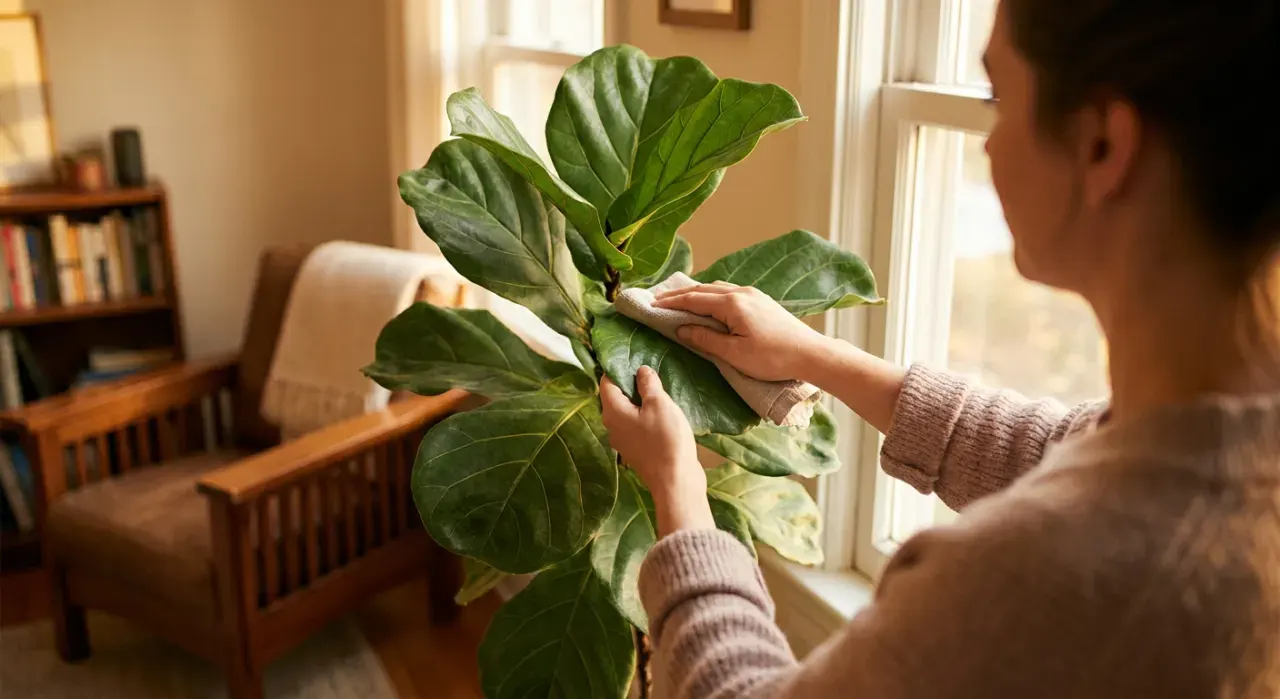
The large leaves collect dust that dulls them and blocks light, so wipe both sides with a soft, damp cloth every few weeks; this also lets you spot pests early. Monsteras occasionally attract spider mites in dry air (fine webbing and stippled leaves), mealybugs (white cottony clusters in leaf joints), and scale (brown bumps on stems). Treat with insecticidal soap or neem oil, wiping mealybugs and scale off with an alcohol-dipped swab, and repeat over several weeks since one treatment rarely clears every generation. Keeping humidity up discourages mites.
Caring for a Fast-Growing Monstera
Monsteras grow vigorously, and part of care is keeping that growth in bounds and directed. Give the plant something to climb from the start, because a supported monstera grows upward with larger, more fenestrated leaves, while an unsupported one sprawls sideways and takes over a room's worth of floor space. Tie new stems loosely to the moss pole as they extend, and guide aerial roots toward it.
Prune in spring to control size and shape: cut a stem just above a node and the plant branches from there, and the cutting you removed can be rooted into a new plant if it includes a node with an aerial root. This is the ideal way to rein in a monstera that has outgrown its corner while multiplying your collection. Pruning also lets you remove damaged or yellowing leaves at the base so the plant looks tidy and channels energy into healthy growth. Rotate the pot a quarter turn weekly so it does not lean hard toward the light, and repot every year or two as it fills its container, since a fast grower becomes root-bound quickly and a cramped root system slows growth and yellows leaves.
Common problems and fixes
| Symptom | Likely cause | Fix |
|---|---|---|
| No splits in the leaves | Too little light or juvenile plant | Brighter indirect light, a moss pole, patience |
| Yellowing leaves | Overwatering | Let the top 2 inches dry; check drainage |
| Brown, crispy leaf edges | Dry air or underwatering | Raise humidity, water more consistently |
| Drooping, curling leaves | Underwatering or too much heat/sun | Water thoroughly; move out of direct sun |
| Leggy, small new growth | Insufficient light | Move to brighter spot; add support |
| Brown spots with yellow halos | Possible root rot or overwatering | Check roots, repot in fresh mix, water less |
Give a monstera bright light, a pole to climb and a disciplined watering hand, and it rewards you with some of the most dramatic foliage any houseplant offers.
A quick word on names, since it causes confusion at the garden center. The plant most people mean by "monstera" is Monstera deliciosa, the large-leaved Swiss cheese plant with deep splits and, on mature plants, holes. It is often muddled with Monstera adansonii, a smaller, faster-vining species whose leaves are covered in oval holes rather than edge splits, and with the unrelated Rhaphidophora tetrasperma, sold as "mini monstera," which looks like a scaled-down deliciosa but is a different genus. Care is broadly similar across all three — bright indirect light, water when the top inch or two dries, a pole to climb — so if you have one of the look-alikes, this guide still serves you well; the main difference is that the smaller species grow faster and need more frequent pinching and support to stay tidy. Whatever you are growing, the payoff for getting the basics right is the same: a fast-growing, architectural plant that turns a corner of a room into a small piece of jungle. Everything else is at the houseplants and indoor greenery hub.