 Garden

Affiliate Disclosure
Some links on this page are affiliate links. As an Amazon Associate, we earn from qualifying purchases — at no extra cost to you. We do not buy, test, or physically handle the products we cover; our rankings come from aggregated owner reviews, ratings and expert consensus. Commissions never change our verdicts. How we rank · full disclosure.
The short answer: the Breville Bambino Plus is the best espresso machine for beginners, because it automates the hardest beginner skill (milk texturing) and holds a stable brew temperature while you learn everything else. If $500 is too much, the De’Longhi Stilosa at around a hundred dollars answers the "do I actually enjoy this?" question honestly. If you want one appliance instead of two, the Breville Barista Express has a burr grinder built in. If nobody wants a hobby, get the one-touch Philips 3200 LatteGo.
One rule before you spend anything: a cheap machine with a good grinder beats an expensive machine with a bad one. That is not a slogan, it is the reason most beginner espresso setups disappoint their owners.
Top Picks at a Glance
Our #1 Pick: Breville Bambino Plus
Beginners fail at espresso in two predictable places. The first is milk: getting steam to spin a whirlpool that pulls air into the milk and produces glossy microfoam rather than a bubble bath takes weeks of practice. The Bambino Plus does it automatically — you set temperature and foam level, drop the wand in, and it stops when it gets there. That single feature converts more pod-machine owners than any spec on the box.
The second failure is inconsistency. A machine whose brew temperature drifts between shots makes it impossible to know whether your last change helped. The Bambino Plus uses a ThermoJet heater and a PID controller, so temperature is one variable you can stop thinking about while you work on grind and dose.
It has no grinder, which is the honest catch. Budget for one, or buy the Barista Express instead. And be aware that the automatic milk wand is set-and-forget rather than latte-art precise — you can switch it to manual once your hands know what to do.
Check price on Amazon → (paid link)
The Ranked Field

Best for a first machine you will not outgrow in a year
- Automatic milk texturing to a set temperature and foam level
- PID temperature control, 3-second heat-up
- Ships with pressurised and non-pressurised baskets
- Only 7.7 inches wide
Why buy it: the automatic steam wand removes the hardest beginner skill on day one, and the PID means your shots are repeatable while you learn everything else.
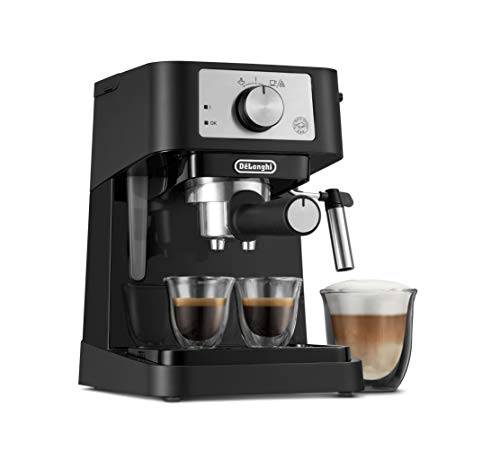
Best for finding out if espresso is for you for the price of a week of lattes
- Pressurised baskets for single and double shots
- Manual steam wand for milk
- Stainless steel boiler, compact 13.5 x 8 inch footprint
- Tamper included
Why buy it: about a hundred dollars to learn whether you actually enjoy the ritual, with pressurised baskets that forgive the pre-ground coffee most beginners start with.

Best for a narrow counter or a small apartment kitchen
- Just 6 inches wide
- Thermoblock heating, 40-second warm-up
- Adjustable drip tray for tall latte glasses
- Automatic flow stop for single and double shots
Why buy it: the only serious starter machine that fits in six inches of counter, and the one people in small kitchens keep instead of returning.

Best for skipping the separate grinder decision entirely
- Integrated conical burr grinder that doses into the portafilter
- PID temperature control and pre-infusion
- Razor tool trims the puck to a repeatable dose
- 67-oz tank
Why buy it: it solves the beginner trap — a good machine paired with a bad grinder — by putting a real burr grinder inside the machine.

Best for a household where nobody wants to learn anything
- 100% ceramic burr grinder, 12 settings
- LatteGo two-part milk system, no tubes, rinses in about 15 seconds
- Five one-touch drinks
- AquaClean filter reduces descaling frequency
Why buy it: the milk system is two parts with no tubes, which is why owners actually clean it — the reason most one-touch milk machines end up smelling sour.

Best for a metal-bodied machine with a real steam wand under $200
- Stainless steel housing, 1,350 W
- 43.9-oz removable water tank
- Steam wand for cappuccino and latte
- Pressurised double-wall baskets
Why buy it: twice the machine of the cheapest tier for not much more money, and the steam wand is the part that makes milk drinks actually work.
Quick Comparison
| Product | Best for | Rating | Price | Buy |
|---|---|---|---|---|
| Breville Bambino Plus Espresso Machine (BES500BSS) | Best Overall for Beginners | — | Check (paid link) | |
| De’Longhi Stilosa Manual Espresso Machine (EC260BK) | Best Budget Starter | — | Check (paid link) | |
| De’Longhi Dedica Deluxe Espresso Machine (EC685M) | Best Compact | — | Check (paid link) | |
| Breville Barista Express Espresso Machine (BES870XL) | Best All-in-One | — | Check (paid link) | |
| Philips 3200 Series Fully Automatic Espresso Machine with LatteGo | Easiest to Use | — | Check (paid link) | |
| CASABREWS 3700 Essential Espresso Machine | Best Value Step-Up | — | Check (paid link) |
The Grinder Rule Nobody Tells Beginners
Espresso forces water through a compressed bed of coffee in 25 to 35 seconds. For that to extract evenly, the particles must be close to the same size — finer than table salt, roughly the texture of powdered sugar with a slight grit. A burr grinder crushes beans between two surfaces held a fixed distance apart, so it produces that. A blade grinder is a propeller in a cup: it chops randomly, making dust and boulders in the same batch. Water rushes through the dust, over-extracting it into bitterness, and barely touches the boulders, leaving sourness behind. That is why a beginner shot can taste bitter and sour at once.
So the budget split matters more than the total. Roughly:
| Total budget | Sensible split | What you get |
|---|---|---|
| ~$250 | $100 machine + $150 hand grinder | Genuinely good espresso, more effort per shot |
| ~$500 | $250 machine + $250 grinder | Repeatable shots, decent milk |
| ~$700 | One all-in-one machine | Simplicity, a mid-tier grinder ceiling |
| ~$800 | $500 machine + $300 grinder | The setup people keep for years |
Our burr grinder picks for espresso and the wider espresso grinder ranking cover both electric and hand options, and burr vs blade grinder explains the mechanics.
Start With the Pressurised Basket
Every machine here ships with two kinds of filter basket, and beginners should know which is in the portafilter. A pressurised (dual-wall) basket has a single tiny hole in a second layer behind the coffee. It creates back-pressure by itself, so the shot pours slowly and produces thick foam regardless of your grind. A non-pressurised (single-wall) basket has a plain mesh of holes and lets the coffee bed create the resistance, which is real espresso — and it will gush like tea unless the grind is right.
Start pressurised with whatever coffee you have. Buy a burr grinder. Then switch to single-wall and spend a week dialing in. Doing it in the other order is how beginner machines end up returned.
How We Rank
We do not buy these machines or pull shots on them. We weight rating quality against review volume, documented specifications such as PID control, basket type and steam design rather than pump-pressure marketing, durability signals from reviews written six months or more into ownership, and published expert consensus, cited rather than restated as our own findings. For a beginner list we add one more filter: how many one-star reviews are actually user error, because a machine that is easy to fail with is a bad first machine no matter how good its ceiling. Full method: how we rank.
The Beginner Espresso Machines, Reviewed
1. Breville Bambino Plus — Best Overall for Beginners
Covered above. Owners consistently report that the milk automation is what made the machine stick, and that heat-up in about three seconds changed how often they actually used it — a machine that takes fifteen minutes to warm up quietly stops getting used on weekday mornings.
Owners praise: automatic milk foam, near-instant heat-up, temperature stability, small footprint. Owners gripe about: no grinder, a small drip tray, a water tank that is awkward to refill in place, and steam tips that clog if not wiped and purged each time. Check price (paid link).
2. De’Longhi Stilosa — Best Budget Starter
At around a hundred dollars the Stilosa is the cheapest honest entry point. It has a stainless boiler, pressurised baskets, a manual steam wand and a tamper in the box, and it makes a thick-crema shot from ordinary supermarket coffee. What it does not have is temperature control, a three-way valve, or steam with much staying power, so milk texturing takes patience and the puck comes out wet.
Owners praise: price, compact size, easy assembly, decent crema with pressurised baskets. Owners gripe about: weak steam, temperature that drifts across two back-to-back shots, a plastic portafilter handle, and a small water tank. Check price (paid link).
3. De’Longhi Dedica Deluxe — Best Compact
Six inches wide. That is the whole argument, and in an apartment kitchen it is a decisive one. The Dedica heats in about forty seconds from a thermoblock, has an adjustable drip tray so a latte glass fits, and stops the pour automatically at single or double volume. It is a genuine step up from the Stilosa in build and consistency without needing a foot of counter.
Owners praise: the footprint, quick warm-up, build feel for the money, tidy design. Owners gripe about: a steam wand that needs practice, a small water tank that needs refilling often, and pressurised baskets that limit the ceiling unless you buy single-wall replacements. Check price (paid link).
4. Breville Barista Express — Best All-in-One
The Barista Express is the beginner machine that removes the grinder decision. Beans go in the hopper, the conical burr grinder doses straight into the portafilter, the razor tool levels the puck to a repeatable dose, and PID control plus low-pressure pre-infusion keeps the extraction stable. For a lot of people this is the last coffee purchase they make.
Two honest caveats: it takes real counter space, and the built-in grinder is mid-tier — good enough to make excellent espresso, not good enough to satisfy someone who later gets deep into light roasts.
Owners praise: everything in one box, dose consistency, steam power, PID temperature. Owners gripe about: grind retention leaving stale coffee in the chute, a multi-step cleaning routine, footprint, and burrs that need periodic cleaning to stay consistent. Check price (paid link).
5. Philips 3200 LatteGo — Easiest to Use
If the goal is a latte at 7am with no skill involved, this is the machine. A ceramic burr grinder feeds a sealed brew group, five drinks are one touch, and the LatteGo milk system is the standout: two plastic parts, no tubes, rinses under the tap in about fifteen seconds. That matters because the usual failure of one-touch milk machines is a tube system nobody cleans, which turns sour within weeks.
The AquaClean filter genuinely stretches descaling intervals, but it does not remove the need — hard water still ends these machines. For the full super-automatic field see our super-automatic ranking.
Owners praise: the milk system, one-touch operation, quiet ceramic grinder, easy daily cleaning. Owners gripe about: price, milk foam that is good rather than latte-art quality, plastic build, and an espresso ceiling well below a semi-automatic. Check price (paid link).
6. CASABREWS 3700 Essential — Best Value Step-Up
Between the hundred-dollar tier and the serious machines sits this one: stainless housing, a large removable tank, 1,350 watts and a steam wand that produces usable foam. The baskets are pressurised, the temperature is not controlled, and quality control varies between units — but for under two hundred dollars it is more machine than the price suggests.
Owners praise: price-to-feel ratio, tank size, steam wand, quick heat-up. Owners gripe about: temperature drift on consecutive shots, a light body that shifts when locking the portafilter, plastic internals, and occasional units that arrive faulty. Check price (paid link).
The Five Beginner Mistakes That Cause Returns
- Using pre-ground coffee in a single-wall basket. It will gush and taste sour. Either use the pressurised basket or grind fresh and fine.
- Believing the bar number. Espresso is brewed at about 9 bar at the puck. "15 bar" and "20 bar" describe the pump's maximum with nothing in the way. A higher number is not a better machine.
- Not weighing anything. A double shot is roughly 18 grams in and 36 grams out in about 30 seconds. Guessing by eye makes every adjustment meaningless. A $20 scale fixes it.
- Skipping the purge. Wipe and blast the steam wand immediately after every use. Dried milk inside a wand tip is the most common repair in home espresso.
- Ignoring water. Hard water scales an espresso boiler far faster than a drip machine. Filter it, and descale on schedule — see how to descale an espresso machine.
The Verdict
Start with the Breville Bambino Plus if you can stretch to it — it removes the hardest skill, keeps temperature honest, and pairs with any grinder you buy later. Start with the De’Longhi Stilosa if you want to test the hobby cheaply. Buy the Breville Barista Express if you would rather own one appliance than two. And put real money into the grinder, whichever machine you pick. Check price on Amazon → (paid link)
More from this hub: small kitchen appliances · best espresso machine · how to pull an espresso shot · how to steam milk at home · how we rank.