 Garden

Affiliate Disclosure
Some links on this page are affiliate links. As an Amazon Associate, we earn from qualifying purchases — at no extra cost to you. We do not buy, test, or physically handle the products we cover; our rankings come from aggregated owner reviews, ratings and expert consensus. Commissions never change our verdicts. How we rank · full disclosure.
The short answer: under $500, the Breville Bambino Plus is the machine to buy — it puts the entire budget into brew temperature stability and steam power and skips everything else. If you want something to repair and modify for the next fifteen years, the Gaggia Classic Evo Pro at around $450 uses commercial 58mm parts. If your counter is tiny, the six-inch-wide De’Longhi Dedica. And if you do not yet own a burr grinder, spend $170 on the CASABREWS 3700 and put the other $300 into grinding — that split makes better coffee.
Prices quoted here are typical US street prices as of 2026 and move around with sales; a machine that lists at $500 is frequently discounted below it.
Top Picks at a Glance
What $500 Actually Buys You
It helps to know where the money goes, because the marketing on the box describes almost none of it.
| Budget | What you reliably get | What you do not |
|---|---|---|
| Under $150 | Pressurised baskets, a steam wand, thick foamy crema | Temperature control, dry steam, a three-way valve |
| $150–$300 | Metal build, faster heat-up, better steam, flow stop | PID control, 58mm parts, consistent back-to-back shots |
| $300–$500 | PID or well-tuned thermoblock, real steam, both basket types | Dual boiler, built-in grinder worth keeping, auto tamping |
| $500–$1,200 | Built-in grinder or dual boiler, pre-infusion control | Commercial-grade group thermal mass, plumbed water |
The specification that matters most in this bracket is temperature stability. Coffee extracted at 205°F tastes different from the same coffee at 190°F, and a machine whose temperature swings between shots makes it impossible to know whether the change you just made helped. PID control, or a well-designed thermoblock like Breville's ThermoJet, is what you are actually paying for.
The second is steam. Cheap single-boiler machines produce wet steam — steam carrying liquid water — which heats milk but cannot spin it into microfoam. If you drink lattes, that is the difference between a coffee with hot milk and a coffee with silky milk.
The Ranked Field

Best for the best combination of brew temperature and steam at this price
- PID temperature control with ThermoJet 3-second heat-up
- Automatic milk texturing, adjustable temperature and foam
- 54mm portafilter, both basket types included
- 7.7 inches wide, 64-oz tank
Why buy it: it spends the entire budget on temperature stability and steam power, which are the two things that decide whether a shot and a latte are any good.

Best for a machine you can modify, repair and still be using in 2040
- 58mm commercial portafilter and brass group head
- Three-hole commercial steam wand
- Made in Italy, serviceable, huge parts ecosystem
- Accepts aftermarket PID kits and pressure mods
Why buy it: the only machine under $500 that takes standard 58mm commercial accessories, so every basket, tamper and portafilter on the market fits it.

Best for six inches of counter and a genuinely usable machine
- Only 6 inches wide
- Thermoblock heats in about 40 seconds
- Automatic flow stop for single and double shots
- Adjustable drip tray for tall glasses
Why buy it: nothing else this narrow is this competent, and in a small kitchen the footprint is the specification that actually decides the purchase.

Best for a stainless machine with a real steam wand for under $200
- Stainless steel housing, 1,350 W
- 43.9-oz removable tank
- Steam wand for cappuccino and latte
- Pressurised dual-wall baskets
Why buy it: it leaves $300 of a $500 budget free for a proper burr grinder, which will improve your coffee more than a $500 machine with no grinder will.
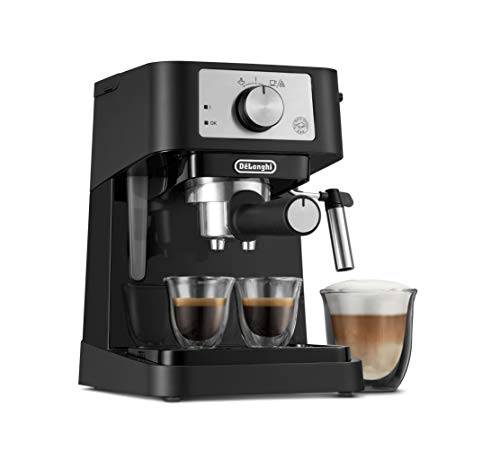
Best for the cheapest way to find out whether you like the process
- Stainless steel boiler, 15-bar pump (maximum, not brew pressure)
- Pressurised single and double baskets
- Manual milk frother wand
- Tamper included, 13.5 x 8 inch footprint
Why buy it: a hundred dollars for a machine that makes a genuinely enjoyable milk drink, and the honest test of whether you want this hobby at all.

Best for real 9-bar pressure with no pump, no plug and no plastic
- Direct-lever press with an integrated pressure gauge
- You control the pressure — target the 9-bar line on the dial
- No preheat needed on the current brewing cylinder
- Two portafilters: convenience and control
Why buy it: the gauge means you brew at an actual measured 9 bar, which no pump machine under $500 can honestly promise you.
Quick Comparison
| Product | Best for | Rating | Price | Buy |
|---|---|---|---|---|
| Breville Bambino Plus Espresso Machine (BES500BSS) | Best Overall Under $500 | — | Check (paid link) | |
| Gaggia Classic Evo Pro Espresso Machine | Best Upgrade Path | — | Check (paid link) | |
| De’Longhi Dedica Deluxe Espresso Machine (EC685M) | Best Compact | — | Check (paid link) | |
| CASABREWS 3700 Essential Espresso Machine | Best Value | — | Check (paid link) | |
| De’Longhi Stilosa Manual Espresso Machine (EC260BK) | Best Budget | — | Check (paid link) | |
| Flair NEO Flex Manual Espresso Maker | Best Manual Option | — | Check (paid link) |
The Grinder Split: The Most Important Decision on This Page
Espresso forces water through a compressed bed of coffee in about half a minute. For that to extract evenly, particles have to be close to the same size — finer than table salt, with a slight grit. A burr grinder crushes beans between two surfaces set a fixed distance apart and produces that. A blade grinder chops randomly and produces dust and boulders in the same batch, so water races through the dust (bitter) and skips the boulders (sour). The result is a shot that manages to taste burnt and sour simultaneously, and it is the number one reason people conclude their machine is bad.
So the honest advice for a $500 total budget is this:
- You already own a burr grinder: spend the full $500 on the machine. Bambino Plus or Gaggia Classic Evo Pro.
- You own nothing: spend roughly $200 on the machine and $300 on the grinder. CASABREWS or Dedica, plus a proper espresso-capable burr grinder.
- You want one appliance: stretch past $500 to a machine with a grinder built in, or accept pressurised baskets and pre-ground coffee.
Our espresso grinder ranking and burr grinder picks for espresso cover both electric and hand grinders, and hand grinders are the value story here — a $150 hand grinder outperforms a $300 electric one for espresso, at the cost of a minute of cranking per shot.
Ignore the Bar Number
Every machine in this price bracket advertises 15 or 20 bar. Both figures describe the maximum a vibratory pump can produce into a blocked line. Espresso is brewed at roughly 9 bar at the coffee puck, and well-designed machines fit an over-pressure valve to bleed the surplus. A higher bar number is not a better machine; it is the same pump with a different sticker. The Flair NEO Flex on this list is the only one that lets you see actual brewing pressure, because it has a gauge and your arm is the pump.
How We Rank
We do not buy these machines or pull shots on them. We weight rating quality against review volume, documented specifications (temperature control type, portafilter size, basket type, steam design) over marketing pressure claims, durability signals from reviews written six months or more into ownership — where pump failures, scale damage and dead steam valves surface — and published expert consensus, cited rather than restated as our own findings. Full method: how we rank.
The Machines, Reviewed
1. Breville Bambino Plus — Best Overall Under $500
The Bambino Plus is a deliberately narrow machine: no grinder, no display, no programmable anything. What it has is a ThermoJet heater that reaches brew temperature in about three seconds, a PID controller holding it there, and a steam wand with enough pressure to spin milk into microfoam — plus an automatic mode that stops at a set temperature so beginners do not scald it.
Owners praise: heat-up speed, temperature consistency, automatic milk texturing, tiny footprint. Owners gripe about: no grinder, a small drip tray, a fiddly water tank, and a 54mm portafilter size with a narrower accessory market than 58mm. Check price (paid link).
2. Gaggia Classic Evo Pro — Best Upgrade Path
The Gaggia is the machine enthusiasts keep recommending under $500 for one reason above all: 58mm commercial parts. Every bottomless portafilter, precision basket, puck screen and tamper on the market fits it, so the machine becomes a platform rather than a dead end. The brass group head has real thermal mass, and the three-hole steam wand is a genuine commercial part.
There is no PID from the factory, so you either learn to temperature-surf — flushing the group and timing your shot to the heating cycle — or fit an aftermarket PID kit, which is among the most common owner modifications in home espresso.
Owners praise: build, steam power, 58mm compatibility, repairability, the ceiling it reaches with a good grinder. Owners gripe about: the learning curve, no PID out of the box, a small drip tray, and a plastic water tank on an otherwise metal machine. Check price (paid link).
3. De’Longhi Dedica Deluxe — Best Compact
Six inches wide, roughly forty seconds to heat, an automatic flow stop for single and double shots, and a drip tray that raises for a latte glass. For an apartment kitchen or a counter already full of appliances, the footprint is not a nice-to-have — it is the deciding specification.
Owners praise: the width, quick warm-up, solid build for the money, tidy looks. Owners gripe about: a steam wand that takes practice, a small tank that needs frequent refilling, and pressurised baskets that cap the quality unless you buy single-wall replacements. Check price (paid link).
4. CASABREWS 3700 Essential — Best Value
Stainless housing, a 43.9-ounce removable tank, 1,350 watts and a steam wand that produces usable foam, for under two hundred dollars. Its real argument on this page is arithmetic: buy it and you still have $300 of a $500 budget for a grinder, and that combination beats a $500 machine with a bad grinder.
Owners praise: price, metal shell, tank size, quick heat-up. Owners gripe about: temperature drift on back-to-back shots, a light body that shifts when locking the portafilter, pressurised baskets in practice, and quality control that varies between units. Check price (paid link).
5. De’Longhi Stilosa — Best Budget
At around a hundred dollars this is the cheapest machine worth owning. Stainless boiler, pressurised baskets, a manual frothing wand and a tamper in the box. It has no temperature control and no three-way valve, so shots vary and pucks come out wet, but the milk drinks are genuinely enjoyable and it costs less than a month of cafe visits.
Owners praise: price, compact size, easy setup, thick crema from pressurised baskets. Owners gripe about: weak steam, drifting temperature, a plastic portafilter handle, and a small water tank. Check price (paid link).
6. Flair NEO Flex — Best Manual Option
The NEO Flex is a lever press: you add hot water and a dose of up to 18 grams, then push the lever. The integrated gauge shows the pressure you are generating, which means you can brew at an actual measured 9 bar — the only machine here that can honestly claim that. It needs no preheat on the current cylinder, it has no pump to fail, and it takes almost no counter space.
The trade-offs are obvious: no steam wand at all, so milk drinks need a separate milk frother, and one shot at a time with a kettle of hot water on the side. It is a brewer for people who find the ritual enjoyable. See the full field in our manual espresso maker ranking.
Owners praise: real 9-bar control, shot quality, no electronics to break, easy cleanup. Owners gripe about: no steaming, needing a separate kettle, one shot at a time, and a grind requirement as demanding as any pump machine. Check price (paid link).
What Owners Actually Complain About
Sour, fast-pouring shots. A grind problem in almost every case, not a machine problem. See why espresso tastes sour.
Waiting between brewing and steaming. Every machine here is a single boiler or thermoblock, so it has to change temperature between the two jobs. Ten to forty seconds is normal. A dual boiler removes this and costs well over $1,000.
Scale. Espresso machines heat small volumes of water constantly and scale far faster than a drip brewer. Slow flow and weak steam are the early symptoms. Our descaling guide has intervals by water hardness, and how long espresso machines last covers what actually kills them.
Counter height. Several of these are taller than they look once the tank lid opens. Measure your cabinet clearance — our counter space planning guide exists for exactly this.
The Verdict
If you already grind properly, the Breville Bambino Plus is the best machine under $500 and it is not especially close — it spends everything on the parts that matter. If you want a platform to build on and enjoy tinkering, the Gaggia Classic Evo Pro will still be on your counter in fifteen years. And if you own no grinder, buy less machine and more grinder: the CASABREWS 3700 plus $300 of burrs beats any $500 machine fed bad coffee. Check price on Amazon → (paid link)
More from this hub: small kitchen appliances · best espresso machine · best semi-automatic espresso machine · best espresso machine for beginners · build your own comparison · how we rank.