 Garden


Affiliate Disclosure
Some links on this page are affiliate links. As an Amazon Associate, we earn from qualifying purchases — at no extra cost to you. We do not buy, test, or physically handle the products we cover; our rankings come from aggregated owner reviews, ratings and expert consensus. Commissions never change our verdicts. How we rank · full disclosure.
The short answer: the Bialetti Moka Express 6-cup is the best moka pot for most people — the original 1933 design, still made in Italy, with replacement gaskets and filters available everywhere for a few dollars. If you have an induction cooktop, buy stainless: the Cuisinox Roma for a 25-year warranty or the Bialetti Venus for the same capability at a lower price. If you want foam on top of the cup, only the Bialetti Brikka makes it. Drinking alone? Buy the 3-cup Moka Express, because a half-filled basket brews badly.
Top Picks at a Glance

Our #1 Pick: Bialetti Moka Express 6-Cup
The Moka Express wins on an argument that has nothing to do with features. Alfonso Bialetti's octagonal aluminum pot went into production in 1933 and has been made continuously ever since, in the tens of millions. That means the gasket, the filter plate and the safety valve for a pot bought this year are the same parts as one bought thirty years ago, they cost a few dollars, and every kitchen store and hardware aisle in America stocks them. Almost nothing else in a modern kitchen is repairable that cheaply.
The design itself is sound. The eight-sided body spreads heat around the base rather than concentrating it at one point, the safety valve releases if the grind is too fine or the filter blocks, and it brews six 2-ounce servings in four to five minutes on a medium flame.
Be clear about the limits. It is aluminum, so it is not induction-compatible without a steel adapter plate, and it should not go in the dishwasher — detergent dulls and pits the metal. It also cannot make crema, because it does not make espresso pressure. And it must be brewed with attention: walk away and it will scorch. Everything else on this page is a variation on that trade-off.
Check price on Amazon → (paid link)
The Ranked Field
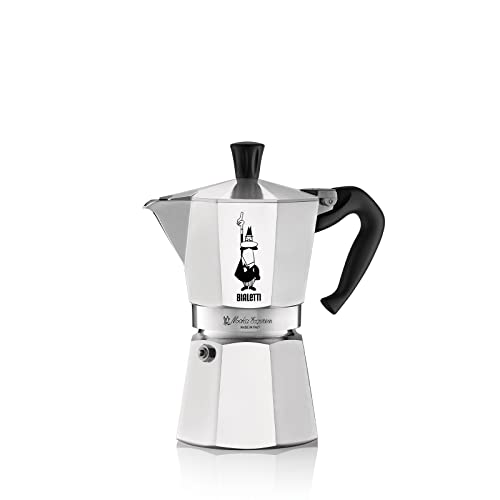
Best for the default moka pot, and the one every gasket and filter fits
- Cast aluminum, made in Italy, octagonal body diffuses heat evenly
- Brews six 2-oz cups in about 4–5 minutes
- Patented safety valve, replaceable gasket and filter plate
- Gas and electric coil; needs an adapter plate on induction
Why buy it: ninety years of production means parts are everywhere and cost a few dollars — a moka pot you can keep alive for decades instead of replacing.

Best for the closest thing to crema a stovetop pot can produce
- Weighted pressure valve holds back the brew until pressure builds
- Silicone membrane column on the current generation
- 4-cup (5.7 oz) and 2-cup sizes
- Aluminum body, made in Italy
Why buy it: the valve lets pressure build before release, so the coffee comes out with a genuine foam cap no standard moka pot can make.

Best for induction cooktops and a pot that will outlive the stove
- 18/10 stainless steel, mirror finish
- Induction-ready base, works on every cooktop type
- 25-year manufacturer warranty
- Dishwasher safe, non-reactive interior
Why buy it: stainless will not pit or take on the metallic edge aluminum develops, and the 25-year warranty is the longest in the category by a wide margin.

Best for an induction hob without paying premium-brand prices
- 18/10 stainless steel with a magnetic induction base
- Brews 6 cups in about 4–5 minutes
- Heat-resistant handle and knob, dishwasher safe
- Bialetti gasket sizing, so spares are easy to find
Why buy it: induction compatibility and Bialetti spare-part availability in one pot, at roughly two-thirds the price of the stainless specialists.

Best for a single drinker who does not want to brew a half-empty pot
- Makes about 4.3 oz total — one large or two small servings
- Same aluminum construction and safety valve as the 6-cup
- Ready in 3–4 minutes
- Fits a small burner without wobbling
Why buy it: a moka pot only works properly when the basket is full, so buying the right size matters more here than with any other brewer.

Best for camping, a second pot, or a colored one for the counter
- Food-grade anodized aluminum, 9.3-oz yield
- Works on gas, electric coil and propane camp stoves
- Wide range of colors
- Replacement gaskets sold as a kit
Why buy it: the same physics as the Bialetti in a lighter, cheaper body that people are happy to throw in a camping box.
Quick Comparison
| Product | Best for | Rating | Price | Buy |
|---|---|---|---|---|
| Bialetti Moka Express 6-Cup Stovetop Espresso Maker | Best Overall | — | Check (paid link) | |
| Bialetti New Brikka 4-Cup Moka Pot | Best for Crema | — | Check (paid link) | |
| Cuisinox Roma 6-Cup Stainless Steel Stovetop Espresso Maker | Premium Pick | — | Check (paid link) | |
| Bialetti Venus 6-Cup Stainless Steel Stovetop Espresso Maker | Best for Induction | — | Check (paid link) | |
| Bialetti Moka Express 3-Cup Stovetop Espresso Maker | Best for One Person | — | Check (paid link) | |
| GROSCHE Milano 6-Cup Stovetop Espresso Maker | Best Budget | — | Check (paid link) |

How a Moka Pot Actually Works (And Why It Is Not Espresso)
Water in the bottom chamber heats until steam pressure above it forces liquid water up the funnel, through the coffee basket, and out into the top chamber. The pressure involved is roughly 1 to 1.5 bar — one and a half times atmospheric.
Espresso is brewed at about 9 bar at the coffee puck. That six-fold difference is the whole story. It is why moka coffee has no genuine crema (the foam you sometimes see is CO2 from fresh beans, not emulsified oils), why the body is heavier and more roasty, and why moka pots work best with medium and dark roasts that do not need high pressure to give up their sweetness.
None of that makes a moka pot worse — it makes it different. The coffee it produces sits between a strong drip cup and a diluted espresso, and it is excellent in milk. If you want actual espresso, that requires a pump: our espresso machine ranking and moka pot vs espresso machine lay out the difference in detail.
Buy the Right Size, Not the Biggest
This is the mistake that causes more bad moka coffee than any other. A moka pot only brews correctly when the basket is full and the boiler is filled to the valve. Half-fill either and the ratio collapses — you get a thin, over-extracted, bitter cup. There is no "small batch" mode.
| Size | Yield | Coffee dose | Suits |
|---|---|---|---|
| 1-cup | ~2 oz | ~7 g | A single small serving |
| 3-cup | ~4.3 oz | ~15 g | One drinker, or one milk drink |
| 6-cup | ~9 oz | ~30 g | Two drinkers, or two lattes |
| 9-cup | ~13.5 oz | ~45 g | Three or four small cups |
Note that a moka "cup" is about 1.5 to 2 fluid ounces, not an 8-ounce mug. A 6-cup pot makes roughly 9 ounces of concentrated coffee in total. If two people each want a latte, a 6-cup is right; if one person wants a single cup, buy the 3-cup and own two pots rather than under-filling one.
How We Rank
We do not buy these pots or brew on them. We weight rating quality against review volume, because a strong average across an enormous body of feedback beats a perfect score across two hundred reviews. We weight material and cooktop compatibility, which is the single most common source of returns in this category. We look hard at parts availability and warranty, since a moka pot is a consumable-gasket product and one you cannot re-gasket is disposable. And we read reviews written a year or more in, where handle failures, valve leaks and pitting show up. Full method: how we rank.

The Moka Pots, Reviewed
1. Bialetti Moka Express 6-Cup — Best Overall
Covered above. The pattern across owner feedback is that the pot itself almost never fails; what fails is the gasket, at around one to two years of daily use, and it costs a few dollars. Reviewers who rate it poorly overwhelmingly describe burnt coffee, which is a heat and grind problem rather than a manufacturing one.
Owners praise: price, parts availability, the coffee, that it works forever. Owners gripe about: a plastic handle that can soften if the flame licks up the side, aluminum that dulls, not being induction-compatible, and a learning curve on heat control. Check price (paid link).
2. Bialetti New Brikka 4-Cup — Best for Crema
The Brikka is the one moka pot that produces a foam cap, and it does it mechanically: a weighted valve sits on the outlet and holds the brew back until pressure builds behind it, then releases in a burst that aerates the coffee. The current generation replaced the older weight with a silicone membrane column and owners report it is less fussy than the original.
It is more particular than a standard pot. The pressure valve wants a slightly finer grind and a properly full basket, and it is unforgiving of a worn gasket. When it works, the cup is noticeably richer than a Moka Express; when it does not, it sputters.
Owners praise: real foam, richer body, the same simple cleaning as any moka pot. Owners gripe about: fussiness about grind and dose, a valve that needs cleaning to stay reliable, a higher price, and inconsistency between the old and new generations. Check price (paid link).
3. Cuisinox Roma 6-Cup — Premium Pick
Heavy 18/10 stainless, mirror finish, an induction-capable base, dishwasher safe, and a 25-year warranty — nothing else in this category comes close on that last point. Stainless does not pit, does not react with acidic coffee, and does not develop the faint metallic note that some drinkers notice in a well-used aluminum pot.
The trade-offs are weight, price, and heat-up time: stainless conducts more slowly than aluminum, so it takes a little longer to brew and rewards a slightly lower flame. Owners who bought it after wearing out two aluminum pots almost never go back.
Owners praise: build quality, the warranty, induction compatibility, dishwasher safety. Owners gripe about: the price relative to a Bialetti, weight, a handle that gets hot on a wide burner, and a longer brew time. Check price (paid link).
4. Bialetti Venus 6-Cup — Best for Induction
The Venus is Bialetti's own stainless answer, and the practical case for it over the Cuisinox is money plus parts: it costs meaningfully less and uses Bialetti gasket sizing, so replacements are stocked in the same places as Moka Express spares. It has a magnetic base for induction, a cool-touch handle and it goes in the dishwasher.
Owners praise: induction compatibility, easy cleaning, spare-part availability, price against other stainless pots. Owners gripe about: a lid hinge that can loosen over years, a handle that is less insulated than the Cuisinox, and slower heating than aluminum. Check price (paid link).
5. Bialetti Moka Express 3-Cup — Best for One Person
Identical construction to the 6-cup, scaled for one drinker. Roughly 4.3 ounces of finished coffee, about 15 grams of grounds, ready in three to four minutes. If you live alone and have been under-filling a 6-cup pot, this single change will improve your coffee more than switching beans will.
Owners praise: the right size for one, quick brew, low price, same parts as the big one. Owners gripe about: a small base that can sit unstably on a large gas burner grate, a handle close to the flame, and the same aluminum and induction caveats. Check price (paid link).
6. GROSCHE Milano 6-Cup — Best Budget
Anodized aluminum, a good range of colors, and the same three-chamber physics as everything else here for around thirty dollars. It works on gas, electric coil and propane camp stoves, which is why it turns up so often in camping kits. Replacement gaskets are sold as a kit, so it is repairable too.
Owners praise: price, colors, camp-stove use, light weight. Owners gripe about: a finish that scratches, a handle that is not as heat-isolated as the Bialetti, and gasket life shorter than the Italian pots. Check price (paid link).
What Owners Actually Complain About
Read a thousand three-star moka pot reviews and the same five things appear.
"It tastes burnt." The most common complaint and almost never the pot's fault. Too much heat, too fine a grind, or leaving it on the burner until it hisses dry. Medium-low flame, hot water in the base to start, and off the heat at the first sputter.
"It leaks from the middle." That is the gasket, and gaskets are consumables. Replace annually with daily use. A leaking pot also means low pressure, so the coffee gets worse before it stops working.
"It doesn't work on my stove." Aluminum pots do not work on induction. This is the single biggest source of returns in the category, and it is entirely avoidable — check your cooktop before you buy, or buy stainless.
"The handle melted." A gas flame wider than the base licks up the side. Use a burner no wider than the pot, or a simmer plate.
"There's no crema." There will not be, except on the Brikka. See the pressure section above — this is physics, not a defect.
How to Brew a Good Cup in One Paragraph
Fill the bottom chamber with hot water to just below the safety valve — starting hot means less time on the burner and less scorching. Fill the basket level with a medium-fine grind and do not tamp. Assemble, put it on medium-low heat with the lid open, and watch. When coffee starts flowing it should come out honey-colored and steady, not spitting. When the stream turns pale and starts to gurgle, take the pot off the heat and run the base under cold water for a second or two to stop extraction. Serve immediately; moka coffee does not improve sitting. If your grinder cannot hold a consistent medium-fine, that is the next upgrade — see burr vs blade grinder.
The Verdict
Buy the Bialetti Moka Express 6-cup unless something specific rules it out. It is cheap, it is repairable for a few dollars, it has been made continuously since 1933, and it holds one of the highest owner ratings in all of coffee. Induction cooktop? Bialetti Venus for value or Cuisinox Roma for a 25-year warranty. Want foam? Brikka. Drinking alone? 3-cup Moka Express. Check price on Amazon → (paid link)
More from this hub: small kitchen appliances · moka pot vs espresso machine · best espresso machine · best french press · how we rank.