 Garden

Affiliate Disclosure
Some links on this page are affiliate links. As an Amazon Associate, we earn from qualifying purchases — at no extra cost to you. We do not buy, test, or physically handle the products we cover; our rankings come from aggregated owner reviews, ratings and expert consensus. Commissions never change our verdicts. How we rank · full disclosure.
Espresso forces hot water through finely ground, compressed coffee at about 9 bar of pressure for 25 to 30 seconds, producing 1 to 2 ounces of liquid at roughly 8 to 12 percent dissolved solids. Drip coffee lets water fall through a coarser bed by gravity for 4 to 6 minutes, producing 8 to 60 ounces at roughly 1.2 to 1.5 percent. Same beans, same extraction percentage, radically different concentration. Espresso is the base for milk drinks; drip is the base for a mug you sip. Choose by which of those you actually drink.
What is the actual difference?
Pressure and time. A drip machine heats water and lets gravity carry it through a paper filter full of medium-ground coffee. Contact time is four to six minutes and the resulting liquid is mostly water with a small fraction of dissolved coffee solids in it.
An espresso machine uses a pump to push water through a compressed puck of very finely ground coffee at roughly 9 bar — about 130 psi, or nine times atmospheric pressure. That pressure does two things gravity cannot: it forces water through a bed so fine that water would otherwise barely pass, and it emulsifies coffee oils and dissolved CO2 into crema, the tan foam on top of a shot.
One thing worth clearing up, because the appliance aisle depends on you not knowing it: espresso machines advertising "15 bar" or "20 bar" are quoting pump maximum, not brewing pressure. The coffee sees about 9 bar on a well-designed machine, and a bigger number on the box is not a better machine.
Espresso vs drip coffee at a glance
| Espresso | Drip coffee | |
|---|---|---|
| Pressure | ~9 bar at the puck | Gravity only |
| Brew time | 25–30 seconds | 4–6 minutes |
| Grind | Very fine, powdered-sugar texture | Medium, coarse-sand texture |
| Dose per serving | ~18 g for a double | ~15 g per 8 oz cup |
| Serving size | 1–2 oz | 8–12 oz |
| Dissolved solids | ~8–12% | ~1.2–1.5% |
| Caffeine per serving | ~63 mg per shot (USDA) | ~95 mg per 8 oz (USDA) |
| Crema | Yes | No |
| Grinder required | Burr grinder, non-negotiable | Helpful, not required |
| Machine cost | ~$400+ plus grinder | ~$40–$360 |
Which is stronger?
Espresso, by a wide margin, if "strength" means concentration. At 8 to 12 percent total dissolved solids against drip's 1.2 to 1.5 percent, a shot is roughly six to eight times as concentrated. That is what produces the syrupy body, the lingering finish and the intensity that lets a single ounce stand up to six ounces of milk.
But both methods aim for a similar extraction yield — the percentage of the ground coffee's mass that ends up dissolved, generally 18 to 22 percent. Espresso is not pulling more out of the beans; it is putting the same proportion into a fraction of the water. That distinction explains a lot of confusion about which is "stronger": strength as concentration and strength as extraction are different measurements.
Which has more caffeine?
Per fluid ounce espresso wins easily. Per drink, drip usually wins, because nobody drinks 12 ounces of espresso. Using the USDA reference figures, a 1-ounce shot carries about 63 mg of caffeine and an 8-ounce cup of drip carries about 95 mg. So:
- Single espresso: ~63 mg
- Double espresso: ~126 mg
- 8-oz drip: ~95 mg
- 12-oz drip: ~140 mg
- 16-oz drip: ~190 mg
A latte made with a double shot has roughly the caffeine of a small mug of drip coffee, regardless of how large the cup is — the milk adds volume, not caffeine. Dark roast, incidentally, does not have more caffeine than light roast; if anything it has marginally less by weight, because roasting burns off a small amount.
Which tastes better?
They taste different rather than better, and the honest framing is what each one flatters. Espresso concentrates everything — sweetness, acidity, body and any defect. A well-roasted, freshly ground coffee tastes extraordinary as espresso; a stale or poorly roasted one tastes harsh in a way it never would as drip. Drip is more forgiving and gives a cleaner, lighter cup where delicate floral and fruit notes in a light roast come through more clearly.
Milk is the deciding factor for most households. A shot of espresso stands up to six ounces of steamed milk; eight ounces of drip coffee plus milk is just weak coffee. If lattes and cappuccinos are what you actually drink, that alone settles it — and see how to steam milk at home for the other half of that drink.
Which costs more?
Espresso, at both ends. A drip brewer worth owning costs $90 to $180 and needs no grinder to be usable — see the best drip coffee makers. A capable espresso setup means roughly $400 or more for the machine plus $200 or more for a burr grinder, and the grinder genuinely is not optional: espresso needs a fine, tightly consistent particle size that a blade grinder physically cannot produce, which is why so many cheap espresso setups disappoint their owners. Burr vs blade grinder covers the mechanics.
Per cup, a double espresso uses about 18 grams of coffee for a 2-ounce drink; an 8-ounce drip cup uses about 15 grams. So espresso is slightly more per serving and far more per ounce. Electricity is minor for both — an espresso machine draws 1,000 to 1,600 watts in short bursts, a drip machine 900 to 1,200 watts for a few minutes plus the warming plate. Price your own with the appliance running cost calculator.
Is one better for you?
Both are coffee and the broad health picture is the same. The one measurable difference is diterpenes — cafestol and kahweol, oily compounds in coffee that are associated with raised LDL cholesterol. A paper filter traps most of them, so drip coffee is low in diterpenes. Espresso is brewed through a metal basket with no paper, so it retains more — though considerably less than unfiltered methods like a French press or boiled coffee, because the volume is so small. If cholesterol is a concern for you, paper-filtered drip is the more conservative default.
One machine for each side

Best for small, concentrated shots and cafe-style milk drinks at home
- PID temperature control, 3-second heat-up
- Automatic milk texturing
- Both pressurised and non-pressurised baskets included
- 7.7 inches wide
Why buy it: the smallest machine that still delivers stable brew temperature and steam strong enough for real microfoam.
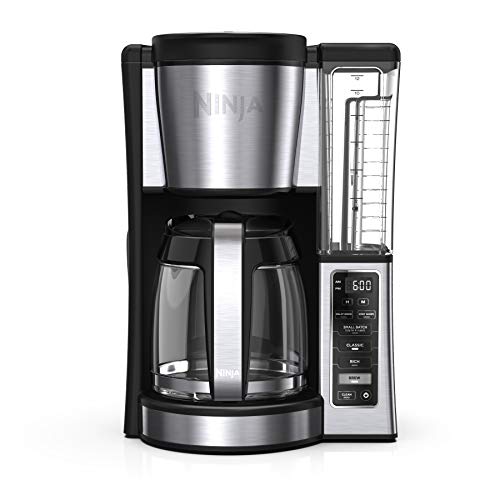
Best for a full pot of genuinely hot coffee for a household
- 12-cup glass carafe, 60-oz removable reservoir
- Classic and Rich brew styles
- Small-batch setting for 1–4 cups
- Warming plate holds heat up to 4 hours
Why buy it: the drip machine owners keep saying finally brews hot, with a small-batch mode that does not turn two cups into weak coffee.
Our rankings come from aggregated owner reviews, star ratings and published expert consensus rather than first-hand use — the method is on how we rank.
Which should you buy?
- You drink lattes, cappuccinos or flat whites. Espresso. Nothing else makes a base concentrated enough to survive milk.
- You drink a mug of black coffee while you work. Drip, and put the saved money into better beans and a grinder.
- You make coffee for four people at breakfast. Drip. Pulling six shots back to back on a single-boiler espresso machine is a chore.
- You enjoy process and want a hobby. Espresso rewards attention more than any other brewing method.
- You want both without two machines. An espresso machine plus hot water makes an Americano that is close to drip, and a moka pot makes strong concentrated coffee on a stovetop for about thirty dollars.
Where to go next
Ready to choose a machine? The best espresso machines, the best for beginners, or the best drip coffee makers. Comparing other formats? Moka pot vs espresso machine and Nespresso vs Keurig. Everything sits under the small kitchen appliances hub.