 Garden

Affiliate Disclosure
Some links on this page are affiliate links. As an Amazon Associate, we earn from qualifying purchases — at no extra cost to you. We do not buy, test, or physically handle the products we cover; our rankings come from aggregated owner reviews, ratings and expert consensus. Commissions never change our verdicts. How we rank · full disclosure.
PTFE nonstick coatings are chemically stable and inert at normal cooking temperatures. They begin to degrade above roughly 500 degrees F and release fumes, and that breakdown becomes substantial above about 660 degrees F. Those fumes are documented as rapidly lethal to pet birds and, at high exposure, can cause a temporary flu-like reaction in people known as polymer fume fever. PFOA — a separate compound used historically as a processing aid — has not been used in US nonstick manufacture since 2013. The practical rules are short: never preheat an empty pan on high, ventilate while cooking, and replace pans once the coating flakes.
This page sticks to what is well established and says plainly where the evidence stops. We never buy or physically handle the products we rank; recommendations come from aggregated owner reviews and published regulatory and manufacturer information, as described in how we rank. The category lives at the small kitchen appliances hub.
Three different things with similar names
Most confusion about nonstick comes from three terms being used interchangeably when they refer to entirely different things.
| Term | What it is | Where it appears |
|---|---|---|
| PTFE | Polytetrafluoroethylene — the nonstick coating itself, a solid fluoropolymer. Teflon is one brand name for it. | On the pan, bonded to the metal |
| PFOA | Perfluorooctanoic acid — a processing aid historically used to make PTFE. Not a meaningful component of the finished coating. | Phased out of US manufacture by 2013 |
| PFAS | Per- and polyfluoroalkyl substances — the broad chemical family, thousands of compounds, including both of the above. | Water, firefighting foam, textiles, packaging, industry |
A great deal of what circulates as nonstick pan safety concern is actually about PFAS in drinking water and industrial contamination, which is a genuine and active area of regulation — the EPA finalized enforceable national drinking water limits for six PFAS compounds in April 2024 — but is a different question from what happens on your stovetop.

The PFOA timeline, which most articles skip
PFOA was used as a polymerization aid in manufacturing PTFE. It is persistent in the environment and has been the subject of substantial litigation and regulatory action. In 2006 the EPA launched the PFOA Stewardship Program, in which eight major manufacturers committed to eliminating PFOA from emissions and products by 2015. That elimination was completed in 2013.
This is why the phrase PFOA-free on a pan sold today conveys almost nothing — every nonstick pan made in the US since 2013 is PFOA-free by default, and the label is marketing rather than differentiation. It also means that concerns raised about PFOA in the 2000s do not automatically transfer to a pan bought in 2026. Older pans in a kitchen from before that period are a different matter, though the practical case for replacing a functioning pan on this basis alone is weak.
The temperature question, in real numbers
This is the part that matters day to day, and it is worth getting precise about.
| Temperature | What happens |
|---|---|
| Up to 500 degrees F | PTFE is stable. Normal frying, sauteing and baking sit here. |
| Around 500 degrees F | The coating begins to degrade slowly. |
| Around 660 degrees F | Significant breakdown; fume release becomes substantial. |
| Above 700 degrees F | Rapid decomposition. The coating visibly discolors and blisters. |
How do you reach 500 degrees F on a home stove? Almost always the same way: an empty pan left preheating on high. Food and oil act as a heat sink, holding the surface near the boiling or frying temperature of what is in the pan — typically 212 to 400 degrees F. An empty pan has nothing absorbing that energy, and a gas burner or a powerful induction hob can push a thin aluminum pan past 500 degrees F in two to three minutes. The other routes are broiling a nonstick pan, leaving one in a hot oven, or forgetting a pan on a lit burner.
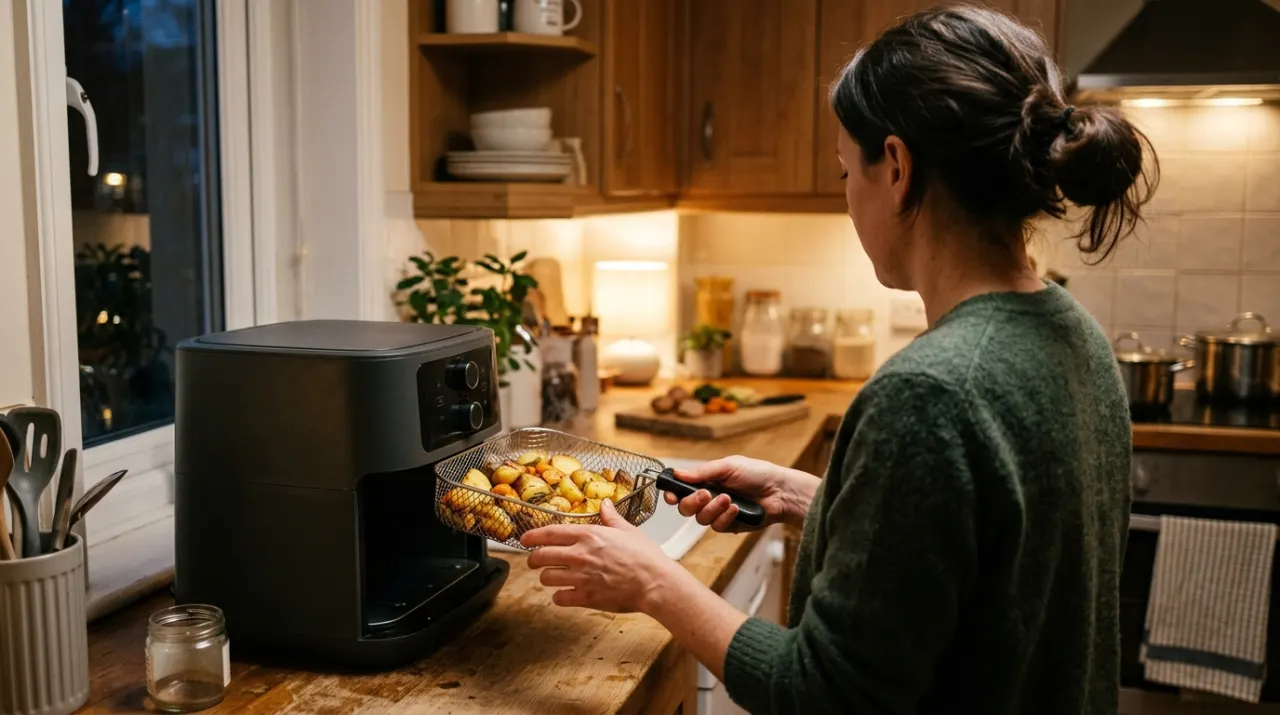
The same logic applies to air fryer baskets, which are usually PTFE-coated. Air fryers are thermostatically limited to about 400 to 450 degrees F, well inside the stable range, which is why the coating question in an air fryer is about scratching and wear rather than overheating. Empty preheating on the highest setting is still worth avoiding.
Birds: the clearly documented hazard
If you keep pet birds, this section is the one that matters. Overheated PTFE releases fumes that are rapidly and often fatally toxic to birds. Avian respiratory systems use a one-way flow-through design that extracts airborne compounds far more efficiently than mammalian lungs, which makes birds acutely vulnerable to airborne toxins generally — the historical use of canaries in coal mines rests on the same physiology.
Veterinary literature and avian welfare organizations have recorded numerous cases of birds dying within minutes of a nonstick pan being overheated, including birds in rooms away from the kitchen. The exposure needed is small and the onset is fast enough that there is usually no opportunity to intervene.
The advice given by avian veterinarians is conservative and consistent: if you keep birds, do not use PTFE cookware, and check other appliances too, since PTFE coatings appear on some irons, space heaters, hair dryers, self-cleaning oven interiors, drip pans and air fryer baskets. Cast iron, carbon steel and stainless steel are the straightforward alternatives.
What happens to people at high exposure
The recognized human effect of inhaling fumes from severely overheated fluoropolymers is polymer fume fever: temporary flu-like symptoms — chills, headache, fever, chest tightness — that typically begin a few hours after exposure and resolve within a day or two without lasting effect. It is documented in occupational medicine and in case reports involving badly overheated pans, usually where a pan was left unattended on high heat, sometimes to the point of smoking.
It is not something that occurs during normal cooking, and the American Cancer Society has stated that there are no proven risks to humans from PTFE cookware itself. We are not going to go further than that here. Claims connecting normal nonstick cookware use to chronic disease are not established, and this page will not make them.
Practical rules that actually reduce risk
- Never preheat an empty nonstick pan on high. This is the single behavior that causes essentially all overheating incidents. Add oil or food first, and preheat on medium.
- Keep nonstick to medium heat and below. Searing, blackening and stir-frying at high heat belong in cast iron, carbon steel or stainless.
- Ventilate. Run the range hood or open a window when cooking, which is good practice for gas combustion products regardless.
- Do not broil in a nonstick pan, and check the manufacturer oven rating before putting one in the oven at all. Many are rated to 400 or 450 degrees F, not higher.
- Use wood, silicone or nylon utensils. Metal is what destroys coatings, and a damaged coating degrades faster and stops working.
- Skip the abrasives. Steel wool and scouring powder take the coating off. Warm water and a soft sponge, and avoid thermal shock by letting the pan cool before washing.
- Replace flaking pans. Once the coating is peeling or the base metal shows, the pan has stopped doing its job. Ingested flakes pass through without being absorbed, so this is about function and further degradation rather than acute poisoning.
- If you keep birds, do not use PTFE at all, in cookware or appliances.
The alternatives, honestly compared
| Material | Nonstick performance | Realistic life | Trade-off |
|---|---|---|---|
| PTFE nonstick | Excellent from new | 3 – 5 years | Heat limit; coating wears out |
| Ceramic (sol-gel) | Very good from new | 1 – 3 years | Loses release faster than PTFE |
| Cast iron, seasoned | Good once seasoned | Decades | Heavy; needs seasoning upkeep |
| Carbon steel | Good once seasoned | Decades | Same upkeep, lighter and faster to heat |
| Stainless steel | Not nonstick | Decades | Requires proper preheating technique |
There is no option here that is best on every axis. A reasonable kitchen keeps one nonstick pan for eggs and delicate fish, used on medium heat and replaced every few years, and does everything hot in cast iron or stainless. That combination sidesteps the temperature question entirely without giving up the convenience.
A note on air fryer baskets
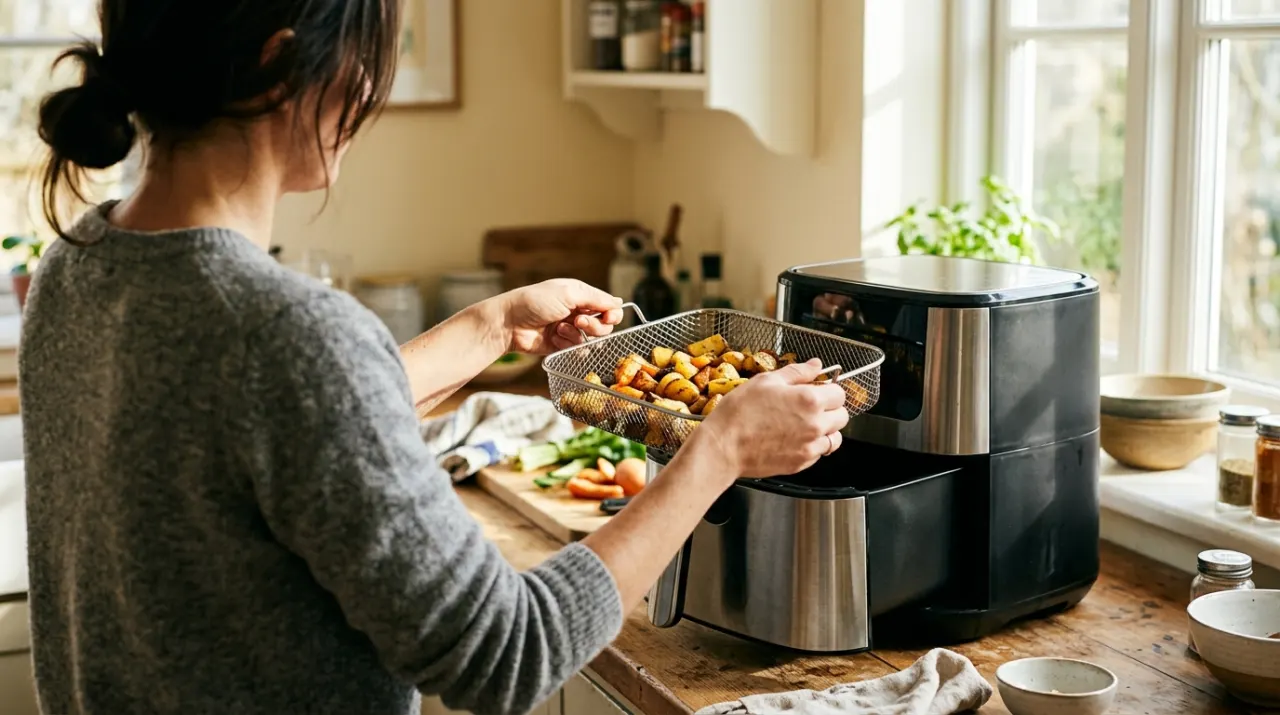
Most air fryer baskets are PTFE-coated aluminum. Because the appliance is thermostatically limited to roughly 400 to 450 degrees F, the overheating concern is much smaller than on a stovetop. The realistic issue is mechanical: metal tongs, stacking, and dishwasher cycles shorten coating life, and basket coatings are excluded from essentially every manufacturer warranty — see appliance warranties decoded. Use silicone tongs, hand wash where the manual allows it, and see how to clean an air fryer and can you put an air fryer basket in the dishwasher.
If your air fryer is producing smoke, that is almost always accumulated fat rather than coating breakdown — the causes are covered in why does my air fryer smoke.
More from this hub: Small Kitchen Appliances · toaster oven vs air fryer · best air fryer · how we rank. This page is general information about materials and appliances, not medical advice.