 Garden
Affiliate Disclosure
Some links on this page are affiliate links. As an Amazon Associate, we earn from qualifying purchases — at no extra cost to you. We do not buy, test, or physically handle the products we cover; our rankings come from aggregated owner reviews, ratings and expert consensus. Commissions never change our verdicts. How we rank · full disclosure.
A toaster oven is a small oven — it toasts, bakes, broils and reheats flat foods on racks. An air fryer is a compact convection cooker with a strong fan and a basket that crisps food fast with fast-moving hot air. The technology overlaps: an air fryer is essentially a small, high-airflow convection oven, and many toaster ovens now include an air-fry mode. Choose an air fryer for quick, crispy small portions; choose a toaster oven for versatility — toast, baking and larger items. If you want just one appliance, a convection toaster oven with an air-fry setting covers the most ground.
What's the difference?
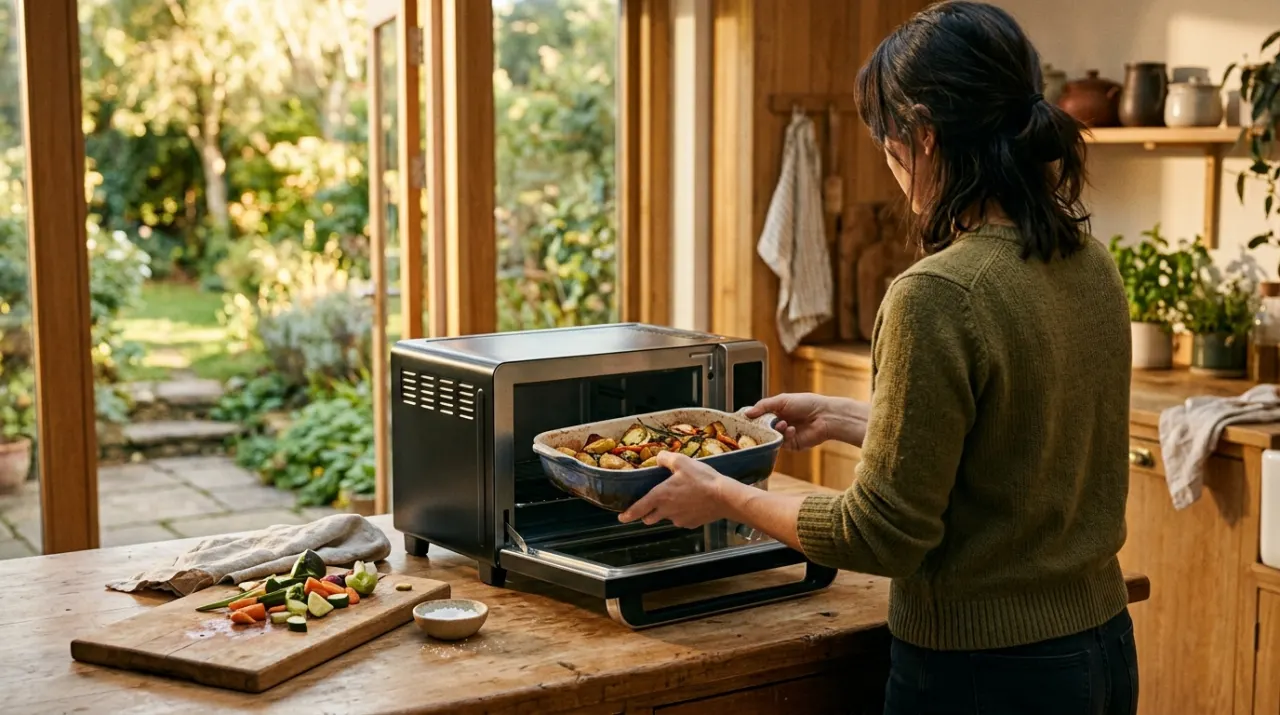
Both cook with hot air, but the shape and airflow differ. An air fryer packs a powerful fan above a perforated basket so hot air circulates all around the food, crisping it quickly in a small chamber. A toaster oven is a scaled-down conventional oven with flat racks; convection models add a fan, but the larger cavity and solid trays mean airflow under the food is less complete. The practical result: the air fryer crisps faster on small batches, while the toaster oven cooks a wider range of foods and larger quantities. The categories are converging as toaster ovens add air-fry settings.
Toaster oven vs air fryer at a glance
| Toaster oven | Air fryer (basket) | |
|---|---|---|
| Best for | Toast, baking, broiling, reheating, larger trays | Fast crisping of fries, wings, nuggets, small batches |
| Cooking style | Radiant + optional convection fan | High-speed convection, food in a basket |
| Typical price | $50 – $350 | $60 – $180 |
| Capacity | 4–8 slices / small casserole | 2–6 qt basket, single to small family serving |
| Usable single layer | 3 – 6 servings | 1 – 3 servings |
| Counter footprint | ~16 x 20 in, wide and low | ~11 x 13 in, narrow and tall |
| Crisping | Good, better with convection + perforated tray | Very good, fast on small portions |
| Typical power | ~1,200–1,800 W | ~1,200–1,800 W |
| Preheat | Short | Little to none |
| Cleanup | Trays and racks | Basket usually dishwasher-safe |
| Versatility | High (toast, bake, broil, air-fry on many models) | Lower (mainly frying/roasting small loads) |
| Noise | Quiet or silent | Noticeable fan |
Capacity is the number people get wrong
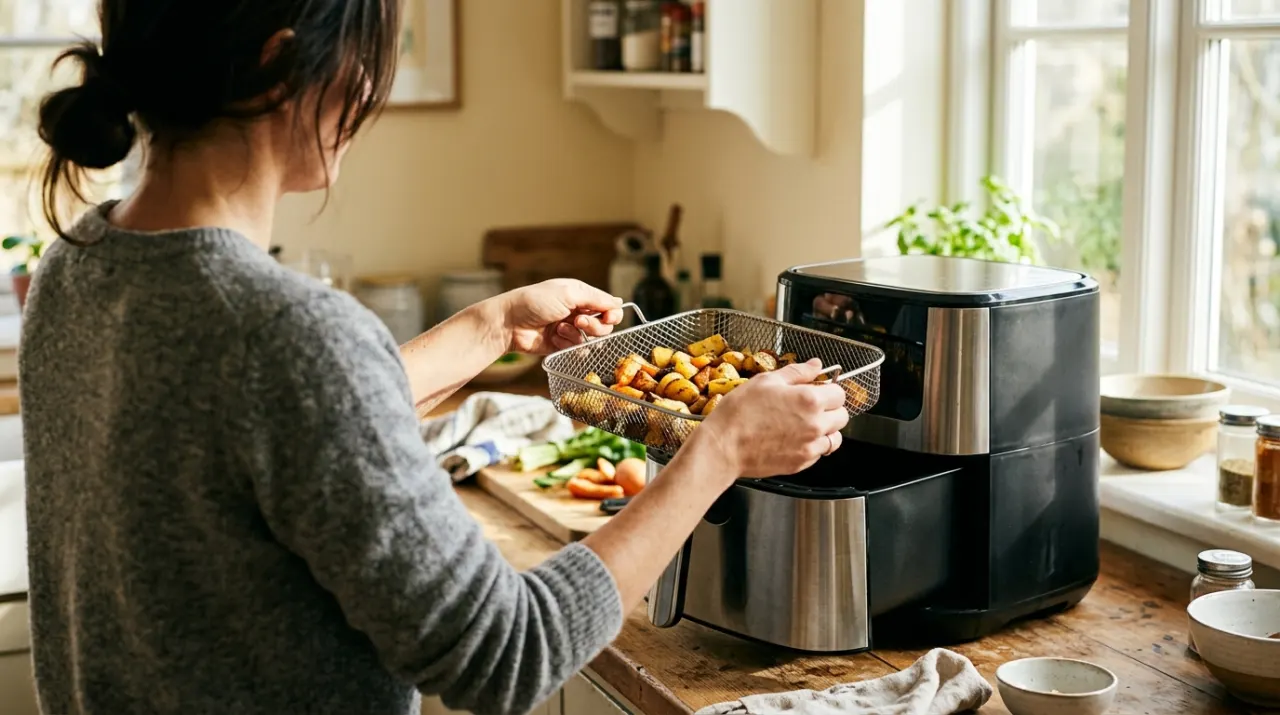
Air fryer quarts measure the volume of the basket, not the area you can actually cook on. Air frying only works when food sits in a single layer with space around each piece — stack it and the pieces steam instead of crisping. So a 5-quart basket, which sounds generous, gives you roughly a 9-inch circle of usable floor: about a pound of fries, four chicken thighs, or two salmon fillets. A 6-quart machine feeds two people comfortably and three at a squeeze, which is the sizing most owners land on. There is a fuller breakdown in how to choose an air fryer size.
Toaster ovens are measured in cubic feet or by how many slices of bread fit. A 0.6 cu ft oven takes a quarter sheet pan and six slices; a 0.8 to 1.0 cu ft oven takes a 9 x 13 pan, a 12-inch pizza or a small chicken. That is the real dividing line. Once you are cooking a tray of vegetables plus a protein for a family of four, the toaster oven does it in one pass and the air fryer does it in three.
Which is better for crispy food?
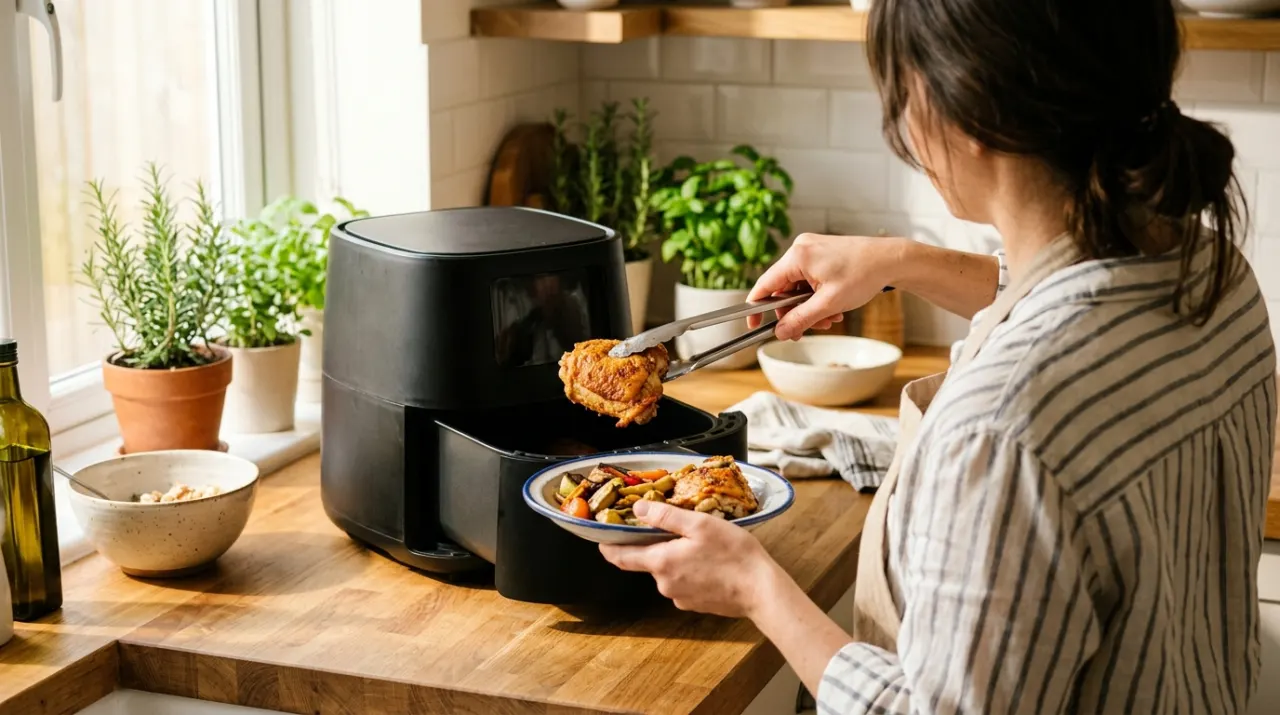
For a single serving of fries or wings, the basket air fryer usually crisps faster and a touch more evenly, because the perforated basket lets air reach every surface. Owners repeatedly mention that frozen foods come out crunchier and quicker in an air fryer than on a toaster-oven rack. But a convection toaster oven on a perforated tray comes close, and it can crisp a whole tray at once where the air fryer would need two batches. Small batch, maximum crunch: air fryer. Larger batch, still crisp: toaster oven.
Which is more versatile?
The toaster oven, by a wide margin. It toasts bread evenly, bakes a small batch of cookies or a couple of potatoes, broils the top of a casserole, and reheats leftovers without drying them out — jobs a basket air fryer cannot do. A basket air fryer is a specialist: excellent at crisping, limited at everything else. That is why a convection toaster oven with a built-in air-fry mode has become the popular single-appliance answer, giving you the crisp of an air fryer plus the range of a small oven.
Running cost and counter space, in real numbers
Wattage is only half of the electricity story; time on is the other half. A 1,500-watt air fryer running 18 minutes uses about 0.45 kWh. A 1,800-watt toaster oven preheating for 8 minutes then cooking for 25 uses roughly 0.99 kWh. At the 2026 US residential average of about 17 cents per kWh that is roughly 8 cents against 17 cents. Both are trivial next to the 2 to 4 kWh a full-size electric oven burns for the same meal, which is the saving people actually notice on a bill. The comparison flips once portions grow: three consecutive air-fryer batches cost more electricity, and far more of your attention, than one toaster oven load. Per-appliance figures are in our appliance wattage guide.
Counter space decides more purchases than specs do. A basket air fryer is tall and narrow — commonly 11 by 13 inches on the counter and 13 to 15 inches high. That height matters: standard US upper cabinets sit 18 inches above the countertop, so a tall fryer will not slide under them, and every air fryer needs 4 to 5 inches of clearance above and behind for the exhaust. A toaster oven is wide and low, typically 16 to 20 inches across and 9 to 12 inches high, which usually fits under a cabinet but eats a much larger share of usable prep surface — and its door needs 12 to 14 inches of clear swing in front. Measure before you buy; our counter space planning guide covers what is realistic to keep out.
What owners complain about
The recurring air fryer gripes are consistent across brands: capacity smaller than the quart rating implies, fan noise around the level of a range hood on medium, nonstick basket coatings that scratch and flake after a year or two of metal-utensil use, and smoke when cooking fatty food over an empty drawer. Most are manageable; the coating question is worth understanding properly, and we cover it in nonstick coating safety.
Toaster oven complaints skew differently: inaccurate thermostats that run 25 to 50 degrees F off the dial, uneven browning front-to-back, interiors that are awkward to clean because the walls sit close to the elements, and exteriors that get hot enough to matter if the unit is pushed against a wall. Owners who buy an oven thermometer and adjust for the offset report far higher satisfaction than those who trust the dial.
Which should you buy?
If you want one appliance and cook a variety of things, buy a convection toaster oven with an air-fry setting. If your priority is fast, crispy small portions and the easiest cleanup, buy a standalone air fryer with a dishwasher-safe basket. Kitchen space and household size decide the rest. In practice it comes down to five cases:
- One or two people, mostly frozen and reheated food, want speed: basket air fryer, 5 to 6 quarts. See best air fryer.
- Family of three or more, cooking real meals: toaster oven, 0.8 cu ft or larger, with convection. See best toaster oven.
- Space for exactly one, and you bake: convection toaster oven with an air-fry mode — the combo units.
- You already own a good toaster oven: adding a basket fryer is a genuine upgrade only if you eat a lot of frozen fried food. Otherwise it is counter space spent on a marginal improvement.
- You have a full-size oven you rarely use for small meals: either appliance pays for itself in convenience and heat, not in dollars.
Our picks come from aggregated owner reviews and expert consensus, not first-hand testing; see how we rank.
Where to go next
See the best air fryers and best toaster ovens ranked on owner ratings. Weighing the running cost? Read do air fryers use less electricity than an oven. There is also a short list of foods neither machine handles well — wet batters, loose leafy greens, anything needing a lot of liquid — in what you cannot cook in an air fryer. More comparisons: basket vs oven air fryer, convection vs regular toaster oven, blender vs food processor and slow cooker vs Instant Pot. All under the small kitchen appliances hub.